01Facts
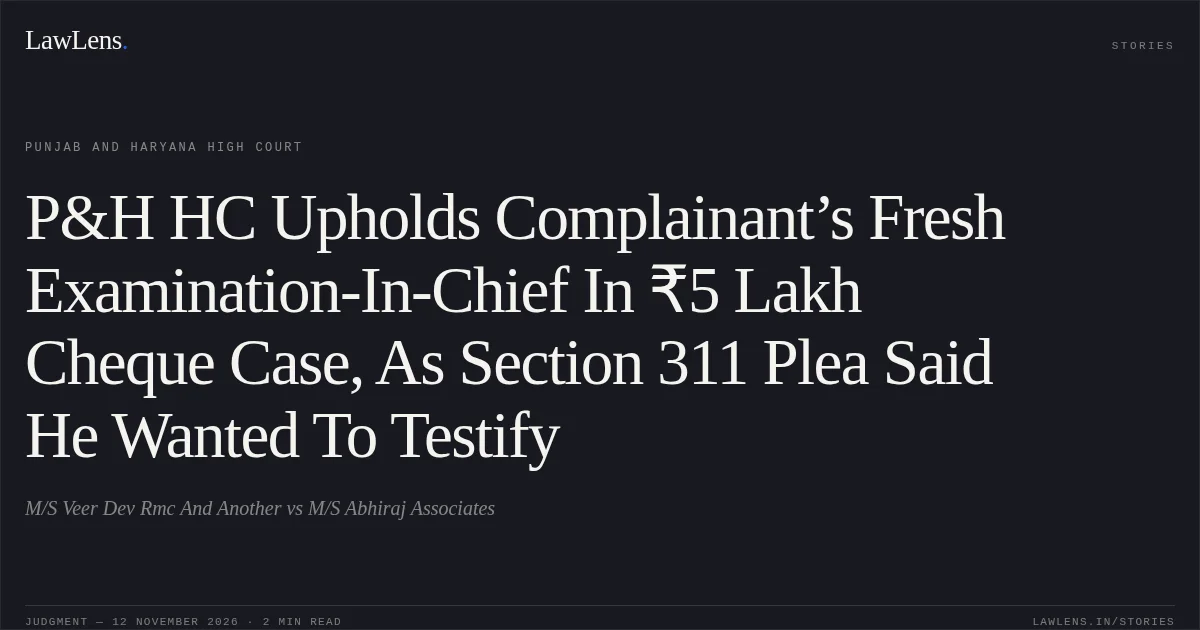
The respondent filed a complaint under Sections 138 and 142 of the Negotiable Instruments Act, 1881, alleging dishonour of a cheque for ₹5,00,000 issued towards an outstanding business liability.
pp. 1–2After the complainant’s preliminary evidence was closed, the trial court allowed his application under Section 311 CrPC to examine additional witnesses.
pp. 2–3On 13 January 2026, the complainant’s examination-in-chief was recorded again, and the matter was adjourned for cross-examination.
pp. 2–3The accused challenged that order, arguing that the application did not specifically seek their recall or re-examination and that the complainant’s evidence had already been closed.
pp. 3–402Issues
i.1. Whether the trial court could permit the complainant to give further examination-in-chief after his evidence had been closed, when the Section 311 CrPC application did not expressly seek his recall or re-examination.
pp. 6–7ii.2. Whether the order permitting that further examination warranted interference under the High Court’s inherent jurisdiction under Section 528 BNSS.
p. 1 · p. 1003Law Applied
Section 311 CrPC empowers a criminal court, at any stage of an inquiry or trial, to summon, examine, recall or re-examine a person where the evidence appears essential to the just decision of the case.
pp. 4–5 · pp. 7–8The court treated that power as broad and not subject to a bar merely because a witness’s earlier evidence had been closed.
pp. 7–8The High Court’s jurisdiction under Section 528 BNSS permits interference where the impugned order discloses sufficient illegality or perversity warranting such intervention.
p. 1 · p. 10The complaint arose under Sections 138 and 142 of the Negotiable Instruments Act, 1881.
p. 1Provisions in the judgment · 5 · Linked ones open on LawLens
Bharatiya Nagarik Suraksha Sanhita, 2023 Section 528
Negotiable Instruments Act, 1881 Section 138Section 142
Code of Criminal Procedure, 1973 Section 311Section 313
04Reasoning
The application, read as a whole, stated that the complainant wished to appear as a witness to place documents on record and support his case; the trial court’s order allowing the application therefore supported the view that the request was not confined to the additional witnesses named in it.
pp. 6–7The earlier closure of the complainant’s evidence did not, by itself, prevent further examination where it was considered necessary for proper adjudication.
pp. 7–8The accused retained the opportunity to cross-examine the complainant, including on the circumstances of his further examination, and had not shown that it altered the nature of the complaint or caused prejudice to their defence.
pp. 7–8The order allowing the Section 311 application had also not been challenged.
p. 805Holding
The High Court held that no sufficient ground had been shown to interfere with the trial court’s order dated 13 January 2026 and dismissed the petition.
pp. 10–11It directed that the trial proceed in accordance with law and that its observations not affect the merits of the case; pending applications were also disposed of.
p. 11Original Court PDF
M/S Veer Dev Rmc And AnothervsM/S Abhiraj Associates
Click to open original judgment
Original judgment, available to read, download and summarize on LawLens.in