01Facts
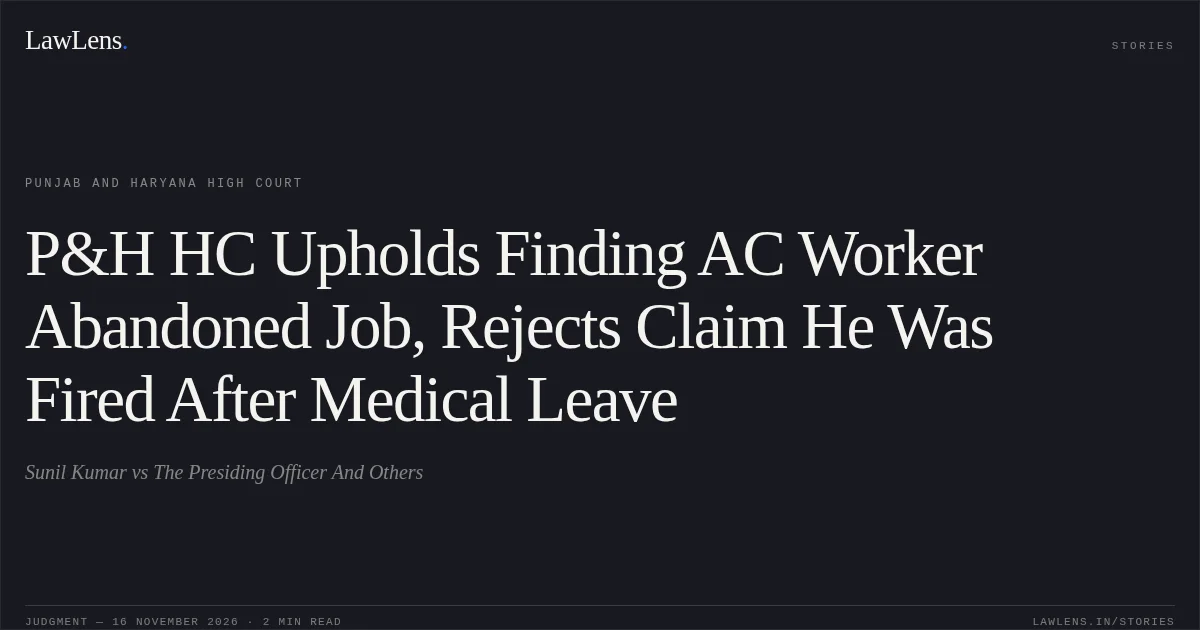
The petitioner claimed that, after taking approved medical leave, he was refused work on returning on 5 September 2015 and was terminated without notice or retrenchment compensation.
¶ 1–4He sought relief under Section 2-A(2) of the Industrial Disputes Act, 1947.
¶ 1–4Respondent No. 2 denied being his employer, while respondent No. 3, the contractor, asserted that the petitioner had abandoned his job despite notices directing him to resume duty.
¶ 1–4The Labour Court dismissed the claim, finding that respondent No. 3 was his employer and that he had abandoned his employment.
¶ 1–4The petitioner challenged that award under Articles 226 and 227 of the Constitution
¶ 1–402Issues
i.Whether the Labour Court’s finding that the petitioner was contract labour employed by respondent No. 3, rather than a direct employee of respondent No. 2, was perverse or otherwise warranted supervisory interference
¶ 8, 10–11ii.Whether the finding that the petitioner abandoned his employment was perverse or legally erroneous, and whether Section 25-F of the Industrial Disputes Act, 1947, was thereby attracted
¶ 8, 1203Law Applied
Under Articles 226 and 227 of the Constitution, a High Court does not sit in appeal over a Labour Court’s factual findings or reappreciate evidence; interference is warranted where a finding is perverse, based on no evidence, or affected by an error of law apparent on the record
¶ 9Under International Airport Authority of India v. International Air Cargo Workers’ Union, (2009) 13 SCC 374, a contractor’s worker does not become the principal employer’s direct employee merely because the principal employer exercises secondary control; direct employment may be found where the contract is sham or a camouflage, assessed by factors including who pays wages, exercises disciplinary authority, and directs and controls the worker
¶ 10Abandonment requires an element of intention, inferred from the surrounding circumstances and the worker’s conduct; mere absence, by itself, is insufficient
¶ 12Section 25-F applies where the employer retrenches the workman, and its protection presupposes an employment relationship with the employer against whom the obligation is asserted
¶ 11–12Provisions in the judgment · 2
Industrial Disputes Act, 1947 Section 2ASection 25F
04Reasoning
The Labour Court’s finding that respondent No. 3 employed the petitioner was supported by wage and employment records identifying respondent No. 3 as employer, the petitioner’s own pleadings, and the absence of a challenge to the contract documents as sham or camouflage.
¶ 11The petitioner’s work for respondent No. 2 was consistent with secondary control and did not establish direct employment
¶ 11As to abandonment, the Labour Court relied not solely on absence but also on notices requiring the petitioner to resume work, his failure to report or prove that he had returned after leave, and his failure to file a rejoinder to the pleaded abandonment.
¶ 12The petitioner’s assertions that the notices went to the wrong address and that he had signed papers under threat were not substantiated by record material.
¶ 12Those findings were therefore evidence-based and not perverse; absent employer-initiated termination, the Section 25-F claim was not made out
¶ 1205Holding
The Court held that no perversity, patent illegality, or jurisdictional error justified interference with the Labour Court’s award.
¶ 9, 13–14It dismissed the writ petition and disposed of any pending applications
¶ 9, 13–14Original Court PDF
Sunil KumarvsThe Presiding Officer And Others
Click to open original judgment
Original judgment, available to read, download and summarize on LawLens.in