01Facts
Rajesh Kumar, a District Manager with HAFED, was charged with failing to act against defaulting rice mills and with allotting paddy beyond mill capacity, allegedly causing HAFED a loss of approximately ₹16 crore.
¶ 2–7HAFED initiated disciplinary proceedings under the HAFED Common Cadre Rules, 1988. The Inquiry Officer proceeded ex parte after Kumar did not appear, found the charges proved, and HAFED dismissed him from service.
¶ 2–7On revision, the Additional Registrar set aside the inquiry report and dismissal order, finding that requested documents had not been supplied and Kumar’s written reply had not been properly considered; HAFED was permitted to initiate a fresh inquiry.
¶ 2–7HAFED challenged that order under Article 226 of the Constitution.
¶ 2–7The High Court noted that Kumar had submitted a reply on 7 July 2020, before the inquiry concluded.
¶ 11, 1402Issues
i.1. Whether the revisional authority’s decision to set aside the inquiry report and dismissal order, and permit a fresh inquiry, suffered from a jurisdictional or legal infirmity warranting interference
¶ 7–9, 18ii.2. Whether the ex parte inquiry established the charges in accordance with law, given the recorded reply, the prior requests for documents, and the evidence relied upon
¶ 13–1703Law Applied
Under the HAFED Common Cadre Rules, 1988, disciplinary proceedings may be initiated under Rule 19, a proposed penalty may be considered under Rule 19.2(g), and revision may be sought under Rule 21.
¶ 3, 5–6An Inquiry Officer may proceed ex parte where a delinquent employee fails to appear despite due notice; however, the department must still follow a fair procedure and prove the charges through evidence.
¶ 13, 15, 17A charge-sheet is not proof of the allegations, and serious misconduct must be established by evidence demonstrating the employee’s attributable conduct.
¶ 13, 15, 17The judgment cites no judicial precedents.
Provisions in the judgment · 4 · Linked ones open on LawLens
Indian Penal Code, 1860 Section 409Section 420
Prevention of Corruption Act, 1988 Section 7Section 13
04Reasoning
The Court held that Kumar’s failure to attend the inquiry did not, by itself, invalidate the ex parte proceedings.
¶ 13–14However, the Inquiry Officer’s report proceeded on the incorrect premise that Kumar had not replied to the charge-sheet, despite his reply having been submitted before the inquiry concluded.
¶ 13–14Further, the evidence—principally one witness affirming the charge-sheet and another adopting that evidence—did not satisfactorily demonstrate how Kumar’s conduct established the alleged connivance or the claimed financial loss.
¶ 15–17The charge-sheet itself could not substitute for proof, and the department had not responded to Kumar’s earlier requests for relevant documents.
¶ 15–17The revisional authority’s decision to set aside the proceedings and permit a fresh inquiry therefore disclosed no infirmity requiring the High Court’s intervention.
¶ 1805Holding
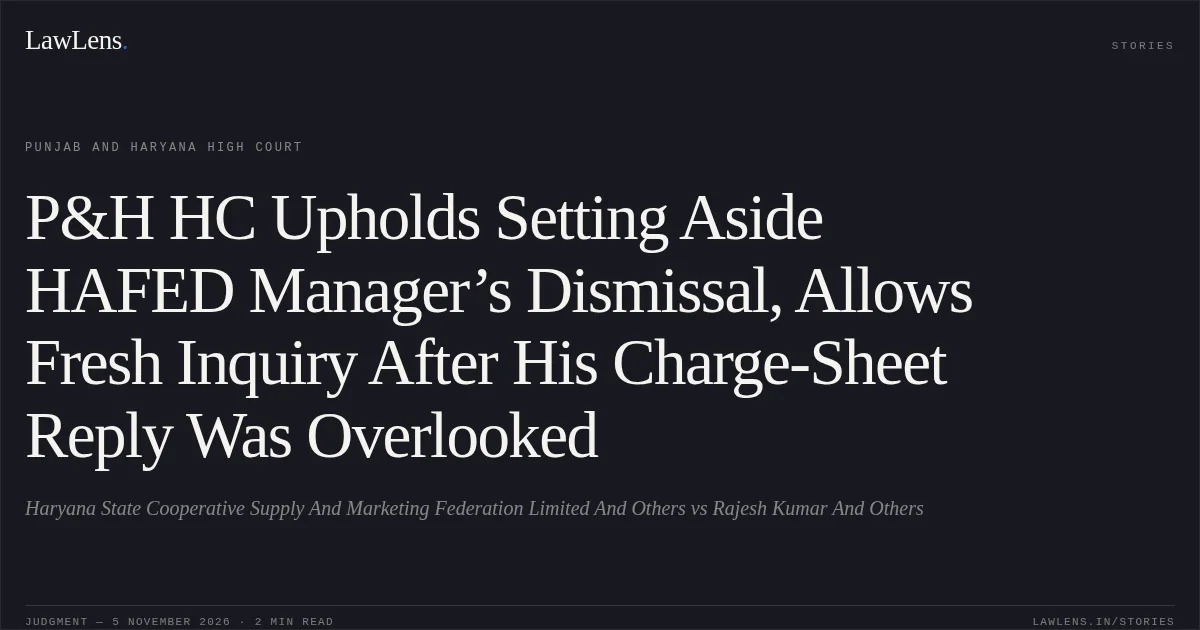
The High Court dismissed HAFED’s writ petition and upheld the revisional order setting aside the inquiry report and dismissal order.
¶ 18–21HAFED remains at liberty to initiate fresh disciplinary proceedings under the applicable Rules, provided Kumar is supplied the relevant documents and given a reasonable opportunity to submit his defence and participate in the inquiry.
¶ 18–21The Court expressed no view on the underlying allegations.
¶ 18–21Original Court PDF
Haryana State Cooperative Supply And Marketing Federation Limited And OthersvsRajesh Kumar And Others
Click to open original judgment
Original judgment, available to read, download and summarize on LawLens.in