Facts
The Petitioner resides with his elderly parents in Mavelikkara, Alappuzha. Directly adjacent to his residence is an abandoned residential plot choked with wild vegetation and tall grass, which has become a breeding ground for venomous snakes, posing a continuous threat to human life.
Source reference: p. 3The Petitioner filed a grievance through the Chief Minister’s portal [Ext. P1], which was forwarded to the 2nd Respondent (Grama Panchayat).
Source reference: p. 4Although the Panchayat confirmed the public nuisance, it declined to act, stating via letters [Ext. P2 P3] that it could not identify the property owner.
Source reference: p. 4The Village Officer (1st Respondent) also failed to provide ownership details from revenue records. The Petitioner approached the High Court seeking a Mandamus for the identification of the owner and immediate clearance of the property.
Source reference: p. 3Issues
1. Whether a Grama Panchayat can refuse to abate a public nuisance that threatens human life solely on the ground that the property owner remains unidentified.
Source reference: p. 1-22. Whether the jurisdictional Grama Panchayat has the inherent power to take swift, independent action to remove hazardous vegetation under the Kerala Panchayat Raj Act, 1994.
Source reference: p. 5Law Applied
Section 238(1)(b) of the Kerala Panchayat Raj Act, 1994 empowers the Village Panchayat to take immediate action regarding dangerous trees or structures without notice if such action is necessary to prevent danger, allowing costs to be recovered from the owner as arrears of public revenue.
Source reference: p. 5Section 239(3)(a)(iii)(iv) of the Kerala Panchayat Raj Act, 1994 specifically grants the power to address nuisances caused by wild/noxious vegetation or the presence of poisonous reptiles.
Source reference: p. 6Section 239(3)(b) of the Kerala Panchayat Raj Act, 1994 authorizes the Panchayat to take any necessary action to abate such nuisances.
Source reference: p. 6Reasoning
The Court observed that with the onset of the academic year, snake bites resulting from unattended vacant plots have become a "public safety emergency."
Source reference: p. 2It reasoned that local self-government institutions cannot remain "silent spectators" to life-threatening conditions. By reading Sections 238 and 239 together, the Court concluded that the Panchayat possesses inherent powers to act even without prior notice when immediate danger exists.
Source reference: p. 7The Court held that "common sense should prevail over the intricacies of the law"; thus, identifying the owner is a secondary administrative task that should not delay the primary duty of protecting citizens' lives.
Source reference: p. 7-8The Court interpreted the statutory framework to mean that the Panchayat can execute the work independently and recover expenses later once the owner is identified.
Source reference: p. 8Holding
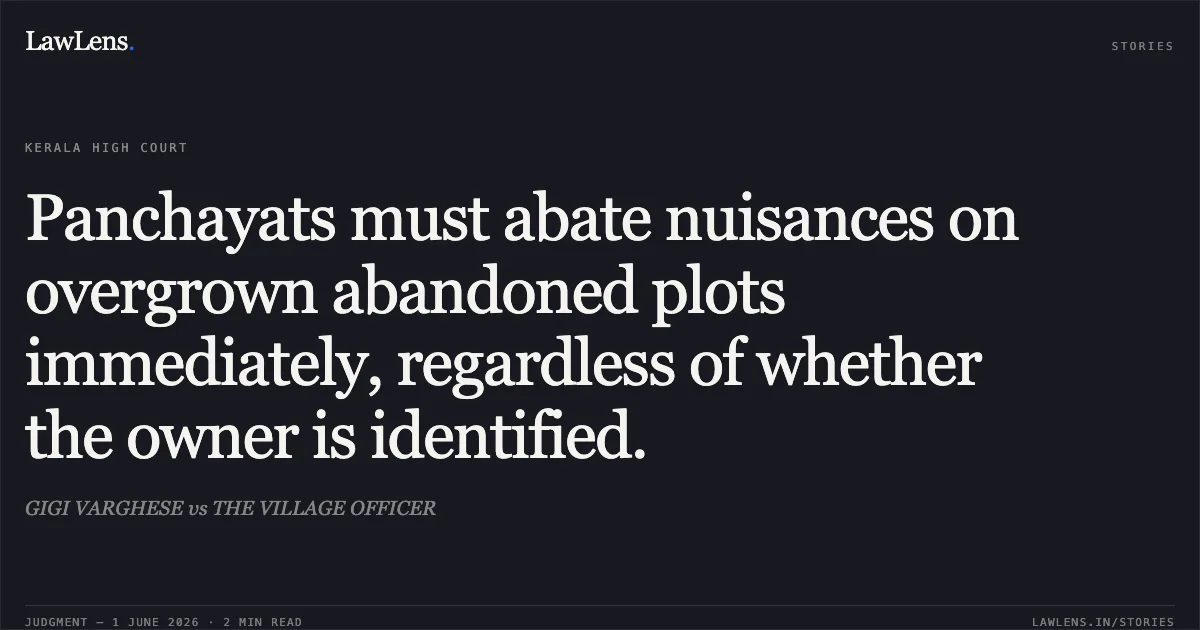
The Court allowed the Writ Petition, declaring that local self-government institutions must act swiftly if a nuisance poses a genuine threat to life. The Court held that if an owner is unknown, the Panchayat must remove the nuisance first and recover costs later.
The 2nd Respondent was directed to clear the overgrown grass and vegetation on the adjacent property within 10 days. It further ordered that once the owner is identified, the costs shall be recovered as arrears of land revenue. These directions were made binding on all local self-government institutions in Kerala.
Source reference: p. 8-9Acts & Sections Cited
2 provisions across 1 statute referred to in this judgment. Linked provisions open on LawLens.
Kerala Panchayat Raj Act, 19942
Original Court PDF
GIGI VARGHESEvsTHE VILLAGE OFFICER
Click to open original judgment
Original judgment, available to read, download and summarize on LawLens.in


