Facts
Twenty writ petitions were heard together involving various jute mills and industrial establishments.
Source reference: p. 1-9These petitioners were "exempted establishments" under Section 17 of the Employees’ Provident Funds and Miscellaneous Provisions Act, 1952 ("the Act"), meaning they managed their own PF trusts under specific conditions.
Source reference: p. 10, 39The Provident Fund authorities issued notices and orders demanding that these companies pay a "differential rate of interest" because their private trusts yielded lower returns than the statutory rate declared by the Government under Paragraph 60 of the EPF Scheme.
Source reference: p. 12-13, 23The authorities based these demands on Paragraph 27AA and Appendix A of the EPF Scheme (as amended), which mandates that exempted trusts must match the statutory interest rate.
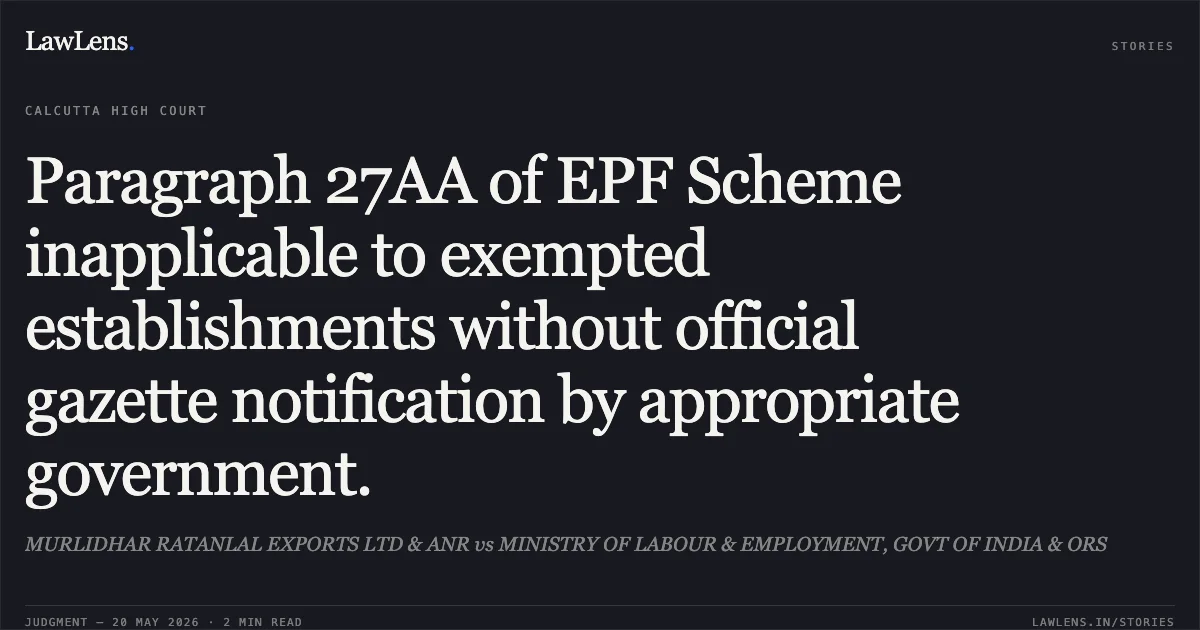
Source reference: p. 28, 39The petitioners challenged these demands and the constitutional validity of Paragraph 27AA, arguing that as exempted bodies, they were not bound by subsequent amendments to a Scheme from which they were already exempted.
Source reference: p. 9, 31-32Issues
1. Whether Paragraph 27AA of the EPF Scheme and Clauses 7 and 9 of Appendix A are ultra vires Section 17 of the Act.
Source reference: p. 9, 392. Whether Paragraph 27AA of the Scheme can be automatically imposed on establishments that were granted exemption under Section 17 of the Act before such amendment.
Source reference: p. 21-22, 40Law Applied
Section 17 of the EPF Act, 1952, which empowers the appropriate government to exempt establishments via notification in the Official Gazette subject to specific conditions.
Source reference: p. 10, 39Paragraph 27AA and Appendix A of the EPF Scheme, 1952, which outlines terms and conditions for exemptions.
Source reference: p. 39-40The precedent in Jiyajeerao Cotton Mills Ltd. vs. Dev Kumar Holani, which established that revised terms and conditions do not apply to exempted establishments automatically unless the Government issues a specific notification amending the exemption in the Official Gazette.
Source reference: p. 11, 43Reasoning
The Court reasoned that under Section 17 of the Act, an exemption is granted by the "appropriate government" through a formal notification.
Source reference: p. 39, 41While the EPF Scheme was amended to include Paragraph 27AA (requiring employers to make good any interest deficiency), the petitioners had been exempted from the operation of that very Scheme.
Source reference: p. 16, 41The Court found that an amendment to the Scheme does not automatically override a Section 17 exemption.
Source reference: p. 42For Paragraph 27AA to apply, the appropriate government must take a proactive step: it must either cancel the existing exemption or modify the original exemption notification in the Official Gazette to incorporate the new conditions.
Source reference: p. 20, 42-43Since the government had not amended the specific notifications under which these mills were exempted, the authorities could not rely on the amended Scheme to demand differential interest.
Source reference: p. 43-44Holding
The Court held that Paragraph 27AA of the EPF Scheme and Appendix ‘A’ are not ultra vires the Act.
It ruled that Para 27AA is not applicable to establishments exempted under Section 17 unless the specific exemption notification is modified and published in the Official Gazette by the appropriate government.
Source reference: para. 36(b)Consequently, the Court quashed and set aside all challenged notices, summons, and orders issued against the petitioners for non-compliance with Para 27AA/Appendix ‘A’.
Source reference: para. 36(c)All connected applications were disposed of and interim orders vacated.
Source reference: para. 37-38Acts & Sections Cited
7 provisions across 2 statutes referred to in this judgment. Linked provisions open on LawLens.
Employees’ Provident Funds And Miscellaneous Provisions Act, 19526
Companies Act, 19561
Original Court PDF
MURLIDHAR RATANLAL EXPORTS LTD & ANRvsMINISTRY OF LABOUR & EMPLOYMENT, GOVT OF INDIA & ORS
Click to open original judgment
Original judgment, available to read, download and summarize on LawLens.in


