Facts
The complainant alleged that the petitioner had misappropriated funds entrusted for Post Office MIS investments.
Source reference: paras. 2–10The petitioner executed a written declaration and notarised agreement acknowledging liability and issued a cheque for ₹8,00,000, which was dishonoured for insufficient funds.
Source reference: paras. 2–10The trial court convicted him under Section 138 of the Negotiable Instruments Act, 1881 (NI Act), and the appellate court affirmed the conviction and sentence.
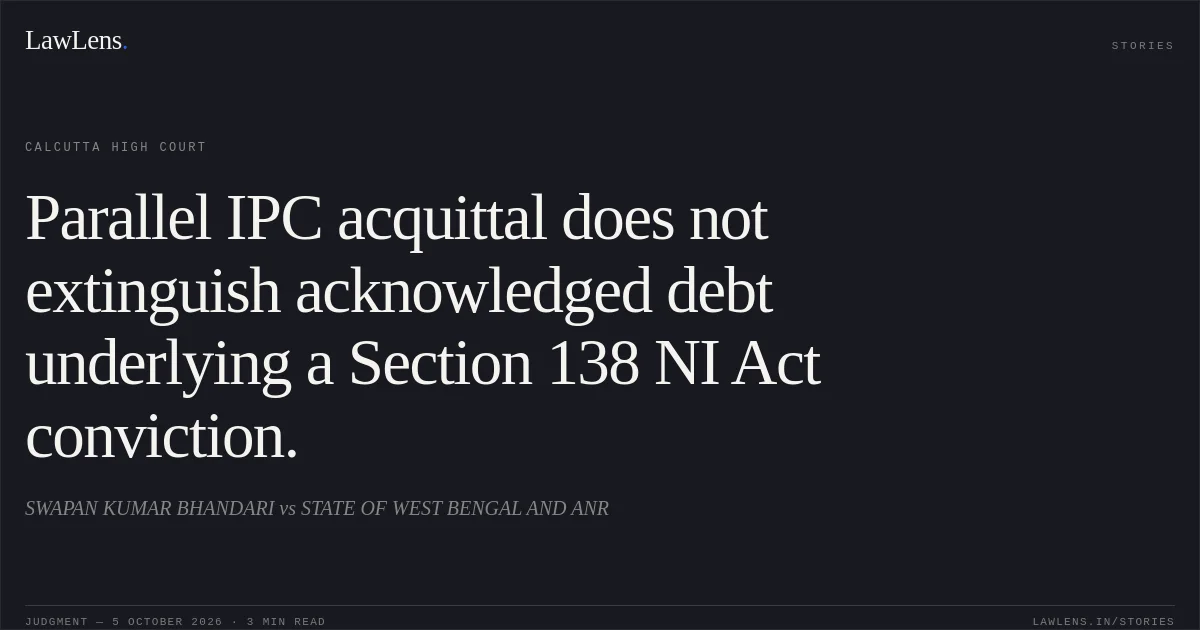
Source reference: paras. 2–10The petitioner challenged the concurrent judgments in revision, relying, among other things, on his acquittal in a separate prosecution under Sections 409 and 420 of the Indian Penal Code, his claim that the cheque leaf had been snatched, and his assertion that the statutory demand notice was not served.
Source reference: paras. 11–19Issues
1. Whether the petitioner’s acquittal in the separate IPC prosecution extinguished the legally enforceable debt underlying the Section 138 conviction
Source reference: para. 20(i)2. Whether the petitioner rebutted the presumptions under Sections 118 and 139 of the NI Act by raising a probable defence that his cheque leaf had been snatched
Source reference: para. 20(ii)3. Whether the statutory demand-notice requirement was satisfied, including in light of the petitioner’s failure to pay within fifteen days of receiving court summons
Source reference: para. 20(iii)4. Whether the concurrent findings disclosed perversity, illegality, or miscarriage of justice warranting revisional interference
Source reference: para. 20(iv)Law Applied
Sections 118(a) and 139 of the NI Act raise presumptions in favour of the holder once the foundational facts concerning the cheque are established; the accused may rebut them on a preponderance of probabilities, including by relying on the complainant’s evidence (*Rangappa v. Sri Mohan*, *Basalingappa v. Mudibasappa*).
Source reference: paras. 29–30Section 138 requires, among other things, a written demand notice following dishonour and non-payment within fifteen days of receipt.
Source reference: para. 35Service may be presumed where notice is sent by registered post to the drawer’s correct address under Section 27 of the General Clauses Act, 1897, read with Section 114 of the Indian Evidence Act, 1872; under *C.C. Alavi Haji v. Palapetty Muhammed*, failure to pay within fifteen days of receiving court summons with the complaint may defeat a non-service objection.
Source reference: paras. 37–38An acquittal in a separate criminal prosecution applying the criminal standard of proof does not, by itself, determine whether a distinct monetary liability exists.
Source reference: paras. 24–26Revisional jurisdiction under Sections 401 and 482 Cr.P.C. is not a second appeal and does not warrant routine reappraisal of evidence absent perversity, illegality, or a miscarriage of justice.
Source reference: para. 42Reasoning
The Court held that the written declaration and notarised agreement acknowledging liability, together with the dishonoured cheque, independently supported the debt; the separate IPC acquittal, based on evidentiary shortcomings in proving criminal breach of trust or cheating, did not extinguish that liability.
Source reference: paras. 21–28The petitioner’s cheque-snatching account was unsupported by defence evidence or any contemporaneous police or bank report and therefore did not establish a probable defence sufficient to rebut the statutory presumptions.
Source reference: paras. 31–34The demand notice had been sent to the petitioner’s correct address, and he produced no adequate proof of incarceration when delivery was attempted; in any event, he did not pay within fifteen days after receiving the court summons and complaint.
Source reference: paras. 36–41The Court found no perversity or material legal error in the concurrent findings.
Source reference: paras. 42–44Holding
The Court answered the first and second issues against the petitioner, held the notice requirement satisfied, and found no basis for revisional interference.
It dismissed the revision and affirmed the conviction and sentence, disposed of the connected application, vacated interim orders, cancelled any bail bonds, and directed the petitioner to surrender within four weeks to serve the sentence and comply with the compensation order.
Source reference: paras. 46–51Acts & Sections Cited
13 provisions across 4 statutes referred to in this judgment. Each provision opens on LawLens.
Negotiable Instruments Act, 18813
Indian Penal Code, 18602
Code of Criminal Procedure, 19737
General Clauses Act, 18971
Original Court PDF
SWAPAN KUMAR BHANDARIvsSTATE OF WEST BENGAL AND ANR
Click to open original judgment
Original judgment, available to read, download and summarize on LawLens.in