Facts
The petitioner-husband and respondent-wife married in 2012 and had two daughters: Mihira Siri Tandra, born in 2016, and Lasya Tanmayi Tandra, born in 2019. After the parties separated in 2021, the petitioner retained custody of the elder daughter, Mihira, while the respondent retained custody of the younger daughter. Mihira had been jointly admitted by the parties to Kendriya Vidyalaya, IISc Campus, in 2021.
Source reference: p. 3, para. 3In June 2025, the respondent filed M.C. No. 3728/2025 seeking divorce and, on 23 June 2025, filed I.A. No. IV seeking interim custody of Mihira. While that application was pending, the respondent went to the school on 4 July 2025 and took custody of Mihira without obtaining an order from the Family Court.
Source reference: p. 4, para. 3Thereafter, on 9 October 2025, the respondent filed I.A. No. VII seeking the petitioner’s cooperation in obtaining Mihira’s transfer certificate from Kendriya Vidyalaya so that she could be admitted to JSS School, Banashankari, or another school. While I.A. No. VII was pending, the respondent admitted Mihira to Bangalore International Academy without obtaining the transfer certificate or prior permission of the Family Court.
Source reference: pp. 4, 8, paras. 3, 8The Family Court observed that the respondent’s conduct in taking custody during the pendency of the custody application without a court order was not appreciable, but allowed I.A. No. VII on the ground that the child’s education and overall welfare should not be affected.
Source reference: pp. 5–6, 9–10, paras. 4, 10The petitioner challenged that order under Article 227 of the Constitution.
Source reference: p. 2, para. 2Issues
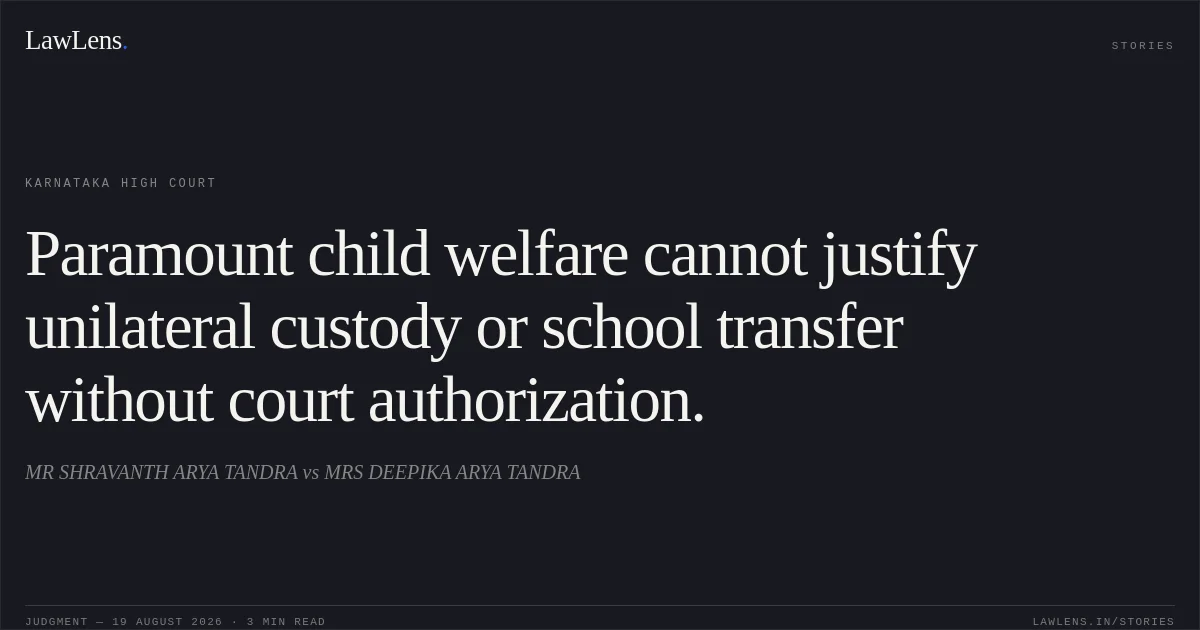
Whether the Family Court was justified in allowing I.A. No. VII and effectively validating the respondent’s unilateral taking of custody and subsequent change of the child’s school without prior court permission, merely on the ground of the child’s welfare?
Source reference: pp. 7–10, paras. 6–10Whether the impugned order directing cooperation for obtaining the child’s transfer certificate was liable to be quashed in the exercise of the High Court’s supervisory jurisdiction under Article 227 of the Constitution?
Source reference: p. 2, para. 2; pp. 10–12, para. 12 and orderLaw Applied
The Court applied the principle that the paramount welfare and overall well-being of the child must guide custody and educational decisions.
Source reference: p. 7, para. 7However, it held that this principle does not authorise a litigant to act unilaterally during the pendency of custody proceedings and subsequently seek judicial approval on the ground that the act was in the child’s best interests.
Source reference: pp. 7–10, paras. 7–10The Court further applied the principle that an order of a court should not validate a party’s unauthorised or legally improper conduct.
Source reference: p. 7, para. 7The respondent relied upon S. Kannan v. Priya, reported in (2009) 6 CTC 760, concerning continuity of the child’s education, but the High Court did not accept that reliance as justification for the respondent’s unilateral conduct.
Source reference: p. 6, para. 5The petition was considered under the High Court’s supervisory jurisdiction under Article 227 of the Constitution.
Source reference: p. 2, para. 2Reasoning
The High Court held that the respondent knew she was required to obtain a court order for custody because she had herself filed I.A. No. IV seeking such custody. Nevertheless, she removed Mihira from Kendriya Vidyalaya while that application was pending, did not seek permission to retain custody, and subsequently admitted the child to another school without obtaining either the transfer certificate or the Family Court’s permission.
Source reference: pp. 7–9, paras. 6–8Although the child’s welfare and continuity of education were paramount, those considerations could not be used to condone or retrospectively validate the respondent’s unauthorised acts. The Court reasoned that permitting such conduct would encourage parties in family proceedings to act first and seek judicial approval later by invoking the child’s best interests.
Source reference: pp. 9–10, paras. 9–10Accordingly, the Family Court’s reliance on the child’s welfare to allow I.A. No. VII, despite recognising the respondent’s improper conduct, was held legally unsustainable.
Source reference: p. 10, para. 12Holding
The writ petition was allowed in part and disposed of by quashing the Family Court’s order on I.A. No. VII in M.C. No. 3728/2025.
To protect Mihira’s education and well-being, the respondent was directed to take all steps necessary for her continuation at Kendriya Vidyalaya, IISc, Bengaluru.
Source reference: p. 12, order (ii)The Principal of Kendriya Vidyalaya, IISc, was directed to enrol Mihira in the sixth standard and provide assistance for her continued education.
Source reference: p. 12, order (iii)The Family Court was directed to pass appropriate orders on any applications concerning the child’s education at Kendriya Vidyalaya.
Source reference: p. 12, order (iv)The High Court clarified that its observations regarding the respondent’s conduct would not influence the final adjudication of the divorce proceedings or other pending or future interlocutory applications.
Source reference: p. 12, order (vi)Original Court PDF
MR SHRAVANTH ARYA TANDRAvsMRS DEEPIKA ARYA TANDRA
Click to open original judgment
Original judgment, available to read, download and summarize on LawLens.in