Facts
The appellants, claimants and allegedly dependants of deceased workman Nitesh, filed an appeal under Section 30 of the Employees’ Compensation Act, 1923, challenging the award dated 22 March 2025 passed by the Commissioner for Employees’ Compensation, Betul, in Case No. 14/W.C.A.F./2021, whereby their claim petition was dismissed.
Source reference: p.1The appellants contended that the Commissioner had failed to properly appreciate the evidence concerning the employer–employee relationship, the deceased’s wages, dependency, and the liability of the employer and insurer, and had not afforded adequate opportunity to lead evidence.
Source reference: p.1The respondents supported the award, asserting that the Commissioner had properly appreciated the evidence and that the findings were findings of fact.
Source reference: p.2The Commissioner had framed nine issues; Issues Nos. 1 to 6 were decided in favour of the appellants, but the claim was ultimately dismissed principally on the ground that the appellants were not established as dependants of the deceased.
Source reference: p.3Issues
1. Whether the Commissioner correctly determined that the appellants, allegedly the parents of the deceased workman, were not “dependants” entitled to compensation under the Employees’ Compensation Act, 1923.
Source reference: paras. 6–8; pp.3–42. Whether the Commissioner properly adjudicated the deceased workman’s wages and the liability of the employer and insurer, if any.
Source reference: para. 9; p.43. Whether the issues concerning compensation, interest and penalty required fresh determination after reconsideration of the appellants’ dependency claim.
Source reference: para. 6; p.3Law Applied
The Court applied Section 30 of the Employees’ Compensation Act, 1923, governing appeals against awards of the Commissioner, and treated the Employees’ Compensation Act as beneficial social-welfare legislation requiring a liberal and purposive interpretation.
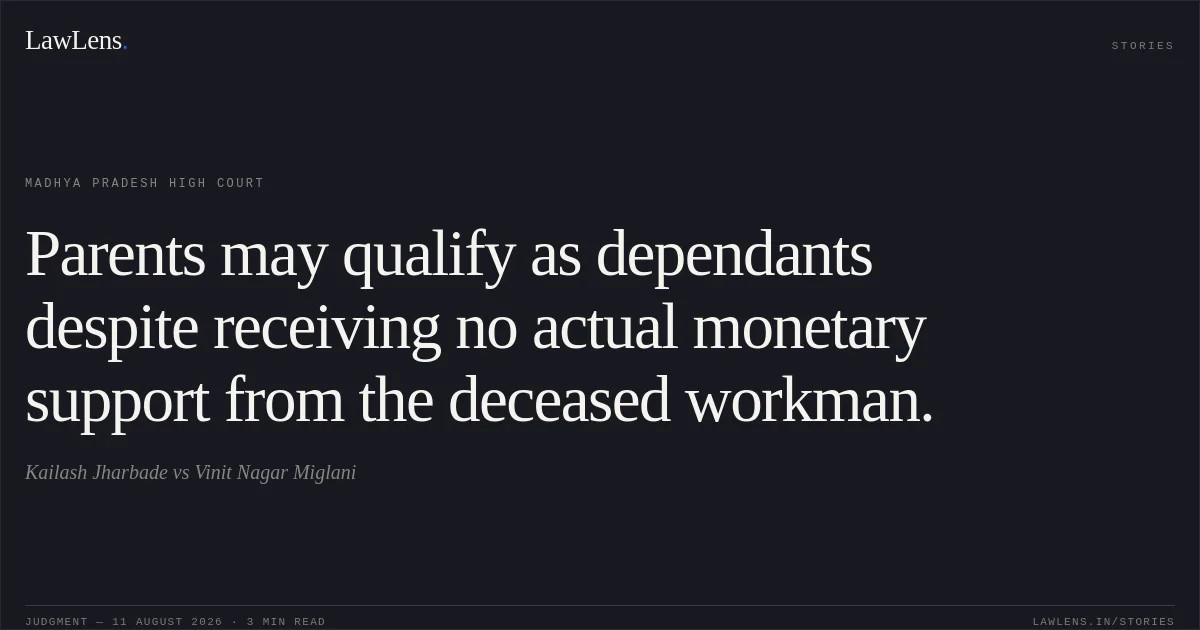
Source reference: paras. 1, 5; pp.1–2It relied principally on Ramji and Another v. Lalit Kumar Bardiya and Others, 1994 ACC 267, which held that the expression “dependant” should not be narrowly confined to parents who had actually received monetary support from the deceased; parents who would ordinarily have been entitled to such support, but were deprived of it because of non-payment of wages or the workman’s death, may also qualify as dependants.
Source reference: paras. 2, 7; pp.1–2, 4The Commissioner was further required to record clear, reasoned and speaking findings on all material issues arising from the pleadings and evidence, including dependency, wages, and employer or insurer liability.
Source reference: para. 5; p.2Reasoning
The High Court found that, although several issues had been decided in the appellants’ favour, the Commissioner had not examined the dependency claim in accordance with the liberal interpretation mandated by Ramji.
Source reference: paras. 6–8; pp.3–4The award did not adequately discuss the evidence relevant to whether the appellants, as parents, were ordinarily entitled to receive financial support from the deceased, nor did it apply the principle that actual receipt of monetary assistance is not indispensable to establish dependency.
Source reference: para. 8; p.4Since dependency went to the root of the appellants’ entitlement to compensation, the failure to determine it according to the applicable legal principles constituted a material error and failure of justice.
Source reference: paras. 8–9; pp.4–5The Court therefore considered it inappropriate to finally determine compensation, wages, interest, penalty, or liability in the appeal and directed a fresh adjudication by the Commissioner.
Source reference: paras. 8–9; pp.4–5Holding
The appeal was allowed to the extent that the finding regarding the appellants’ dependency and the award dated 22 March 2025 were set aside.
The matter was remanded to the Commissioner for Employees’ Compensation, Betul, with directions to restore the claim to its original number and record reasoned findings on: (i) the appellants’ dependency in light of Ramji; (ii) the deceased’s wages; and (iii) the liability of the employer and insurer, if any.
Source reference: para. 9; p.4The Commissioner was directed to pass a fresh, speaking award uninfluenced by the High Court’s observations on the merits and to endeavour to conclude the proceedings preferably within six months from the parties’ appearance.
Source reference: para. 9; pp.4–5A copy of the order was directed to be supplied to the Commissioner, and the miscellaneous appeal was disposed of accordingly.
Source reference: paras. 10–12; p.6Acts & Sections Cited
2 provisions across 1 statute referred to in this judgment. Linked provisions open on LawLens.
Employee2
Original Court PDF
Kailash JharbadevsVinit Nagar Miglani
Click to open original judgment
Original judgment, available to read, download and summarize on LawLens.in