Facts
The applicant sought regular bail in connection with Crime No. VIII/74/DZU/2022 registered by the NCB DZU for offences under Sections 8, 21, 23, and 29 of the NDPS Act.
Source reference: p. 1The prosecution's case originated from the seizure of 4.98 kg of cocaine from a co-accused, Dipali, who claimed in her confessional statement that she received the contraband from the applicant and another individual at a hotel in Mumbai.
Source reference: p. 2The applicant subsequently made disclosure statements regarding his involvement and that of other co-accused, leading to a further recovery of 2.055 kg of cocaine from another co-accused, Kelemuwa.
Source reference: p. 2The applicant sought bail primarily on the ground of parity with co-accused Yesak Angsom, who was granted bail on 28.07.2025.
Source reference: p. 2The NCB opposed the bail, citing the recovery of USD 3,500 from the applicant and the existence of WhatsApp chats with a suspected associate.
Source reference: p. 3Issues
1. Whether the applicant is entitled to regular bail on the grounds of parity with co-accused Yesak Angsom.
Source reference: para 22. Whether the recovery of drug money and the existence of WhatsApp chats constitute sufficient additional evidence to deny bail, notwithstanding the parity argument.
Source reference: para 5-6Law Applied
The Court considered the provisions of Sections 8, 21, 23, and 29 of the Narcotics Drugs and Psychotropic Substances (NDPS) Act.
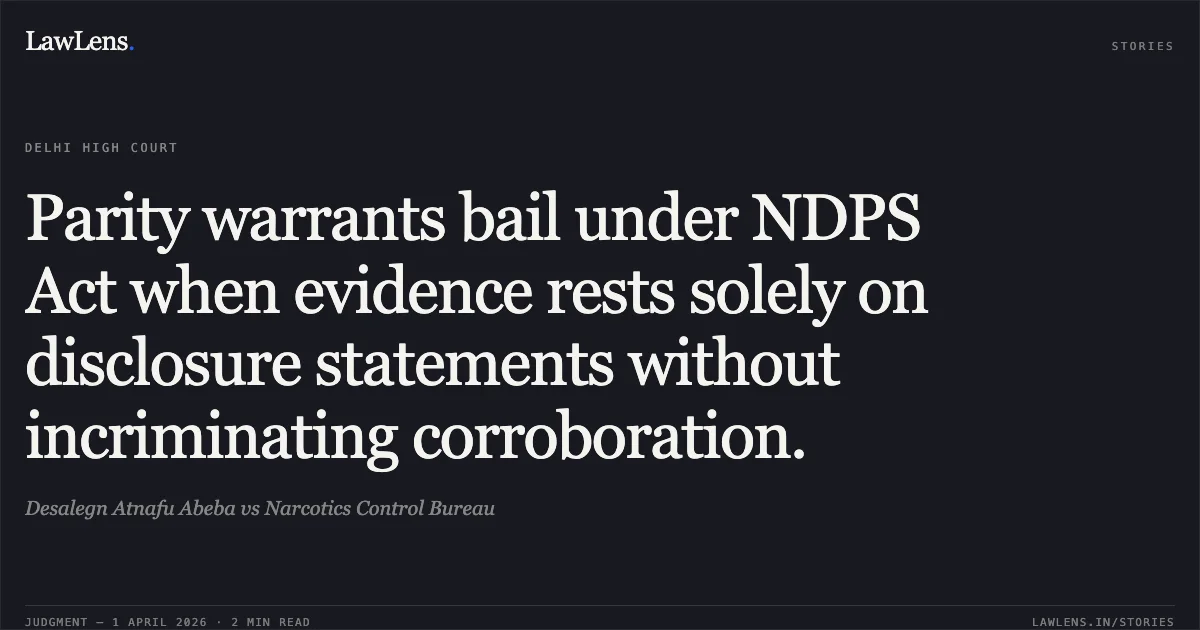
Source reference: p. 1It applied the principle of parity in bail matters, which dictates that similarly situated accused persons should be treated equally unless distinct incriminating evidence exists.
Source reference: para 2, 5The Court also evaluated the evidentiary value of disclosure statements and the requirement for "explicitly incriminating" electronic evidence (WhatsApp chats) to justify continued incarceration.
Source reference: para 6-7Reasoning
The Court examined the NCB's contention that the applicant’s case was distinct from that of the co-accused Yesak due to the recovery of USD 3,500 and WhatsApp chats.
Source reference: para 5However, the Court observed that money had also been recovered from Yesak, albeit a smaller amount.
Source reference: para 6Regarding the electronic evidence, the Court noted that the NCB failed to produce any "explicitly incriminating" WhatsApp chats that would link the applicant to the trade beyond a reasonable doubt at this stage.
Source reference: para 6The Court concluded that, similar to the co-accused who was already on bail, the primary evidence against the applicant remained his disclosure statement.
Source reference: para 7Given that the material circumstances were substantially similar to the co-accused who was granted bail after a review of CCTV footage, the Court found no justification for a different treatment of the applicant.
Source reference: para 4, 6, 7Holding
The Court allowed the bail application, directing the applicant to be released on a personal bond of Rs. 50,000/- with one surety of the like amount.
Since the applicant’s visa had expired, the Court issued a specific direction that upon acceptance of the bail bond, his custody must be handed over by the Jail Superintendent to the Foreign Regional Registration Office (FRRO).
Source reference: para 8, 9The Court clarified that these observations would not prejudice the final trial.
Source reference: para 10Acts & Sections Cited
4 provisions across 1 statute referred to in this judgment. Each provision opens on LawLens.
Narcotic Drugs and Psychotropic Substances Act, 19854
Original Court PDF
Desalegn Atnafu AbebavsNarcotics Control Bureau
Click to open original judgment
Original judgment, available to read, download and summarize on LawLens.in