Facts
The petitioner was convicted under Sections 20 and 29 of the NDPS Act and sentenced to 16 years of rigorous imprisonment
Source reference: para 1Having served over two years and eight months with satisfactory jail conduct, he applied for 28 days of parole on 24.3.2025 to meet his family members
Source reference: paras 1-2The competent authority rejected the application on 11.8.2025 based on reports from the District Magistrate and Superintendent of Police, Mandi.
Source reference: paras 1-2The rejection was grounded on apprehensions that the petitioner might re-engage in drug supply, the fact that his family could travel to the jail to meet him, and the assertion that meeting family was not a "sufficient cause" under the H.P. Good Conduct Prisoners (Temporary Release) Act, 1968
Source reference: paras 1-2Issues
1. Whether meeting family members constitutes "sufficient cause" for the grant of parole under Section 3 of the H.P. Good Conduct Prisoners (Temporary Release) Act, 1968?
Source reference: para 132. Whether the nature of the offence or a general apprehension of re-offending are valid grounds to deny parole under the statutory framework?
Source reference: para 17Law Applied
The court primarily applied Section 3 and Section 6 of the H.P. Good Conduct Prisoners (Temporary Release) Act, 1968, noting that Section 3(1)(d) allows release for "any other sufficient cause"
Source reference: para 10It relied on the Supreme Court's decision in Asfaq v. State of Rajasthan, which characterized parole as a reformative tool essential for maintaining social and family ties
Source reference: para 7Further, the court followed Harbhajan Singh v. State of H.P. and Shor v. State of Uttar Pradesh, establishing that the heinous nature of a crime or the mere nature of the offence cannot be the sole basis for denying parole
Source reference: paras 8-9It also applied Rule 3(2) of the Prisoners Act, which restricts grounds for opposing parole to cases where the prisoner’s release is dangerous to "security of the State" or "prejudicial to the maintenance of public order"
Source reference: para 16Reasoning
The court reasoned that the term "any other sufficient cause" must be liberally construed to include maintaining family ties, which is a facet of the right to life under Article 21
Source reference: paras 11-13It rejected the respondent's argument that the petitioner’s family could visit him in jail, stating that prisoners do not shed their constitutional rights at the gate and must be allowed to breathe fresh air to facilitate reformation
Source reference: paras 7, 15Regarding the apprehension that the petitioner would re-engage in drug supply, the court found this justification legally insufficient under Rule 3(2) of the Act
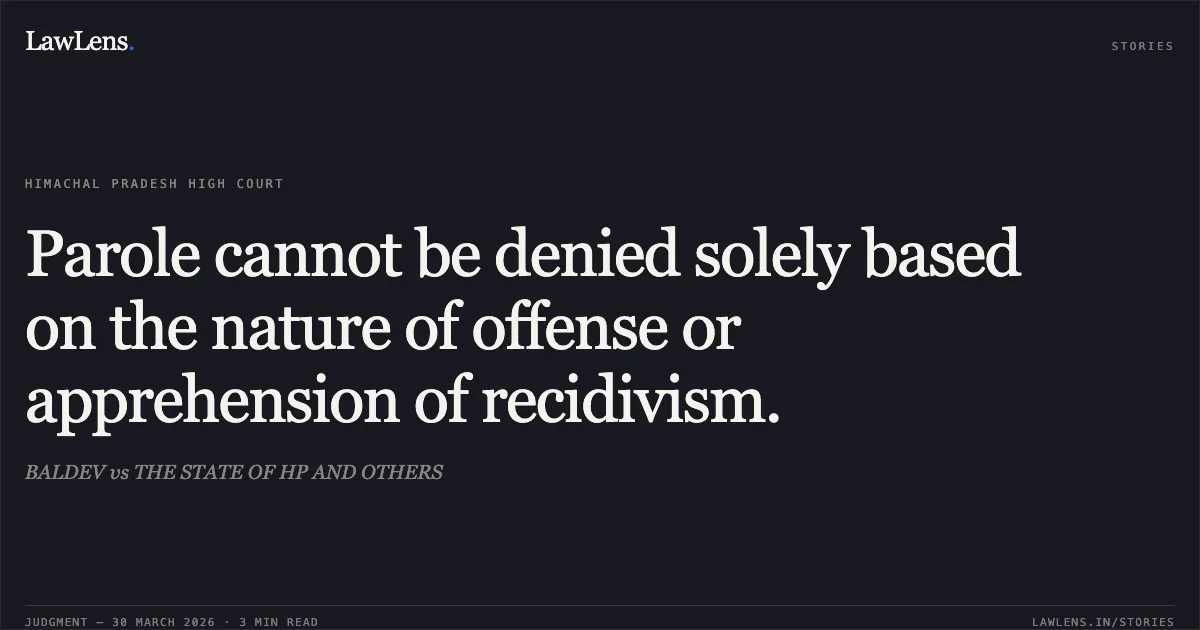
Source reference: para 17The court noted that unless the State demonstrates a specific threat to public order or state security, parole cannot be denied based on the nature of the conviction, especially when the prisoner’s conduct in jail has been satisfactory
Source reference: paras 15-17Holding
The High Court allowed the petition and quashed the rejection order dated 11.8.2025
The court held that meeting family is a valid legal ground for parole and that the reasons provided for rejection fell outside the purview of the Act
Source reference: paras 13, 17It directed the petitioner’s release on parole for 28 days subject to a personal bond of ₹1,00,000, two sureties of the same amount, and an undertaking to maintain good conduct
Source reference: para 18The court further ordered the Probation Officer to monitor the petitioner’s activities and authorized the Superintendent of Jail to impose additional suitable conditions
Source reference: paras 18-19Acts & Sections Cited
4 provisions across 3 statutes referred to in this judgment. Each provision opens on LawLens.
Narcotic Drugs and Psychotropic Substances Act, 19852
Indian Penal Code, 18601
Prisons Act, 18941
Original Court PDF
BALDEVvsTHE STATE OF HP AND OTHERS
Click to open original judgment
Original judgment, available to read, download and summarize on LawLens.in