Facts
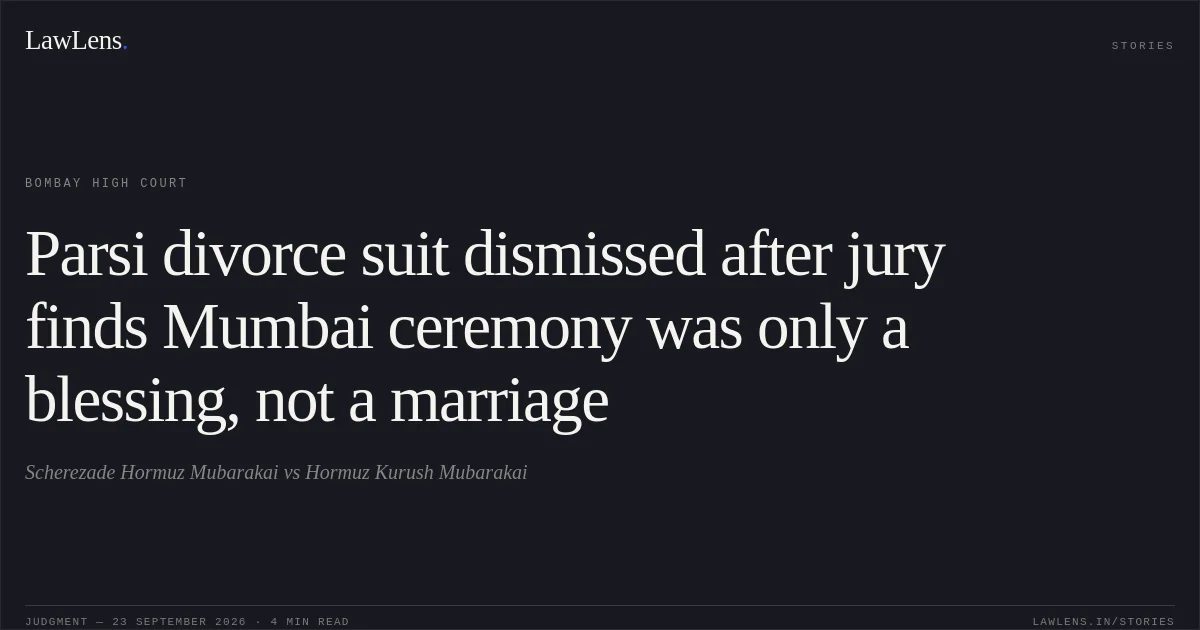
The Plaintiff-Wife instituted Parsi Suit No. 2 of 2018 seeking dissolution of her alleged Parsi marriage, permanent alimony of ₹5 crores, interim maintenance, and costs.
Source reference: p.1; para. 1She relied on a ceremony held in Mumbai on 20 November 2010 as the ceremony solemnising the marriage under the Parsi Marriage and Divorce Act, 1936 (“PMDA”).
Source reference: p.1; para. 1The parties had previously undergone a civil marriage in Perth, Western Australia, on 22 August 2010, had resided in Australia, and had subsequently participated in Australian proceedings concerning custody, division of assets, and divorce.
Source reference: pp.2–3; paras. 4, 51–53The Defendant-Husband filed the Interim Application under Order VII Rule 11(d) of the Code of Civil Procedure, 1908 (“CPC”), contending that the Mumbai event was only a Tandoorasti or blessing ceremony and not the Ashirvad ceremony required for a valid Parsi marriage under Section 3(1)(b) of the PMDA.
Source reference: pp.2, 9–11; paras. 4, 16–20With the parties’ consent, the video recording of the Mumbai ceremony was placed on record and examined by the Parsi delegates.
Source reference: pp.5–8; paras. 8–12The delegates unanimously concluded that the event was not a complete Parsi marriage ceremony but a Tandoorasti or blessing ceremony; they specifically noted the absence of the customary signing of the marriage document by the parties and witnesses.
Source reference: pp.5–8; paras. 8–12Issues
1. Whether the Mumbai ceremony of 20 November 2010 was an Ashirvad ceremony solemnising a Parsi marriage, or merely a Tandoorasti/blessing ceremony?
Source reference: pp.9–11, 19–25; paras. 15–20, 38–492. Whether the finding that no Ashirvad ceremony took place deprived the Bombay High Court of territorial jurisdiction under Section 29 of the PMDA and rendered the Suit barred under Order VII Rule 11(d) CPC?
Source reference: pp.9–11, 22–25; paras. 16–20, 43–493. Whether the CPC, including Order VII Rule 11(d), applied to proceedings under the PMDA despite the proceeding being styled as a matrimonial suit or petition?
Source reference: pp.16–18; paras. 30–364. Whether the Australian proceedings concerning divorce, custody, and division of assets operated as res judicata or otherwise made the Indian Suit conclusive under Section 13 CPC?
Source reference: pp.26–32; paras. 50–60Law Applied
Section 3(1)(b) of the PMDA requires a Parsi marriage to be solemnised according to the Parsi form of ceremony called Ashirvad, by a priest and in the presence of two Parsi witnesses other than the priest.
Source reference: p.9; para. 16Under Section 29, a suit under the PMDA may be filed where the marriage was solemnised; therefore, the place of solemnisation constituted the material jurisdictional fact in this case.
Source reference: p.10; paras. 18–20Sections 19 and 46 of the PMDA allocate functions between the presiding Judge and the Parsi delegates: questions of law and procedure are for the Judge, while questions of fact are decided by the delegates, subject to the statutory framework.
Source reference: pp.12–15; paras. 21–29Section 45 makes the CPC applicable to PMDA suits insofar as applicable, permitting reliance on Order VII Rule 11(d) where the proceeding is barred by law.
Source reference: pp.16–18; paras. 30–34Section 13 CPC governs the conclusiveness of foreign judgments, but only in respect of matters directly adjudicated upon by a competent foreign court, subject to the statutory exceptions.
Source reference: pp.30–32; para. 58The Court also applied the principles in Bhaurao Shankar Lokhande v. State of Maharashtra, that a marriage not solemnised through the legally prescribed ceremony is no marriage in the eye of law, and Dolly Rani v. Manish Kumar Chanchal, that registration cannot substitute for the essential marriage ceremony.
Source reference: p.33; para. 61Reasoning
The Court held that the character of the Mumbai event was a jurisdictional question of fact which the parties had expressly agreed to place before the Parsi delegates.
Source reference: pp.12–19; paras. 24–37Since the Wife herself tendered the video and fully participated in the agreed procedure, she could not subsequently object that the Court had conducted an impermissible “mini-trial” or that the delegates’ conclusion was merely an opinion.
Source reference: pp.12–19, 24–25; paras. 24–37, 46–49The delegates unanimously found that the ceremony was Tandoorasti and not Ashirvad, principally because the essential execution of the marriage document by the parties and two witnesses was absent.
Source reference: pp.7–8; paras. 11–12The Court treated that finding as an answer on Parsi custom and ritual, and found no perversity warranting interference.
Source reference: pp.19–24; paras. 38–47Since the parties resided in Perth and the only asserted connection with the Bombay Court was the alleged solemnisation in Mumbai, the absence of an Ashirvad ceremony meant that the jurisdictional fact required by Section 29 did not exist.
Source reference: pp.22–25; paras. 43–49The plea of res judicata, however, failed because the Australian court had expressly noticed the Indian proceedings but left the Wife’s potential claims relating to Indian assets and the Indian Suit outside the scope of its adjudication.
Source reference: pp.28–32; paras. 54–60Holding
The Court held that the 20 November 2010 Mumbai event was a Tandoorasti/blessing ceremony, not an Ashirvad ceremony solemnising a Parsi marriage.
Consequently, the necessary jurisdictional fact under Sections 3 and 29 of the PMDA was absent, and the Bombay High Court lacked jurisdiction to entertain the Parsi Suit.
Source reference: pp.37–40; paras. 66–69The plea of res judicata based on the Australian proceedings was rejected, but that did not affect the result.
Source reference: pp.37–40; paras. 66–69The Interim Application was allowed and Parsi Suit No. 2 of 2018 was dismissed under Order VII Rule 11(d) CPC; no order as to costs was made.
Source reference: pp.37–40; paras. 66–69The Court clarified that it had not adjudicated the Wife’s financial claims on merits or determined whether any other legal remedy was available to her.
Source reference: p.39; para. 66(I)Acts & Sections Cited
16 provisions across 5 statutes referred to in this judgment. Each provision opens on LawLens.
Parsi Marriage and Divorce Act, 1936.
Code of Civil Procedure, 19081
Family Courts Act, 19841
Special Marriage Act, 19541
Original Court PDF
Scherezade Hormuz MubarakaivsHormuz Kurush Mubarakai
Click to open original judgment
Original judgment, available to read, download and summarize on LawLens.in