Facts
The petitioners (defendants 3 and 8-12) sought to challenge a decree for declaration and injunction granted in O.S.No.32 of 2001 by the District Munsif Court, Sathankulam.
Source reference: p.2They filed a first appeal before the Subordinate Judge, Tiruchendur, with a delay of 78 days, accompanied by I.A.No.226 of 2017 to condone the delay.
Source reference: p.1-2The first petitioner claimed he was incapacitated by fever and joint pain, preventing him from contacting counsel until the second week of January 2017.
Source reference: p.2However, the first petitioner did not testify; instead, the third petitioner gave evidence as P.W.1.
Source reference: p.3-4The Appellate Court dismissed the application, leading to this Civil Revision Petition.
Source reference: p.3Issues
1. Whether the petitioners established "sufficient cause" under Section 5 of the Limitation Act to condone the 78-day delay in filing the first appeal.
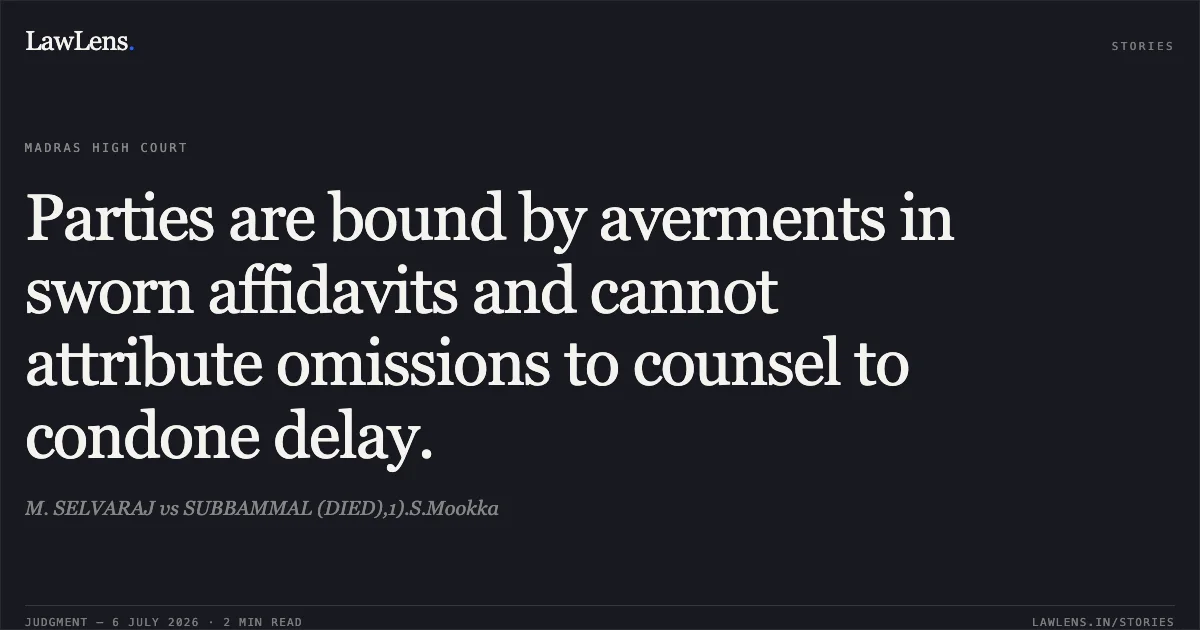
Source reference: p.62. Whether a party can disown omissions or deficiencies in a sworn affidavit by attributing them to the drafting of their advocate.
Source reference: p.5Law Applied
The court applied Section 5 of the Limitation Act, 1963, which requires a petitioner to establish "sufficient cause" for delay.
Source reference: p.6The court emphasized that the length of delay is secondary to the sufficiency and bona fides of the reasons provided.
Source reference: p.6The court reinforced the principle of the sanctity of pleadings and sworn affidavits, holding that litigants are bound by their contents to prevent changing stances for convenience.
Source reference: p.5Reasoning
The Court observed that while the first petitioner cited personal illness as the reason for delay, he failed to explain why the other five petitioners did not take steps to file the appeal within the limitation period.
Source reference: p.3-4The Court found it significant that the first petitioner avoided the witness box—thereby avoiding cross-examination on his health claims—while the third petitioner testified as P.W.1, proving that other petitioners were active in the litigation and the first petitioner was not solely in charge.
Source reference: p.4Regarding the petitioners' argument that deficiencies in the affidavit were the advocate's fault, the Court rejected this, holding that since the party signs the affidavit, they must take responsibility for its contents.
Source reference: p.5The Court reasoned that allowing parties to blame advocates for poor pleadings would defeat the objective of pleadings and strip sworn statements of their legal sanctity.
Source reference: p.5Holding
The High Court answered the issues in the negative and dismissed the Civil Revision Petition.
It held that the petitioners failed to properly explain the delay and that the First Appellate Court’s order contained no material irregularity.
Source reference: p.6The holding confirms that "sufficient cause" must be substantiated by all parties to an appeal if they are jointly seeking relief, and a party cannot escape the consequences of a lean or deficient affidavit by blaming their legal counsel.
Source reference: p.5-6All connected miscellaneous petitions were closed without costs.
Source reference: p.6Acts & Sections Cited
2 provisions across 2 statutes referred to in this judgment. Each provision opens on LawLens.
Code of Civil Procedure, 19081
Limitation Act, 19631
Original Court PDF
M. SELVARAJvsSUBBAMMAL (DIED),1).S.Mookka
Click to open original judgment
Original judgment, available to read, download and summarize on LawLens.in