Facts
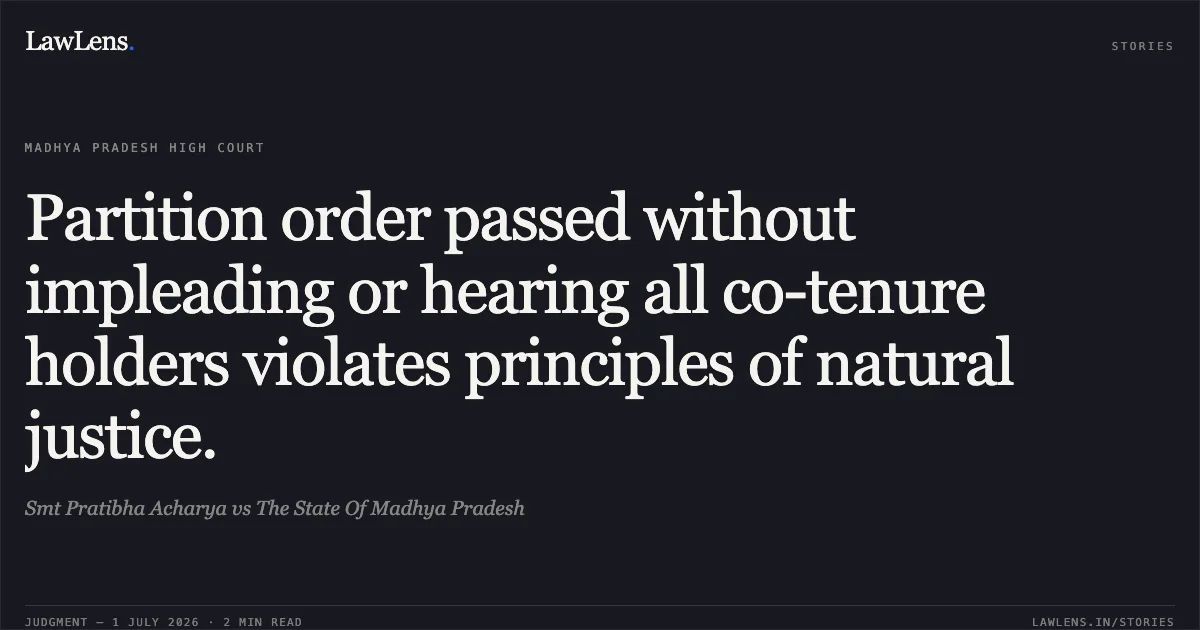
The petitioner filed a writ petition under Article 226 of the Constitution of India challenging the orders of the revenue authorities (Annexures P-1 & P-8) regarding land partition.
Source reference: Order, p. 1-2The petitioner contended that the Tehsildar, City Vidisha, passed partition orders without impleading all co-tenure holders or providing them an opportunity to be heard, despite previous remand directions requiring such participation.
Source reference: Order, p. 1-2The petitioner sought a fresh decision after proper impleadment of all stakeholders.
Source reference: Order, p. 1The matter was presented as being identical to a recently decided case, W.P. No. 10607 of 2026 (Smt. Sushila Dubey v. Brajgopal Dangi).
Source reference: para. 2Issues
1. Whether the impugned orders passed by the revenue authorities suffered from a violation of the principles of natural justice by failing to implead and hear all necessary co-tenure holders in partition proceedings.
Source reference: para. 8, 112. Whether the matter should be remanded for fresh adjudication in light of the binding precedent set in Smt. Sushila Dubey v. Brajgopal Dangi.
Source reference: para. 6, 7Law Applied
Principles of Natural Justice, specifically the right to a fair hearing (audi alteram partem), noting that the requirement to hear all co-owners in partition proceedings is a substantive necessity that goes to the root of the matter.
Source reference: para. 11Principle of Judicial Consistency, whereby identical controversies must be decided in accordance with established precedents, specifically referring to the coordinates bench's findings in Smt. Sushila Dubey v. Brajgopal Dangi.
Source reference: para. 2, 6Reasoning
The Court observed that the facts and legal issues in this petition were substantially identical to those in Smt. Sushila Dubey v. Brajgopal Dangi.
Source reference: para. 6In that precedent, the Court held that partition orders passed without ensuring the participation of all co-owners are unsustainable as they prejudice substantive rights.
Source reference: para. 11The Court found that the Additional Commissioner had reversed lower revenue orders without addressing whether necessary parties were afforded an effective opportunity of hearing or considering the effect of earlier remand directions.
Source reference: para. 10Since the respondents did not dispute the applicability of the Sushila Dubey case, the Court reasoned that the impugned order reflected a non-application of mind to material procedural aspects and violated natural justice.
Source reference: para. 4, 13Holding
The High Court allowed the writ petition and set aside the impugned order.
The Court held that any order passed in the absence of a necessary party in partition proceedings is liable to be quashed for violating natural justice.
Source reference: para. 11, 13The matter was remanded to the Additional Commissioner, Bhopal Division, with directions to decide the appeal afresh after affording all necessary parties an adequate opportunity to be heard and passing a reasoned order considering all contentions.
Source reference: para. 8, 14The Court clarified it expressed no opinion on the merits of the case.
Source reference: para. 9Original Court PDF
Smt Pratibha AcharyavsThe State Of Madhya Pradesh
Click to open original judgment
Original judgment, available to read, download and summarize on LawLens.in