Facts
The plaintiffs (appellants) instituted Title Suit No. 88 of 2001 seeking a partition of 2/3rd share in properties listed in Schedule-I and Schedule-II
Source reference: para. 4The parties are descendants of a common ancestor, Krishna Dayal Singh.
Source reference: para. 4The plaintiffs, sons of Rajendra Singh, alleged that after the death of an issueless uncle (Hardeo Singh), his share devolved to their father, totaling a 2/3rd interest
Source reference: para. 4They claimed that Schedule-II properties in Katihar, though recorded in the name of Ram Sumaro Devi, were acquired via joint family funds
Source reference: para. 4, 23The defendants (respondents) contended that the family had separated in 1976 and that Schedule-II properties were individual acquisitions
Source reference: para. 5While the defendants filed written statements, they did not lead any oral or documentary evidence during the trial
Source reference: para. 9, 12.iThe Trial Court dismissed the suit, finding no unity of title or possession
Source reference: para. 10Issues
1. Whether the plaintiffs/appellants established unity of title and unity of possession over the suit properties to entitle them to a decree of partition?
Source reference: para. 142. Whether the properties in Schedule-II were acquired using joint family funds?
Source reference: para. 6, 233. Whether the absence of evidence from the defendants entitles the plaintiffs to a decree as a matter of course?
Source reference: para. 17, 19Law Applied
The court primarily applied Section 101 of the Indian Evidence Act, which mandates that the burden of proof lies on the party asserting a legal right
Source reference: para. 17It relied on the principle from State of Madhya Pradesh v. Ushadevi (2015), stating that a plaintiff must succeed on the strength of their own case and cannot rely on the weakness of the defense
Source reference: para. 18The court applied Order VIII Rule 5 and Rule 10 of the CPC, as interpreted in Asma Lateef v. Shabir Ahmad (2024), which establishes that even if a defendant fails to contest or file a written statement, the plaintiff is not relieved of the obligation to prove their case to the court's satisfaction
Source reference: para. 19, 21The court also noted that long-standing separate transactions by family members constitute strong evidence of a prior partition
Source reference: para. 13.iii, 26Reasoning
The court examined whether the plaintiffs discharged their initial burden of proving the joint nature of the properties.
Source reference: no citationRegarding Schedule-II, the court noted that while the R.S. Khatian (Exhibit-9) showed joint names at one point, subsequent registered sale deeds (Exhibit-1 series) revealed that both branches of the family had been transferring portions of the land to third parties independently over a long period
Source reference: para. 24, 26The court found that the plaintiffs’ oral evidence (PW-1 to PW-3) was general and failed to prove the existence of a "joint family nucleus" sufficient to acquire the Katihar properties
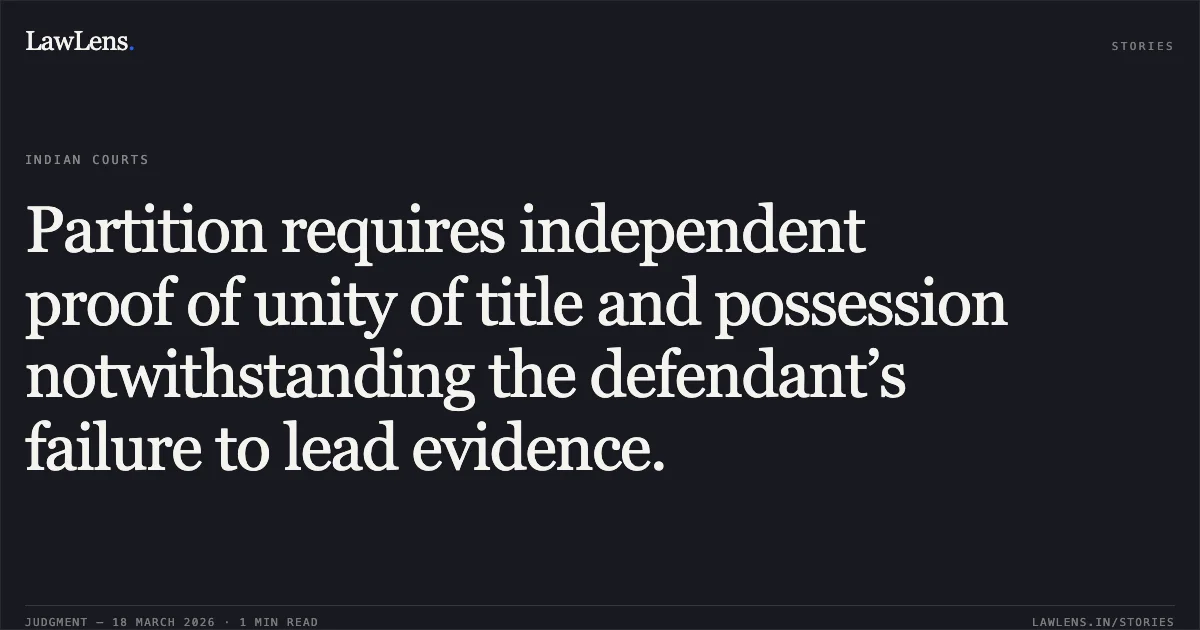
Source reference: para. 25Critically, the court rejected the appellants' argument that the defendants' failure to lead evidence (unrebutted testimony) necessitated a decree in the plaintiffs' favor.
Source reference: para. 19-21It held that under the CPC and the Evidence Act, the court must still satisfy itself of the claim's validity
Source reference: para. 19-21The history of separate dealings with the property strongly supported the inference that a prior oral partition or family arrangement had already severed the joint status
Source reference: para. 24, 26Holding
The High Court dismissed the appeal and upheld the Trial Court's judgment dated 26.02.2011
It held that the plaintiffs failed to establish unity of title and unity of possession over the suit properties
Source reference: para. 29The court concluded that the plaintiffs did not prove that Schedule-II properties were joint family assets or that they maintained a joint status after the admitted separation in mess and business
Source reference: para. 26The findings of the Trial Court were confirmed as being based on a proper appraisal of the evidence on record
Source reference: para. 27, 31Acts & Sections Cited
2 provisions across 1 statute referred to in this judgment. Linked provisions open on LawLens.
Indian Evidence Act, 18722
Original Court PDF
Nageshwar Pd. SinghvsJugal Kishor Singh
Click to open original judgment
Original judgment, available to read, download and summarize on LawLens.in