Facts
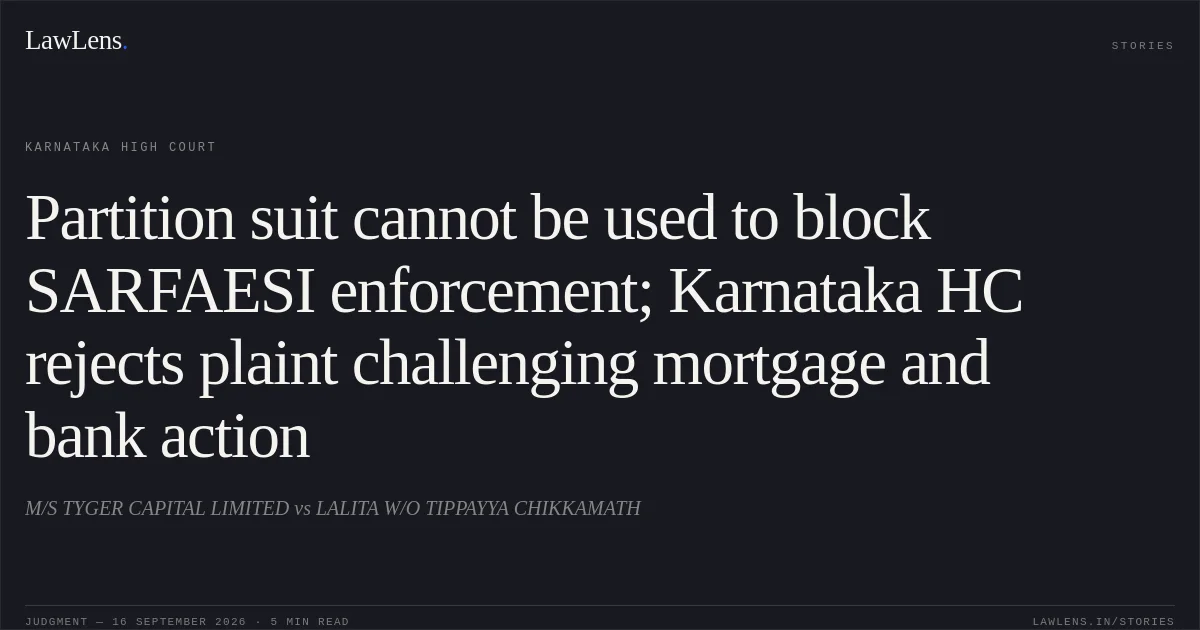
The petitioner-financial institution challenged the order dated 09.09.2025 by which the Senior Civil Judge, Yellapur, rejected its application under Order VII Rule 11(d) read with Section 151 CPC and Section 34 of the SARFAESI Act seeking rejection of the plaint in O.S. No. 44/2024.
Source reference: para. 1The respondents had instituted a suit claiming shares in the suit property, partition and separate possession, declaration that a mutation entry was illegal, and a declaration that the mortgage created in favour of the petitioner was illegal, null, void and not binding upon them.
Source reference: para. 77The plaint alleged that one co-sharer had created a mortgage on the basis of an allegedly fraudulent relinquishment deed and mutation entry, and that the Bank had acted fraudulently and attempted to interfere with the plaintiffs’ possession pursuant to the mortgage.
Source reference: paras. 81–87The petitioner contended that the suit was, in substance, a challenge to SARFAESI measures and was therefore barred by Section 34, with the respondents’ remedy lying before the Debts Recovery Tribunal under Section 17.
Source reference: paras. 63–67Issues
1. Whether Section 34 of the SARFAESI Act barred the jurisdiction of the Civil Court in a suit concerning mortgaged property instituted by family members or co-sharers.
Source reference: para. 5(i)2. Whether a suit which, in substance, challenges measures taken or proposed under Section 13(4) of the SARFAESI Act is maintainable before the Civil Court.
Source reference: para. 5(ii)3. Whether a non-alienating coparcener or co-sharer asserting an independent pre-existing right and seeking partition and separate possession stands on a different footing from a plaintiff directly challenging SARFAESI measures.
Source reference: para. 5(iii)4. Whether a prayer declaring that a mortgage is not binding on the plaintiff’s share automatically attracts the bar under Section 34.
Source reference: para. 5(iv)5. Whether the plaint could be rejected under Order VII Rule 11(d) CPC when, on a meaningful reading, it disclosed a substantive civil relief within the jurisdiction of the Civil Court.
Source reference: para. 5(v)Law Applied
Section 9 CPC confers broad jurisdiction on Civil Courts over suits of a civil nature, subject to express or implied statutory exclusion.
Source reference: paras. 6–7Sections 13(4) and 17 of the SARFAESI Act provide the secured creditor’s enforcement measures and the remedy before the DRT for any person aggrieved by those measures; Section 34 bars Civil Court jurisdiction over matters which the DRT or DRAT is empowered to determine, while Section 35 gives the Act overriding effect.
Source reference: paras. 8–10Under Mardia Chemicals Ltd. v. Union of India, (2004) 4 SCC 311, Civil Court jurisdiction is excluded in matters falling within the SARFAESI mechanism, subject to limited exceptions.
Source reference: paras. 10–12Under Jagdish Singh v. Heeralal, (2014) 1 SCC 479, the expression “any person” in Section 17 includes persons other than the borrower, and challenges to Section 13(4) measures must be brought before the DRT.
Source reference: paras. 13–14M/s. Sree Anandhakumar Mills Ltd. v. M/s. Indian Overseas Bank, Civil Appeal Nos. 7214–7216 of 2012, confirms that a partition suit cannot be used to obstruct SARFAESI measures.
Source reference: para. 15However, Central Bank of India v. Prabha Jain, 2025 SCC OnLine SC 121, clarifies that Section 34 is not an omnibus bar against every partition suit involving secured property, particularly because the DRT lacks jurisdiction to grant a decree of partition; an independent claim for share and partition may remain within Civil Court jurisdiction.
Source reference: paras. 20–26, 33–36Under Order VII Rule 11(d) CPC, the plaint must be examined as a whole and rejected only if the suit appears from its own averments to be barred by law; the Court must identify the real nature of the controversy rather than rely on the form or nomenclature of the relief.
Source reference: paras. 44–48A plaint cannot ordinarily be rejected in part where a substantive civil relief survives, but the entire plaint is liable to rejection where its dominant purpose is to challenge SARFAESI enforcement.
Source reference: paras. 49–55Reasoning
The Court distinguished between a genuine partition action, in which a non-borrower co-sharer seeks determination of an independent share and partition while leaving the secured creditor’s enforcement rights intact, and a suit using partition as a device to invalidate the mortgage or restrain SARFAESI action.
Source reference: paras. 27–32, 37–43Although the respondents had claimed partition and separate possession, prayers (c) and (d) sought a declaration that the mortgage itself was illegal, null and void and a permanent injunction restraining the Bank from interfering with the property.
Source reference: paras. 77–80Read with the allegations that the Bank had fraudulently created the mortgage, entered the property and threatened dispossession, these prayers showed that the dominant controversy was the validity of the mortgage and the Bank’s consequential enforcement action, rather than merely the respondents’ independent civil shares.
Source reference: paras. 81–95The Court held that the respondents could not obtain through a Civil Court suit relief which effectively nullified or restrained measures falling within Section 13(4). Their status as family members or alleged co-sharers did not confer Civil Court jurisdiction where the substantive grievance was against the secured creditor’s statutory action.
Source reference: paras. 96–110The decision in Central Bank of India v. Prabha Jain did not save the suit because the mortgage-related reliefs were not incidental to partition; they formed an integral and dominant part of the cause of action.
Source reference: paras. 98–104Holding
The Court held that Section 34 of the SARFAESI Act does not automatically bar every suit concerning secured property or every genuine claim for partition, share and separate possession. However, where the suit substantially challenges the mortgage and seeks to restrain or nullify the secured creditor’s SARFAESI measures, the remedy lies before the DRT under Section 17 and the Civil Court’s jurisdiction is barred.
The Civil Revision Petition was allowed; the order dated 09.09.2025 was set aside; the petitioner’s application under Order VII Rule 11(d) CPC and Section 34 of the SARFAESI Act was allowed; and the plaint in O.S. No. 44/2024 was rejected as barred by Section 34.
Source reference: para. 118The Court expressly left open the merits of the respondents’ alleged share, the relinquishment deed, mutation entry, mortgage and SARFAESI measures, and permitted the Bank to proceed under the SARFAESI Act in accordance with law.
Source reference: para. 118(v)–(vi)Acts & Sections Cited
7 provisions across 2 statutes referred to in this judgment. Each provision opens on LawLens.
Code of Civil Procedure, 19083
Securitisation and Reconstruction of Financial Assets and Enforcement of Security Interest Act, 20024
Original Court PDF
M/S TYGER CAPITAL LIMITEDvsLALITA W/O TIPPAYYA CHIKKAMATH
Click to open original judgment
Original judgment, available to read, download and summarize on LawLens.in
![Frequent premature transfers do not warrant judicial interference absent mala fides or statutory violation.. mukhtar ahmad khuroo vs REVENUE DEPARTMENT. CAT - ['Srinagar']. LawLens](/stories/thumbnails/frequent-premature-transfers-do-not-warrant-judicial-interference-absent-mala-fides-or-sta-4c2b6d056d6242a5b5b0063672599c7e.webp)