Facts
On 10 August 2018, Teena Makkar and her sister-in-law, Honey Makkar, were walking near Arya Samaj Mandir, Subhash Nagar, New Delhi. A truck bearing registration no. DL-1M-3658, owned by the Municipal Corporation of Delhi and driven by Phool Kumar, allegedly hit Teena, causing her to fall and be run over by the truck’s rear wheel.
Source reference: paras. 2–5She died the same day at Deen Dayal Upadhyay Hospital. An FIR under Sections 279 and 304A IPC was registered on Honey Makkar’s complaint, and a Detailed Accident Report and chargesheet were filed against the driver.
Source reference: paras. 2–5The MACT awarded Rs.1,16,42,016 with interest at 9% per annum to the deceased’s legal representatives.
Source reference: paras. 1, 6–8MCD appealed, disputing negligence, reliance on Honey Makkar’s testimony, absence of CCTV footage, contributory negligence, and the computation of compensation.
Source reference: paras. 1, 6–8Issues
Whether the evidence of Honey Makkar, an alleged interested eyewitness, together with the FIR, medical records, site plan and chargesheet, established that the accident was caused by the rash and negligent driving of MCD’s truck.
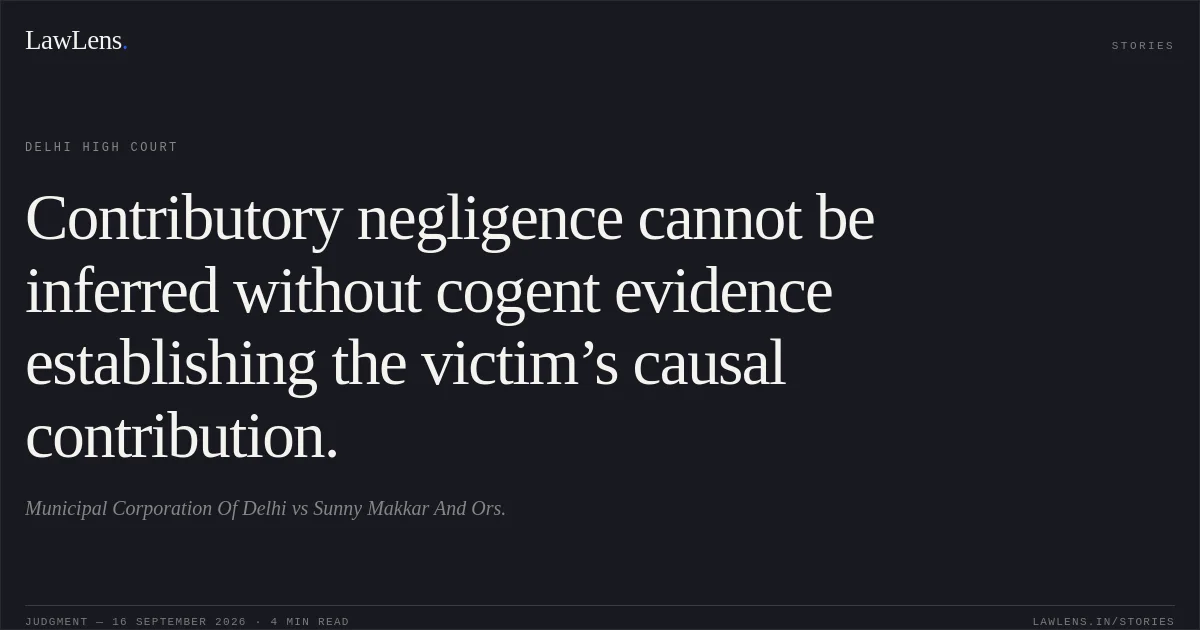
Source reference: paras. 9–21, 33–37Whether contributory negligence could be attributed to the deceased merely because she was allegedly crossing near a parked car in a crowded area.
Source reference: paras. 22–26, 33–38Whether the MACT correctly assessed the deceased’s income, future prospects, personal-expense deduction and non-pecuniary damages.
Source reference: paras. 39–45Law Applied
Proceedings before the MACT are inquisitorial in nature, and negligence is determined on the touchstone of preponderance of probabilities rather than proof beyond reasonable doubt.
Source reference: para. 36The testimony of a related or interested witness is not liable to be rejected merely on that ground; its credibility must be assessed with reference to cross-examination and corroborative material, including the FIR, medical records and site plan.
Source reference: paras. 14–17The doctrine of res ipsa loquitur may apply where the accident, such as a heavy vehicle running over a pedestrian, ordinarily would not occur absent negligence, shifting the evidentiary burden to the party controlling the vehicle.
Source reference: para. 36Under Municipal Corporation of Greater Bombay v. Laxman Iyer, contributory negligence requires negligent conduct of the victim that materially contributed to the accident or injury, and the loss may be apportioned only where such negligence is proved.
Source reference: para. 23The burden of proving contributory negligence lies on the party alleging it and cannot be discharged through conjecture or presumption.
Source reference: paras. 24–25Section 134 of the Motor Vehicles Act, 1988 imposes duties on a driver following an accident, while Rule 8 of the Rules of the Road Regulations, 1989 and Regulations 5 and 39 of the Motor Vehicles (Driving) Regulations, 2017 require drivers to exercise due care, slow down near junctions and pedestrian crossings, and protect vulnerable road users.
Source reference: paras. 27–29Compensation was to be assessed in accordance with Pranay Sethi, Sarla Verma and related principles governing future prospects, deductions and conventional heads.
Source reference: paras. 43–45Reasoning
The Court found Honey Makkar’s testimony credible and materially corroborated by the FIR lodged on the date of the accident, the MLC recording that the deceased had been run over by a truck, the nature and location of her injuries, the post-mortem report, and the site plan.
Source reference: paras. 9–17, 20–21The absence of fresh damage in the mechanical inspection report was immaterial because the collision was between the truck and a pedestrian, not two vehicles.
Source reference: para. 18The alleged contradiction regarding whether the truck approached from the front or struck the deceased from behind was insufficient to displace the consistent core account of the accident.
Source reference: paras. 11–17The Court further held that a truck driver must anticipate pedestrians and maintain control, particularly near a junction and in a crowded urban setting; MCD led no evidence rebutting the inference of negligence or establishing that the deceased’s conduct caused or contributed to the accident.
Source reference: paras. 22, 26, 33–38The deceased’s income was supported by income-tax returns, evidence from the Income Tax Department, corporate records and remuneration documents.
Source reference: paras. 39–45The MACT therefore correctly adopted annual income of Rs.7,70,749, applied 40% future prospects, deducted one-third for personal expenses and awarded conventional damages consistently with applicable precedent.
Source reference: paras. 39–45Holding
The High Court dismissed MCD’s appeal, holding that the truck driver’s rash and negligent driving caused the accident and that no contributory negligence had been established against the deceased.
The MACT award of Rs.1,16,42,016 with 9% interest was upheld, including the calculation of loss of dependency and non-pecuniary damages.
Source reference: paras. 43–46MCD was directed to deposit the entire compensation amount with accrued interest before the MACT within four weeks, if not already deposited, for disbursement in accordance with the MACT’s directions.
Source reference: para. 47Any statutory deposit was to be refunded only upon such deposit, and the pending applications were rendered infructuous.
Source reference: paras. 48–50Acts & Sections Cited
6 provisions across 3 statutes referred to in this judgment. Each provision opens on LawLens.
Indian Penal Code, 18601
Motor Vehicles Act, 19884
Probation of Offenders Act, 19581
Original Court PDF
Municipal Corporation Of DelhivsSunny Makkar And Ors.
Click to open original judgment
Original judgment, available to read, download and summarize on LawLens.in