Facts
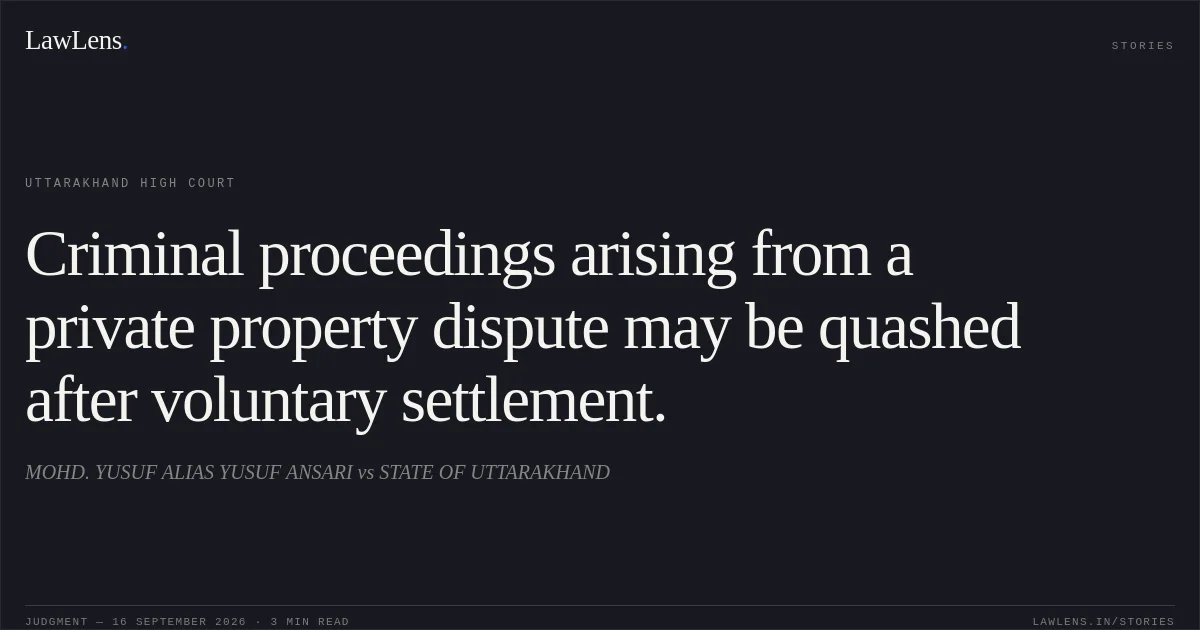
The petitioner sought quashing of FIR/Case Crime No. 0404 of 2020, registered at Police Station Patel Nagar, District Dehradun, for offences under Sections 420, 328, 504, 506, 323 and 120-B of the IPC.
Source reference: para. 4–5The FIR had been registered pursuant to an order under Section 156(3) Cr.P.C.
Source reference: para. 4–5During the pendency of the writ petition, the petitioner and respondent no. 2/complainant entered into an amicable settlement and filed a compounding application supported by separate affidavits, asserting that the compromise was voluntary and free from coercion, pressure, inducement or undue influence.
Source reference: para. 7The complainant appeared through video conferencing, was identified by counsel, confirmed the settlement, and stated that he was no longer desirous of prosecuting the petitioner.
Source reference: para. 8The petitioner also relied upon an earlier order of a Coordinate Bench quashing proceedings against co-accused persons on the basis of the same compromise.
Source reference: para. 5Issues
Whether the High Court could quash FIR/Case Crime No. 0404 of 2020 and the consequential criminal proceedings in exercise of its jurisdiction under Article 226 of the Constitution on the basis of an amicable settlement between the parties?
Source reference: para. 4–5, 12–14Whether continuation of the criminal proceedings, despite the complainant’s voluntary settlement and unwillingness to prosecute, would amount to an abuse of the process of law where the possibility of conviction was remote and bleak?
Source reference: para. 11–13Law Applied
The Court exercised its extraordinary jurisdiction under Article 226 of the Constitution of India to consider quashing of the FIR and consequential proceedings.
Source reference: para. 4–5The FIR involved offences under Sections 420, 328, 504, 506, 323 and 120-B IPC, and had originated from proceedings under Section 156(3) Cr.P.C.
Source reference: para. 4–5The Court relied on Gian Singh v. State of Punjab, (2012) 10 SCC 303, and Narinder Singh v. State of Punjab, (2014) 6 SCC 466, which recognise that criminal proceedings involving predominantly private or civil disputes may be quashed where the parties have genuinely settled the matter, the possibility of conviction is remote and bleak, and continuation of the prosecution would constitute an abuse of the process of law or cause unnecessary oppression and prejudice.
Source reference: para. 12Reasoning
The Court verified the compromise through the affidavits and the complainant’s statement recorded during video conferencing.
Source reference: para. 7–11It found that the dispute was essentially private in nature and had been amicably resolved voluntarily, with the complainant expressly stating that he no longer wished to prosecute the petitioner.
Source reference: para. 7–11Applying the principles in Gian Singh and Narinder Singh, the Court concluded that the settlement substantially diminished the likelihood of conviction and that continuation of the prosecution would serve no meaningful purpose.
Source reference: para. 11–13Although the Court noted that the dispute arose from a property dispute, it also referred to the matter as emanating from an unfortunate accident; in either event, its decisive considerations were the private character of the dispute, the genuine settlement, the complainant’s unwillingness to pursue the case, and the remote possibility of conviction.
Source reference: para. 11–13Holding
The High Court allowed the writ petition and quashed FIR/Case Crime No. 0404 of 2020, registered at Police Station Patel Nagar, District Dehradun, along with all proceedings arising from it.
The compounding application and all pending applications were consequently disposed of.
Source reference: para. 15–16Acts & Sections Cited
6 provisions across 2 statutes referred to in this judgment. Each provision opens on LawLens.
Indian Penal Code, 18605
Code of Criminal Procedure, 19731
Original Court PDF
MOHD. YUSUF ALIAS YUSUF ANSARIvsSTATE OF UTTARAKHAND
Click to open original judgment
Original judgment, available to read, download and summarize on LawLens.in