01Facts
The plaintiffs, widows of Dasegowda and Govindaraju, sued in O.S. No. 28/2007 for partition of 15 items of suit properties, claiming joint family status and a one-third share each
¶ 2The defendants (widow and son of Venkategowda) pleaded an earlier partition and that certain items were the self-acquired properties of Venkategowda
¶ 3The trial court decreed the suit only for Items 1, 2, 9 and 10 and dismissed it for Items 3–8, 11, 14 and 15
¶ 6The first appellate court (R.A. No. 5/2014) additionally declared Items 12 and 13 joint family property, but otherwise affirmed dismissal
¶ 6, 34Defendant No. 1 (Chandramma) died during the pendency of the suit, and her legal representatives were not brought on record. Children of Govindaraju and of Venkategowda were also not impleaded
¶ 9–10The first appellate court refused (a) remand to bring the LRs on record and (b) cross-examination of DW2 and DW3, which had not been conducted before the trial court, and rejected I.A. No. 7 under Order XLI Rule 27 CPC for about 29 documents
¶ 11, 13, 15The respondents were served but did not contest the appeal
¶ 702Issues
i.1. Whether the first appellate court was justified in refusing the appellants an opportunity to bring the LRs of deceased defendant No. 1 on record and remit the matter to the trial court.
¶ 8(1) · ¶ 11–12ii.2. Whether the first appellate court was justified in rejecting I.A. No. 7 under Order XLI Rule 27 CPC for production of additional documents.
¶ 8(2) · ¶ 15–1603Law Applied
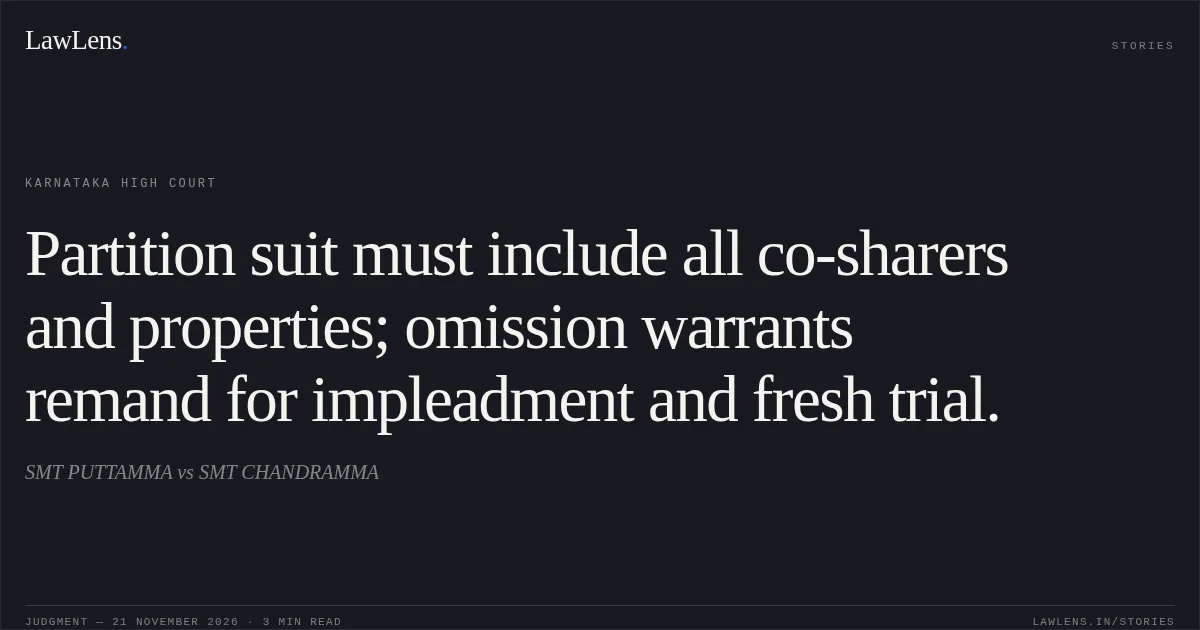
A suit for partition must include all parties and all properties, failing which it is not maintainable.
¶ 12Remand of a suit is not to be ordered casually, only in rare cases to secure a just decision or to give parties an opportunity, and a party at fault cannot seek remand.
¶ 11, quoting the first appellate court's reasoning, which the High Court found unsustainableWhen deciding whether to admit additional documents under Order XLI Rule 27 CPC, the merits, demerits, and evidentiary value of those documents are not relevant.
¶ 15A justice-oriented approach applies in deciding whether a party should be allowed to cross-examine witnesses whose evidence is material.
¶ 14Provisions in the judgment · 1 · Linked ones open on LawLens
Code of Civil Procedure, 1908 Section 100
04Reasoning
The first appellate court refused remand solely because the plaintiffs had not diligently prosecuted the suit or impleaded all necessary parties
¶ 11The High Court held that this reasoning failed to account for the settled position that a partition suit without all parties and properties is not maintainable. This made impleadment of the LRs of the deceased defendant and the omitted branches necessary for a proper decision, so refusal of the opportunity was an error
¶ 12On cross-examination, the evidence of DW2 and DW3 was material to the contested issues, and the first appellate court should have allowed one more opportunity to cross-examine them
¶ 13–14On I.A. No. 7, the first appellate court wrongly examined the merits of the documents, which relate to the parties and suit properties
¶ 15Because the trial court had found Items 3–8, 11, 14 and 15 to be self-acquired properties of the defendants, the plaintiffs needed an opportunity to establish their claim through these documents and related evidence
¶ 16Given these defects, both lower court judgments were held unsustainable and a remand was warranted
¶ 16–1705Holding
Both additional substantial questions of law were answered in favour of the appellants
¶ 16The appeal is allowed, and the judgments of the trial court (O.S. No. 28/2007) and first appellate court (R.A. No. 5/2014) are set aside. The documents filed with I.A. No. 7 are received on record, and the entire record is remitted to the trial court for fresh disposal. The appellants are given liberty to cross-examine DW2 and DW3 if they are alive and available, subject to the process of the court, on 14.12.2026, and to seek impleadment of all LRs of Venkategowda, Dasegowda and Govindaraju. The trial court is directed to issue notice to all parties and dispose of the suit expeditiously, preferably within one year from service of notice. All rival contentions on merits are kept open.
¶ 18Original Court PDF
SMT PUTTAMMAvsSMT CHANDRAMMA
Click to open original judgment
Original judgment, available to read, download and summarize on LawLens.in



