Facts
The plaintiff (Appellant) filed a suit for partition claiming a 1/7th share in properties belonging to the late Kuruviyan alias Munusamy.
Source reference: p.5The plaintiff claimed to be the son of Munusamy through his first wife, the 7th defendant.
Source reference: p.5Defendants 1 to 5 (Respondents) are sons of Munusamy through his second wife, the 6th defendant.
Source reference: p.4The defendants denied the plaintiff’s paternity and the marriage of the 7th defendant to Munusamy, further propounding an unregistered Will (Ex-B.2) dated September 21, 1988, in their favor.
Source reference: p.6The Trial Court decreed the suit in favor of the plaintiff, but the First Appellate Court reversed it, upholding the Will.
Source reference: p.8The plaintiff preferred this Second Appeal challenging the character of the property and the validity of the Will.
Source reference: no citationIssues
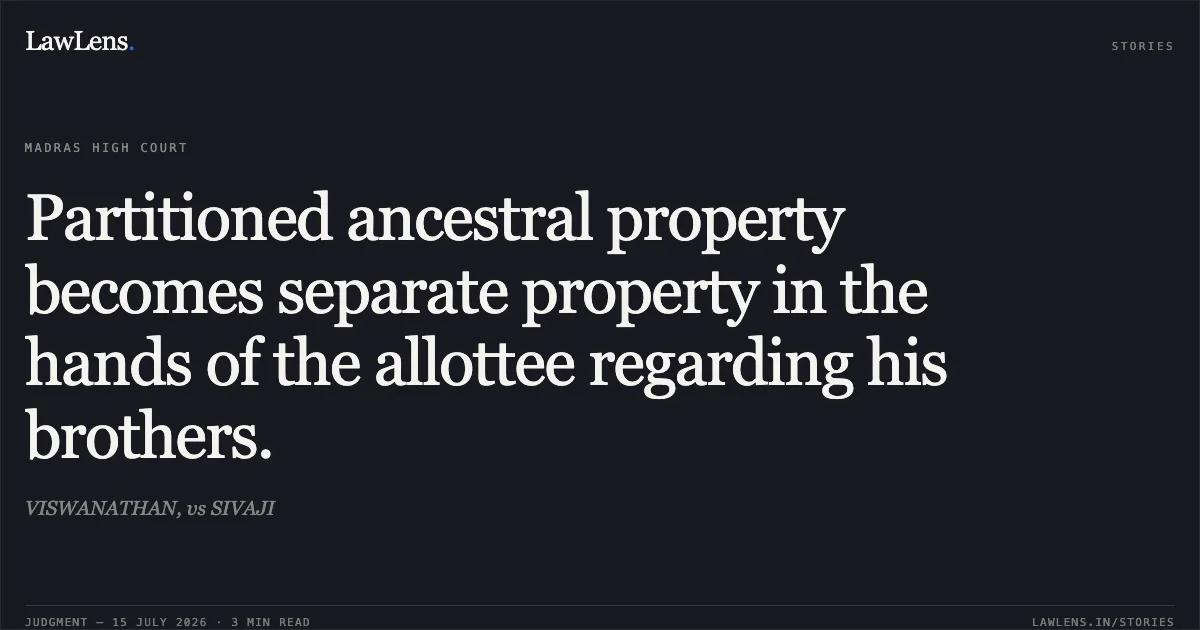
1. Whether the lower Appellate Court erred in holding that, following a partition among brothers, the character of ancestral property becomes absolute/separate property under Hindu Law.
Source reference: p.10 / para. 92. Whether the lower Appellate Court erred in holding that the unregistered Will (Ex-B.2) was properly proved as per law.
Source reference: p.10 / para. 93. Whether the respondents could challenge an adverse finding regarding the legitimacy of the plaintiff's mother's marriage without filing a cross-objection.
Source reference: p.10 / para. 15Law Applied
The court applied Section 100 of the CPC regarding the scope of Second Appeals.
Source reference: p.4Order XLI Rule 22 & 33 of the CPC allows a respondent to defend a decree by attacking adverse findings without filing a cross-objection if the final decree is entirely in their favor.
Source reference: p.17-20 / para. 16-18Section 63 of the Indian Succession Act, 1925, and Section 68 of the Indian Evidence Act, 1872, dictate the requirements for proving due execution and attestation of a Will.
Source reference: p.29 / para. 32The "suspicious circumstances" doctrine established in H. Venkatachala Iyengar v. B.N. Thimmajamma, requires the propounder to remove all legitimate doubts regarding the testator's sound mind and voluntary action.
Source reference: p.30-37 / para. 33-34Under Section 8 of the Hindu Succession Act, 1956, the court determined the devolution of separate property for a male Hindu dying intestate.
Source reference: p.38 / para. 36Reasoning
The Court first held that the defendants were entitled to challenge the finding on the 7th defendant’s marriage without a cross-objection because the First Appellate Court had dismissed the suit in its entirety.
Source reference: p.21On merits, the Court upheld the finding that the 7th defendant was the first wife and the plaintiff was the legitimate son, relying on public documents like Voter Lists (Ex-A.8) and Suit Registers (Ex-A.7).
Source reference: p.23-25Regarding the property's character, despite oral admissions by D.W.1, the Court found no documentary evidence of ancestral origin and, based on the plaintiff's own pleadings, treated the properties as the separate property of Munusamy.
Source reference: p.26-27The Court found the Will (Ex-B.2) surrounded by "suspicious circumstances": the testator was elderly, severely ill, and illiterate; the beneficiaries (defendants 1 and 6) actively participated in its execution; and it remained unregistered despite the proximity to the Sub-Registrar’s office.
Source reference: p.28-29The Court concluded that the defendants failed to prove the testator was in a "sound and disposing state of mind" at the time of execution.
Source reference: p.37Holding
The High Court held that Ex-B.2 (Will) was not proved satisfactorily and was void due to unremoved suspicious circumstances.
The High Court allowed the Second Appeal in part, setting aside the First Appellate Court’s judgment, and granting a preliminary decree for partition (1/7th share each) and a limited permanent injunction.
Source reference: p.39-40 / para. 36.2 & 37.1Acts & Sections Cited
5 provisions across 4 statutes referred to in this judgment. Each provision opens on LawLens.
Code of Civil Procedure, 19081
Indian Succession Act, 19252
TAMIL NADU SURVEY AND BOUNDARIES ACT, 19231
Hindu Succession Act, 19561
Original Court PDF
VISWANATHAN,vsSIVAJI
Click to open original judgment
Original judgment, available to read, download and summarize on LawLens.in