Facts
The complainant had taken premises at Abhilasha Business Center, Ahmedabad, on leave-and-licence terms under an agreement dated 20 June 2019, containing a 12-month locking period. The licence fee was fixed at ₹3,75,000 per month plus GST, and the complainant alleged that the partnership firm vacated the premises on 10 December 2019 before expiry of the locking period, thereby becoming liable for unpaid licence fees, TDS, municipal tax and GST amounting in aggregate to approximately ₹30,54,174
Source reference: paras. 3–3.1; pp. 2–3Towards the alleged liability, cheques were issued on behalf of the firm; the cheques were dishonoured for insufficiency of funds and alteration requiring authentication. Statutory notices were issued on 2 March 2020 and served on 6 March 2020, but payment was not made, resulting in complaints under Section 138 of the Negotiable Instruments Act, 1881, being Criminal Case Nos. 40709 and 40611 of 2020
Source reference: paras. 3.2–3.3; p. 3The applicants, who were partners but not signatories to the cheques, invoked Section 482 CrPC seeking quashing of the complaints and consequential proceedings. They contended that they were “sleeping partners,” were not involved in the firm’s day-to-day affairs, and that the complaints lacked specific averments showing that they were in charge of or responsible for the conduct of the firm’s business
Source reference: paras. 4–4.2; pp. 4–5Issues
Whether non-signatory partners of a partnership firm can be prosecuted under Sections 138 and 141 of the Negotiable Instruments Act merely because they were partners, in the absence of specific averments that they were in charge of or responsible for the conduct of the firm’s business
Source reference: para. 6.1; p. 6Whether the applicants’ asserted status as “sleeping partners” raised a ground for quashing the complaints under Section 482 CrPC at the pre-trial stage
Source reference: paras. 6.1, 6.6–6.7; pp. 6, 19–20Whether the principles requiring specific averments regarding a person’s role in a company, as stated in S.M.S. Pharmaceuticals Ltd. v. Neeta Bhalla, applied in the same manner to partners of a partnership firm
Source reference: para. 6.8; pp. 20–21Law Applied
The Court applied Section 482 of the Code of Criminal Procedure, 1973, concerning the High Court’s inherent jurisdiction to prevent abuse of process; Sections 138 and 141 of the Negotiable Instruments Act, 1881, concerning cheque dishonour and liability of persons associated with a firm; and Sections 25 and 26 of the Indian Partnership Act, 1932, under which partners are jointly and severally liable for acts of the firm and the firm is liable for wrongful acts of a partner committed in the ordinary course of business
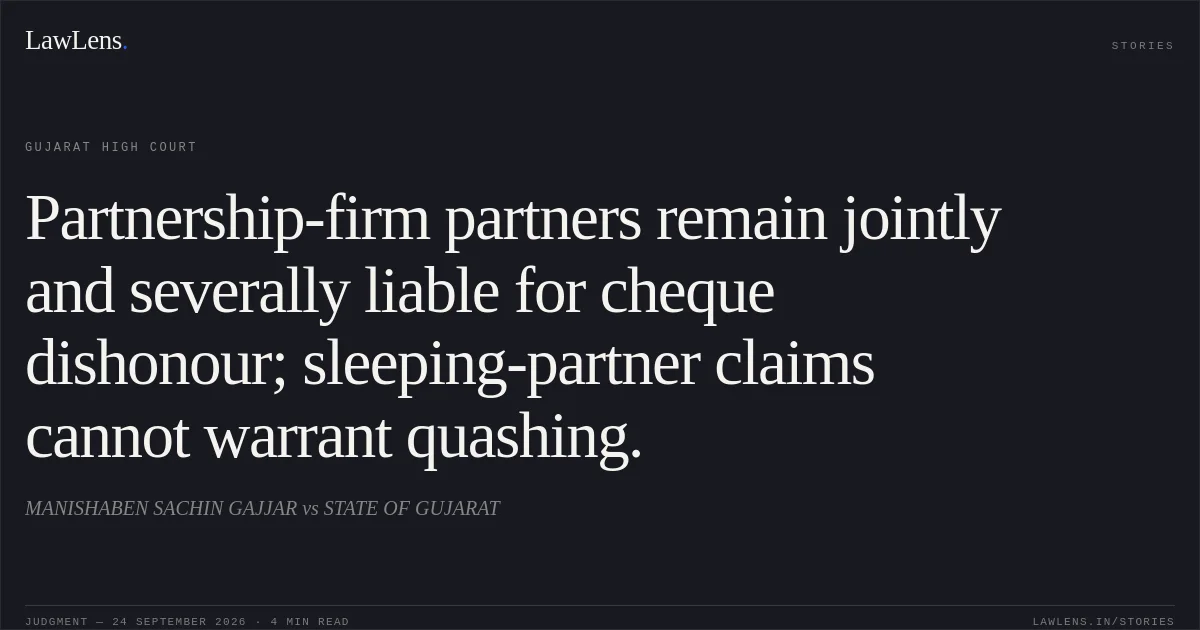
Source reference: paras. 6.2, 6.7; pp. 7–16, 20Relying principally on Dhanasingh Prabhu v. Chandrasekar, the Court held that a partnership firm is not a separate legal entity in the same manner as a company and that, in the context of cheque dishonour, the liability of partners is joint and several rather than merely vicarious; partners may therefore be proceeded against even where the cheque is issued in the firm’s name
Source reference: paras. 6.2, 6.5; pp. 7–16, 19The Court also considered Sonali Verma v. State of U.P., which held that partners could not avoid prosecution at the summons stage by relying on their alleged non-involvement in the firm’s affairs
Source reference: paras. 6.3–6.4; pp. 16–18The applicants’ reliance on S.M.S. Pharmaceuticals Ltd. v. Neeta Bhalla and Jyotsnaben Sureshbhai Rathi v. Shri Ganesh Khand Sahkari Mandli Ltd. was not accepted as determinative in view of the Court’s understanding of the later decision in Dhanasingh Prabhu and the distinction between companies and partnership firms
Source reference: para. 6.8; pp. 20–21Reasoning
The Court found that the applicants’ status as partners was prima facie established, whereas their assertion that they were sleeping partners was unsupported by sufficient material and constituted a disputed factual defence
Source reference: paras. 6.6–6.7; pp. 19–20Applying Dhanasingh Prabhu, the Court reasoned that a partnership firm has no legal existence independent of its partners and that partners’ liability for the firm’s business obligations is joint and several. Consequently, the absence of signatures on the cheques or specific averments regarding day-to-day management did not, in the Court’s view, justify quashing the proceedings at the threshold
Source reference: paras. 6.2, 6.5–6.6; pp. 7–16, 18–19The Court distinguished the rule in S.M.S. Pharmaceuticals, observing that it primarily concerned the vicarious liability of directors of a company, whereas the present proceedings involved partners of a partnership firm
Source reference: para. 6.8; pp. 20–21Whether the applicants lacked knowledge, exercised due diligence, or were not responsible for the firm’s affairs was held to be a matter for consideration during trial, particularly because the applicants had raised only a bald assertion that they were sleeping partners
Source reference: para. 6.7; p. 20Holding
The Court answered the issues against the applicants. It held that the applicants’ non-signatory status and claim of being sleeping partners did not warrant quashing the complaints at the Section 482 CrPC stage, since they were prima facie partners of the firm and their liability could be examined during trial
Criminal Misc. Applications Nos. 11128 and 11143 of 2022 were accordingly rejected; the notices were discharged and any interim relief was vacated. The trial court was directed to proceed on the merits and in accordance with law, uninfluenced by the rejection of the quashing applications
Source reference: para. 7–7.1; p. 21Acts & Sections Cited
9 provisions across 4 statutes referred to in this judgment. Each provision opens on LawLens.
Code of Criminal Procedure, 19732
Negotiable Instruments Act, 18813
Indian Partnership Act, 19322
Bharatiya Nagarik Suraksha Sanhita, 20232
Original Court PDF
MANISHABEN SACHIN GAJJARvsSTATE OF GUJARAT
Click to open original judgment
Original judgment, available to read, download and summarize on LawLens.in