Facts
The Petitioner, the biological mother of a minor son, sought a writ of mandamus directing the Respondent authorities to issue/renew her son’s passport without insisting on the father’s consent
Source reference: para 1The Petitioner’s marriage was dissolved by a decree of divorce dated 23.06.2022 under Section 13-B of the Hindu Marriage Act, which granted her legal custody and recorded the father’s "no objection" to the same
Source reference: para 4, 8The child previously held a passport valid until 2022
Source reference: para 5However, the Passport Officer rejected the renewal application solely due to the non-submission of the father’s consent, despite the Petitioner’s declaration under Annexure ‘C’ that the father’s whereabouts were unknown
Source reference: para 5-6Issues
1. Whether, in the facts and circumstances of the case, the respondent authorities were justified in insisting upon the consent of the father for issuance of a passport to the minor child
Source reference: para 82. Whether the refusal to process a minor's passport application due to lack of parental consent, despite undisputed legal custody, violates Articles 14 and 21 of the Constitution of India
Source reference: para 4, 18Law Applied
The Court primarily applied Section 5 of the Passports Act, 1967, regarding applications by guardians, and Section 6, which exhaustively lists the grounds for refusal of a passport
Source reference: para 9, 18It relied on the Passport Rules, 1980 (Schedule III) and the Passport Manual, specifically Annexure ‘C’, which allows for a declaration by a single parent in cases where the other parent's consent cannot be obtained
Source reference: para 9, 14-15The Court followed the precedent of Maneka Gandhi v. Union of India (1978), establishing that the right to travel abroad is a facet of personal liberty under Article 21
Source reference: para 6, 12and cited several High Court decisions (Bombay, Kerala, Allahabad, Gujarat) holding that the welfare of the minor is paramount and procedural consent cannot override natural justice
Source reference: para 11-15Reasoning
The Court reasoned that the statutory scheme does not mandate an "inflexible or absolute" requirement for both parents' consent
Source reference: para 9It observed that the Petitioner’s status as the custodial parent was "legally crystallized" by the divorce decree
Source reference: para 8The Court found that the Respondent's insistence on father's consent was a "mechanical and formulaic" interpretation of procedural requirements that failed to appreciate the relaxation provided under Annexure ‘C’ for genuine cases
Source reference: para 16-17The Court highlighted that the absence of a parent's consent is not a valid statutory ground for refusal under Section 6 of the Act
Source reference: para 18Furthermore, the Court emphasized that where legal custody is undisputed, requiring the consent of an absent parent becomes an "unreasonable" and "impossible" condition that defeats the minor's constitutional right to travel and their overall welfare
Source reference: para 19-20Holding
The Court answered the issues in the negative, holding that the refusal was arbitrary, unreasonable, and violative of Articles 14 and 21
The Court allowed the writ petition and directed the Respondent authorities to issue the passport to the minor son, Akshat Chaturvedi, without insisting on the father's consent, provided other legal formalities are met
Source reference: para 21The exercise is to be completed within four weeks
Source reference: para 22Acts & Sections Cited
2 provisions across 1 statute referred to in this judgment. Each provision opens on LawLens.
Original Court PDF
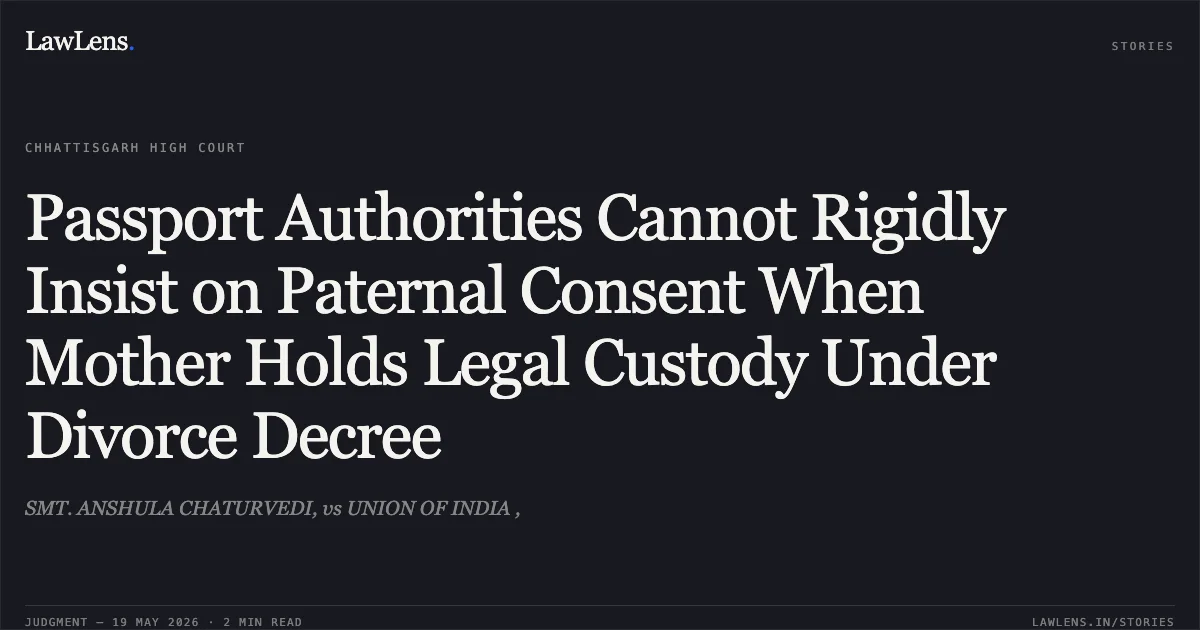
SMT. ANSHULA CHATURVEDI,vsUNION OF INDIA ,
Click to open original judgment
Original judgment, available to read, download and summarize on LawLens.in