Facts
The petitioner’s passport was set to expire on May 10, 2026
Source reference: p. 2He applied for renewal/re-issuance via Application Reference No. (ARN) 26-0059426061
Source reference: p. 1-2The respondent authority withheld the renewal on the grounds that two FIRs were pending against the petitioner
Source reference: p. 2However, the investigation report indicated that no prima facie evidence had been found against him at the investigation stage
Source reference: p. 3The petitioner sought a writ of mandamus directing the authorities to renew the passport for a period of ten years to facilitate his travel abroad
Source reference: p. 2Issues
1. Whether the respondent authority is required to renew the petitioner’s passport despite the pendency of criminal FIRs under the Passports Act, 1967 and relevant Notifications
Source reference: p. 32. Whether the passport authority has the jurisdiction to decide an accused person's right to travel abroad or if such authority rests solely with the Trial Court
Source reference: p. 6Law Applied
Section 6(2)(f) of the Passports Act, 1967, which allows for the refusal of a passport if proceedings in respect of an offense are pending before a criminal court
Source reference: p. 3, 6GSR Notification 570(E) dated 26.08.1993, which provides exemptions for citizens with pending criminal cases, specifying that if a court order does not define a period, the passport should be issued for one year
Source reference: p. 3-4Narendra K. Ambwani (Writ Petition No. 361 of 2014), which clarified that qualifying applicants are entitled to a ten-year renewal and that the Trial Court, not the passport authority, holds the power to restrict travel
Source reference: p. 5-6Reasoning
The court reasoned that while GSR Notification 570(E) initially suggests a one-year renewal for those with pending proceedings, the ambiguity regarding the duration of renewal must be resolved in favor of the citizen’s rights and administrative efficiency
Source reference: p. 6The court noted that the FIRs against the petitioner were only at the investigation stage with no evidence yet established
Source reference: p. 3Drawing from Narendra K. Ambwani, the court observed that the passport authority lacks the judicial power to determine a citizen's right to travel; its role is administrative
Source reference: p. 6Therefore, the passport should be issued for the standard duration of ten years as per the Passport Rules, 1980
Source reference: p. 5-7The court emphasized that the actual permission to depart the country remains subject to the Trial Court’s oversight, which can impose specific conditions regardless of the passport's validity period
Source reference: p. 6-7Holding
The court answered the issues in the affirmative, holding that the respondent authorities must process the application and issue/renew the petitioner’s passport for a period of ten years
The court directed the respondent to decide the application (ARN 26-0059426061) within four weeks
Source reference: p. 7However, it clarified that the petitioner must still obtain specific permission from the Trial Court before undertaking any travel abroad, and the Trial Court retains the power to impose necessary conditions. The petition was allowed with no order as to costs
Source reference: p. 7Acts & Sections Cited
2 provisions across 1 statute referred to in this judgment. Each provision opens on LawLens.
Passports Act, 19672
Original Court PDF
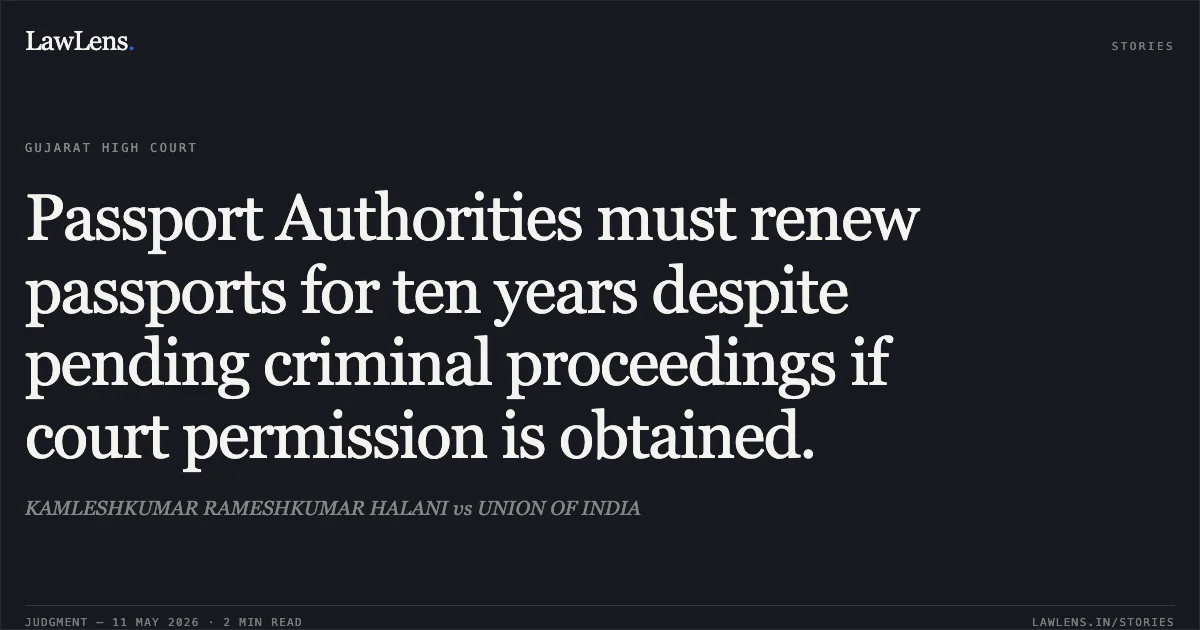
KAMLESHKUMAR RAMESHKUMAR HALANIvsUNION OF INDIA
Click to open original judgment
Original judgment, available to read, download and summarize on LawLens.in