Facts
The petitioner, who operates an immigration-related services business, lost his passport on March 13, 2025, and subsequently registered a police complaint
Source reference: p. 2He applied for a fresh passport with a ten-year validity period (Application No. AH306988527816).
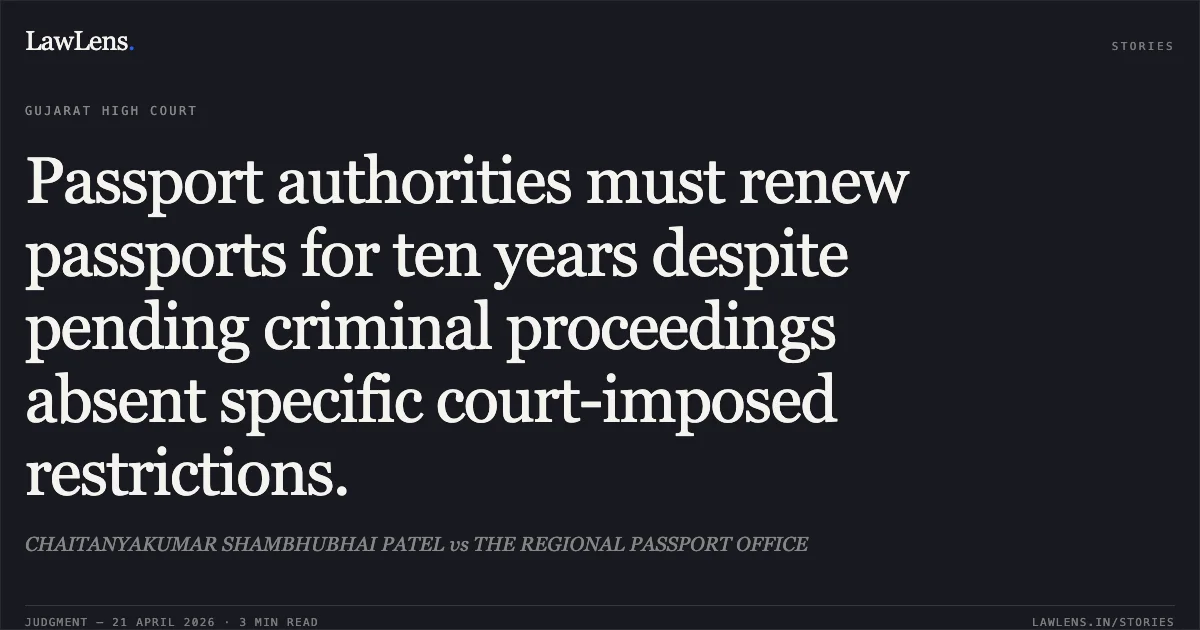
Source reference: p. 2The respondent authority declined to issue the passport for the standard ten-year term, citing a pending criminal case against the petitioner in which a charge sheet had not yet been filed
Source reference: p. 2The respondent contended that under GSR Notification 570(E) dated August 25, 1993, when a trial court order does not specify a duration for passport validity, the authority is restricted to issuing or renewing the document for only one year
Source reference: p. 3, 4Issues
1. Whether the passport authority is required to issue a fresh passport for a ten-year duration to an applicant facing pending criminal proceedings when the trial court's permission does not specify a particular validity period.
Source reference: p. 4 / para. 92. Whether the guidelines established by the Bombay High Court regarding the interpretation of GSR Notification 570(E) are applicable to the passport authorities in the current jurisdiction.
Source reference: p. 5 / para. 10-12Law Applied
The court primarily considered Section 6(2)(f) of the Passports Act, 1967, which empowers authorities to refuse a passport if criminal proceedings are pending against the applicant
Source reference: p. 3GSR Notification 570(E) dated August 25, 1993, which provides exemptions for citizens with pending criminal cases provided they obtain court permission, while setting default validity periods (one year) if the court order is silent on duration
Source reference: para. 8The court relied heavily on the precedent of Narendra K. Ambwani v. Union of India & Ors. (2014 SCC Online Bom 356), which clarifies that qualifying applicants are entitled to a ten-year renewal regardless of the trial court’s silence on duration, as the power to restrict actual travel remains with the trial court, not the passport office
Source reference: para. 10-12Reasoning
The court examined the ambiguity between the Passports Act, the Passport Rules, 1980, and GSR Notification 570(E). It noted that while Clause (ii) of the Notification suggests a one-year limit if the trial court specifies no period, the Division Bench in Narendra K. Ambwani established that all qualifying applicants are entitled to a ten-year renewal under the Passport Rules
Source reference: para. 9-11The court reasoned that the passport authority lacks the legal mandate to determine an accused person’s right to travel; that authority is vested solely in the trial court, which can impose specific conditions at the time of a travel application.
Source reference: para. 12Consequently, the court held that the respondent’s interpretation—restricting the passport to one year—was overly restrictive and that the principles of the Ambwani judgment should be followed to ensure the applicant receives a document with standard ten-year validity
Source reference: para. 12Holding
The Court allowed the petition and directed the respondent authority to issue a fresh passport to the petitioner with a validity of ten years
The court clarified that the issuance of the passport does not grant an absolute right to depart the country; the petitioner must still move an appropriate application before the concerned Trial Court to seek specific permission to travel abroad.
Source reference: para. 13The respondent was ordered to decide the application expeditiously within four weeks of the order.
Source reference: para. 13Rule made absolute
Source reference: para. 14Acts & Sections Cited
2 provisions across 1 statute referred to in this judgment. Each provision opens on LawLens.
Passports Act, 19672
Original Court PDF
CHAITANYAKUMAR SHAMBHUBHAI PATELvsTHE REGIONAL PASSPORT OFFICE
Click to open original judgment
Original judgment, available to read, download and summarize on LawLens.in