Facts
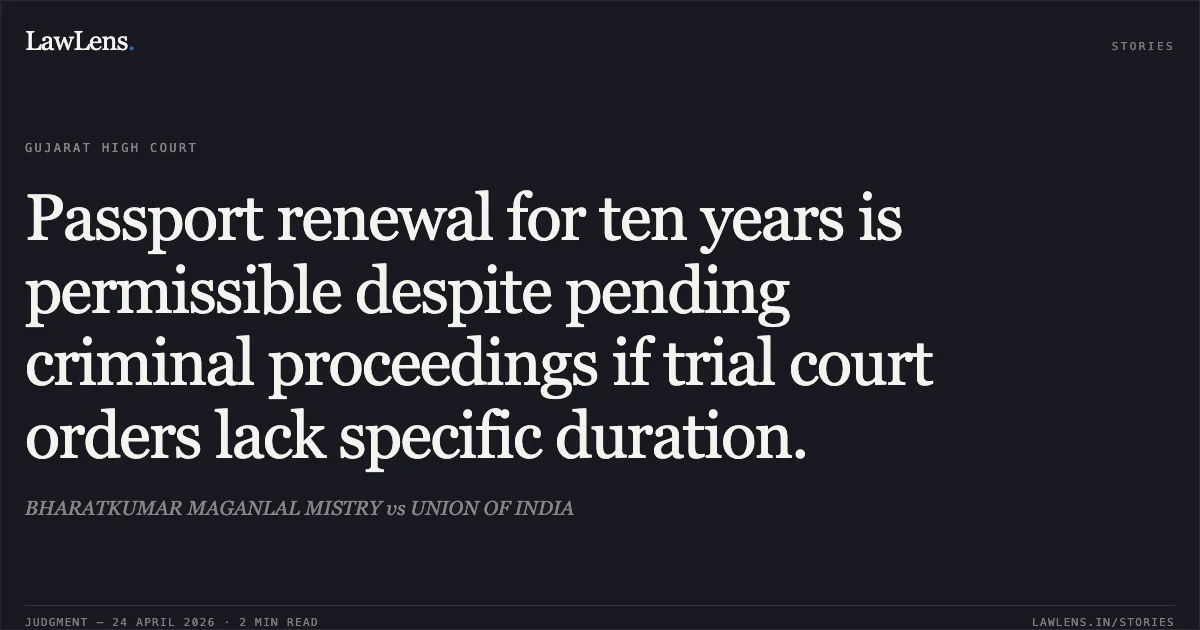
The petitioner, Bharatkumar Mistry, applied for the re-issuance of his passport as the previous one had expired
Source reference: p. 2His criminal sentence had been suspended by the High Court in a pending appeal (Criminal Appeal No. 367 of 2019), and he sought a passport renewal for 10 years to travel abroad
Source reference: p. 2, 7The passport authorities, citing GSR Notification 570(E) dated 25.08.1993, were only inclined to renew the passport for one year because the Trial Court had not specified a longer duration in its orders
Source reference: p. 3-5The petitioner challenged this limitation via a writ petition under Article 226
Source reference: p. 1-2Issues
1. Whether the passport authority is mandated to reissue/renew a passport for the standard period of 10 years when criminal proceedings are pending and the Trial Court has not specified a particular duration
Source reference: p. 2, 52. Whether the guidelines established by the Bombay High Court in Narendra K. Ambwani v. Union of India regarding passport renewals for persons with pending criminal cases should be applied
Source reference: p. 2, 6Law Applied
Section 6(2)(f) and Section 22 of the Passports Act, 1967, which govern the refusal and exemption of passport issuance for individuals with pending criminal proceedings
Source reference: p. 3-4GSR Notification 570(E) dated 25.08.1993, which stipulates that if no period is specified by a court order, a passport shall be issued for one year
Source reference: p. 3-4The court adopted the persuasive precedent of Narendra K. Ambwani v. Union of India (2014 SCC Online Bom 356), which established that qualifying applicants are entitled to a 10-year renewal unless the Magistrate specifically orders otherwise under the 1993 Notification
Source reference: p. 5-6Reasoning
The court reasoned that while GSR Notification 570(E) provides a default one-year renewal where a court order is silent on duration, this creates an ambiguity when read alongside the standard Passport Rules of 1980
Source reference: p. 6Adopting the reasoning in Narendra K. Ambwani, the court held that passport authorities lack the judicial power to decide an accused person's right to travel; that authority rests solely with the Trial Court
Source reference: p. 6-7The court observed that since the petitioner’s sentence was already suspended and the Trial Court had not explicitly restricted the renewal period to one year, the authorities should not arbitrarily limit the validity.
Source reference: p. 7The court found that a 10-year renewal is permissible, provided the petitioner still seeks specific judicial permission before each instance of actual travel
Source reference: p. 7Holding
The Court allowed the petition and directed the respondent authority to reissue the petitioner’s passport for a period of 10 years
The court imposed a condition that the petitioner must obtain specific permission from the concerned Trial Court before undertaking any travel abroad, at which point the Trial Court may impose necessary conditions
Source reference: p. 7-8Rule was made absolute
Source reference: p. 8Acts & Sections Cited
2 provisions across 1 statute referred to in this judgment. Each provision opens on LawLens.
Passports Act, 19672
Original Court PDF
BHARATKUMAR MAGANLAL MISTRYvsUNION OF INDIA
Click to open original judgment
Original judgment, available to read, download and summarize on LawLens.in