Facts
The applicant (husband) and non-applicant (wife) are in a matrimonial dispute.
Source reference: para. 5The wife filed for maintenance under the Code of Criminal Procedure (Case No. 494/2022), supported by an affidavit dated 17.06.2022, declaring she had no source of income and was not an income tax payee.
Source reference: para. 5Consequently, the Family Court awarded maintenance of Rs. 20,000 per month.
Source reference: para. 5The applicant subsequently filed an application under Section 340 of the Cr.P.C., alleging perjury and suppression of material facts.
Source reference: para. 6He produced TDS certificates, ITR acknowledgments (AY 2022–23 and 2023–24), and Wipro Ltd. pay slips to prove the wife was a Software Engineer.
Source reference: para. 6The Family Court dismissed the Section 340 application and registered MCC Case No. 273/2025 on its own motion.
Source reference: para. 4 & 6The applicant filed this revision challenging the order dated 04.11.2025, seeking a direction for the Family Court to file a formal complaint before a competent Magistrate.
Source reference: para. 4 & 6Issues
1. Whether the non-applicant committed perjury by intentionally suppressing her employment status and income in her disclosure affidavit.
Source reference: para. 7 & 92. Whether the Family Court failed to follow the mandatory procedure under Sections 340 and 341 of the Cr.P.C. by registering its own MCC case instead of filing a complaint before a Judicial Magistrate.
Source reference: para. 7Law Applied
Section 340 and 341 of the Code of Criminal Procedure (Cr.P.C.), 1973, which outline the procedure for inquiring into and prosecuting offenses affecting the administration of justice.
Source reference: para. 4 & 7Sections 191, 193, 199, and 209 of the Indian Penal Code (IPC) regarding the punishment for giving false evidence and making false statements on oath.
Source reference: para. 7The Court adhered to the disclosure requirements for maintenance proceedings established by the Supreme Court in Rajnesh v. Neha & Others.
Source reference: para. 9Reasoning
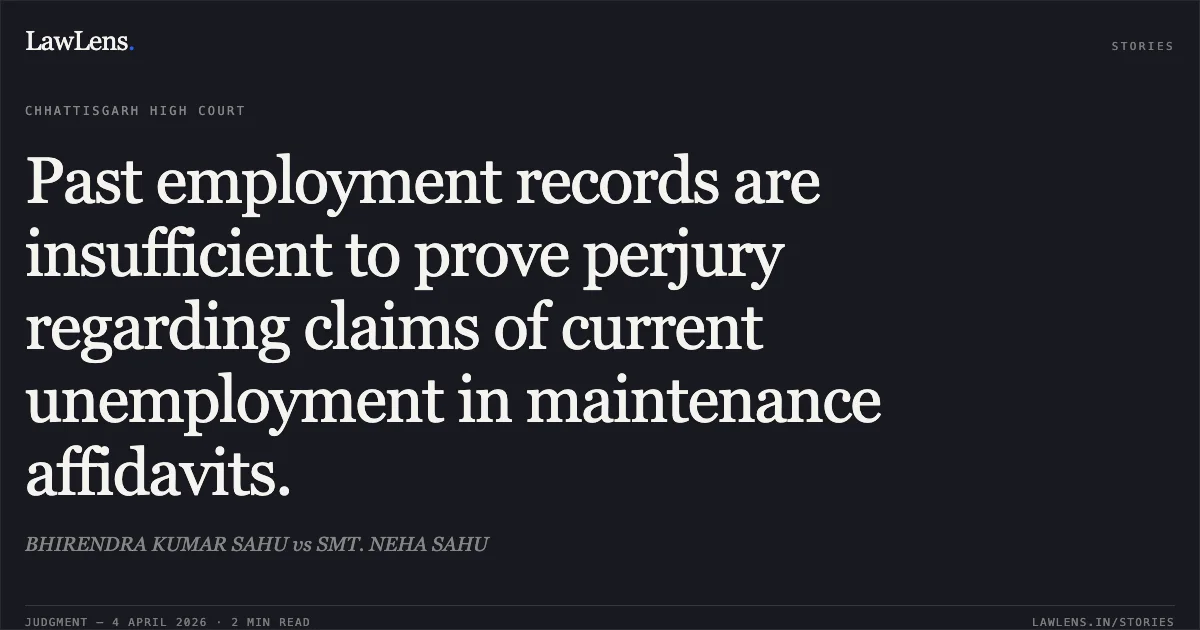
The High Court examined the evidence submitted by the applicant to substantiate the claim of perjury and observed that while the applicant provided Wipro pay slips, TDS statements, and EPF records, these documents pertained to the period prior to the year 2022.
Source reference: para. 9The Court noted that the applicant failed to produce any "contemporaneous documents" or material evidence proving that the non-applicant was gainfully employed on the date she filed the affidavit (17.06.2022) or at any point thereafter.
Source reference: para. 9The court reasoned that in the absence of evidence relating to the relevant period, it cannot be inferred that the non-applicant made a false statement or intentionally suppressed facts.
Source reference: para. 9The court found that the "essential ingredients" for initiating a Section 340 Cr.P.C. inquiry—namely, the expediency in the interest of justice and a prima facie case of intentional falsehood—were not satisfied.
Source reference: para. 11Holding
The High Court condoned the 17-day filing delay but dismissed the revision in limine for lack of merit.
The Court held that the Family Court’s refusal to initiate perjury proceedings was correct as the evidence did not substantiate the allegation of a false affidavit at the relevant time.
Source reference: para. 10-11The Court affirmed that there was no perversity or illegality in the impugned order and directed the office to communicate the decision to the concerned Family Court.
Source reference: para. 10 & 13Acts & Sections Cited
6 provisions across 2 statutes referred to in this judgment. Each provision opens on LawLens.
Code of Criminal Procedure, 19732
Indian Penal Code, 18604
Original Court PDF
BHIRENDRA KUMAR SAHUvsSMT. NEHA SAHU
Click to open original judgment
Original judgment, available to read, download and summarize on LawLens.in