Facts
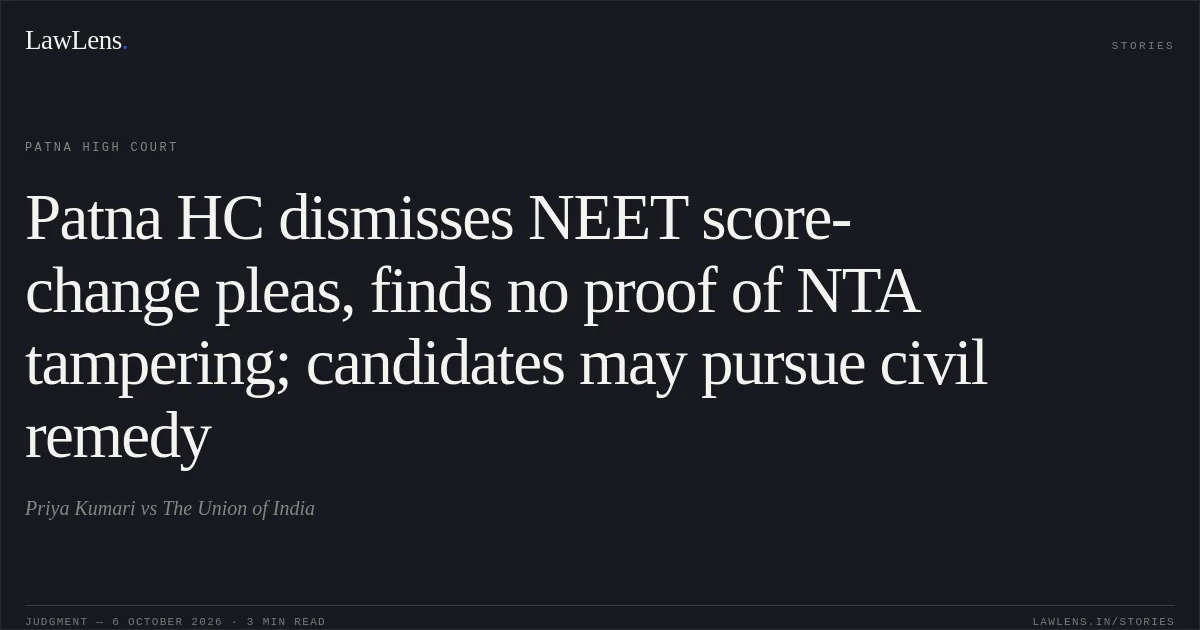
Three NEET-UG 2026 candidates challenged their results and the genuineness of the OMR sheets produced by the National Testing Agency (NTA).
Source reference: no citationTwo petitioners alleged that scorecards initially showing substantially higher marks had later been replaced by scorecards reflecting much lower marks; the third claimed that her OMR sheet did not reflect the answers she had attempted.
Source reference: pp. 3–8, paras. 4–15The Court directed the NTA to produce the original OMR sheets. When shown the sheets, the petitioners denied that they were theirs and disputed the signatures and answers recorded on them.
Source reference: pp. 3–8, paras. 4–15The NTA maintained that the scorecards relied on by the petitioners were not genuine, that the results and OMR records had not been changed, and that the marks followed from the recorded answers and final answer key. It also relied on NIC certificates stating that only one OMR sheet and one set of result data had been uploaded for each petitioner.
Source reference: pp. 14–16, paras. 27–33Issues
Whether the petitioners established a sufficient basis under Article 226 to challenge the NTA’s OMR sheets, evaluation, or published results as altered, manipulated, or otherwise unreliable.
Source reference: pp. 18–20, 30–34, paras. 35–37, 46–53Whether the disputes over the identity and genuineness of the OMR sheets could be resolved in writ proceedings or required adjudication through a civil remedy involving evidence.
Source reference: pp. 27–29, 34–35, paras. 42–43, 55Law Applied
Article 226 permits judicial review of examination decisions where the process is shown to be arbitrary, irrational, discriminatory, mala fide, or contrary to prescribed procedure, but courts exercise restraint in academic and competitive-examination matters and do not substitute their assessment for that of the examining body without a demonstrated defect.
Source reference: p. 24, para. 39The Court relied on Prabhnoor Singh v. National Testing Agency, where the Supreme Court declined to entertain allegations of OMR tampering in the absence of material indicating manipulation.
Source reference: pp. 28–29, 44It also considered the principle, stated in Selishia Mohandas v. Union of India, that official examination records carry a presumption of correctness under Section 114 of the Indian Evidence Act, 1872, unless rebutted by concrete material.
Source reference: pp. 20–23, para. 38Where a claim turns on disputed facts requiring detailed examination of witnesses and documents, the writ court may leave the claimant to pursue an appropriate civil remedy.
Source reference: pp. 28–29, 42–43Reasoning
The Court examined the original OMR sheets and noted that they contained the candidates’ identifying particulars, signatures, thumb impressions, invigilator signatures, and recorded answers.
Source reference: pp. 30–31, para. 47It also considered that two petitioners had not challenged their OMR sheets within the notified objection period, while the third had challenged only one question; the NTA’s records and NIC certificates did not support the alleged alteration of results or OMR sheets.
Source reference: pp. 31–32, paras. 48–52Differences between signatures on the OMR sheets and other documents were not, by themselves, sufficient to establish tampering. The Court concluded that the petitioners had not produced convincing material demonstrating arbitrariness, mala fides, or procedural irregularity.
Source reference: pp. 33–35, paras. 53–55To the extent they continued to dispute the identity or genuineness of the sheets, those contested factual questions required a fuller evidentiary inquiry than was appropriate in the writ proceedings.
Source reference: pp. 33–35, paras. 53–55Holding
The Court dismissed all three writ petitions, finding no sufficient basis to doubt the NTA’s records or interfere with its evaluation.
It left the petitioners at liberty to pursue any appropriate remedy before a competent court or authority.
Source reference: p. 35, para. 56The original OMR sheets were returned to the NTA through its counsel.
Source reference: p. 36, para. 58Acts & Sections Cited
1 provisions across 1 statute referred to in this judgment. Each provision opens on LawLens.
National Investigation Agency Act, 20081
Original Court PDF
Priya KumarivsThe Union of India
Click to open original judgment
Original judgment, available to read, download and summarize on LawLens.in