01Facts
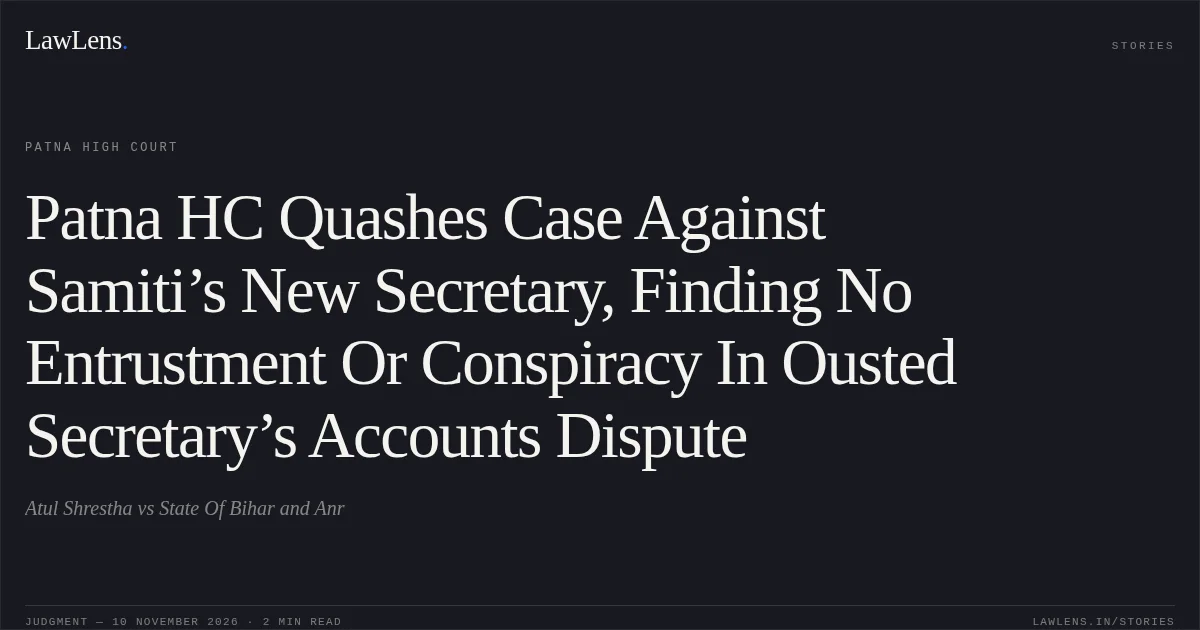
The complainant, formerly Secretary of Samadhan Seva Samiti, alleged that the petitioner and other office-bearers withheld the society’s records and accounts and committed financial irregularities.
¶ 2, 11, 29The dispute followed the complainant’s removal as Secretary and the petitioner’s appointment in his place.
¶ 2, 11, 29An earlier complaint was referred to the police, which submitted a final report finding the dispute civil in nature; the Magistrate accepted that report, but later treated the complainant’s protest petition as a complaint.
¶ 3–4After inquiry, the Magistrate took cognizance against the petitioner under Sections 406, 420 and 120-B IPC and ordered summons.
¶ 5The petitioner sought quashing under Section 482 CrPC.
02Issues
i.1. Whether the complaint and inquiry materials disclosed the essential ingredients of criminal breach of trust or cheating so as to justify proceedings under Sections 406 and 420 IPC
¶ 19–20, 28–33ii.2. Whether the allegations disclosed an agreement or meeting of minds sufficient to constitute criminal conspiracy under Section 120-B IPC
¶ 34–38iii.3. Whether continuation of the proceedings against the petitioner amounted to an abuse of process warranting relief under Section 482 CrPC
¶ 18, 3903Law Applied
Section 482 CrPC empowers the High Court to prevent abuse of process and secure the ends of justice, including where the allegations, taken at face value, do not constitute an offence.
¶ 18Criminal breach of trust under Sections 405–406 IPC requires entrustment of property or dominion over it, followed by dishonest misappropriation, conversion, use or disposal in breach of law or contract.
¶ 21–22Cheating under Sections 415–420 IPC requires fraudulent or dishonest inducement, including the requisite dishonest intention at the inception.
¶ 23Relying on Delhi Race Club (1940) Ltd. v. State of Uttar Pradesh and Arshad Neyaz Khan v. State of Jharkhand, the Court treated cheating and criminal breach of trust as distinct and antithetical offences that could not coexist on the same set of allegations in this case.
¶ 25–27Under Section 120-B IPC, conspiracy requires an agreement between at least two persons to commit an illegal act, or a lawful act by illegal means; the agreement may be inferred from circumstances where direct evidence is unavailable.
¶ 34–35Provisions in the judgment · 11 · Linked ones open on LawLens
Code of Criminal Procedure, 1973 Section 153Section 156Section 482
Indian Penal Code, 1860 Section 34Section 405Section 406Section 415Section 420Section 467Section 468Section 471
04Reasoning
The Court considered the dispute to arise from the society’s management and the complainant’s removal as Secretary, rather than from a criminal transaction.
The record did not show that property had been entrusted to the petitioner and then dishonestly misappropriated, or that the petitioner had dishonestly induced the complainant to deliver property.
¶ 28–32Nor did the allegations or materials identify circumstances showing an agreement among the accused to pursue an unlawful object; association in the society’s management and disagreement over its affairs were insufficient to establish conspiracy.
¶ 36–38The Court therefore found the requisite ingredients of Sections 406, 420 and 120-B IPC absent and considered continuation of the prosecution an abuse of process.
¶ 3905Holding
The Court allowed the petition under Section 482 CrPC and quashed the Magistrate’s order dated 23 November 2016, together with all consequential criminal proceedings, insofar as they related to the petitioner.
¶ 43–44Original Court PDF
Atul ShresthavsState Of Bihar and Anr
Click to open original judgment
Original judgment, available to read, download and summarize on LawLens.in