01Facts
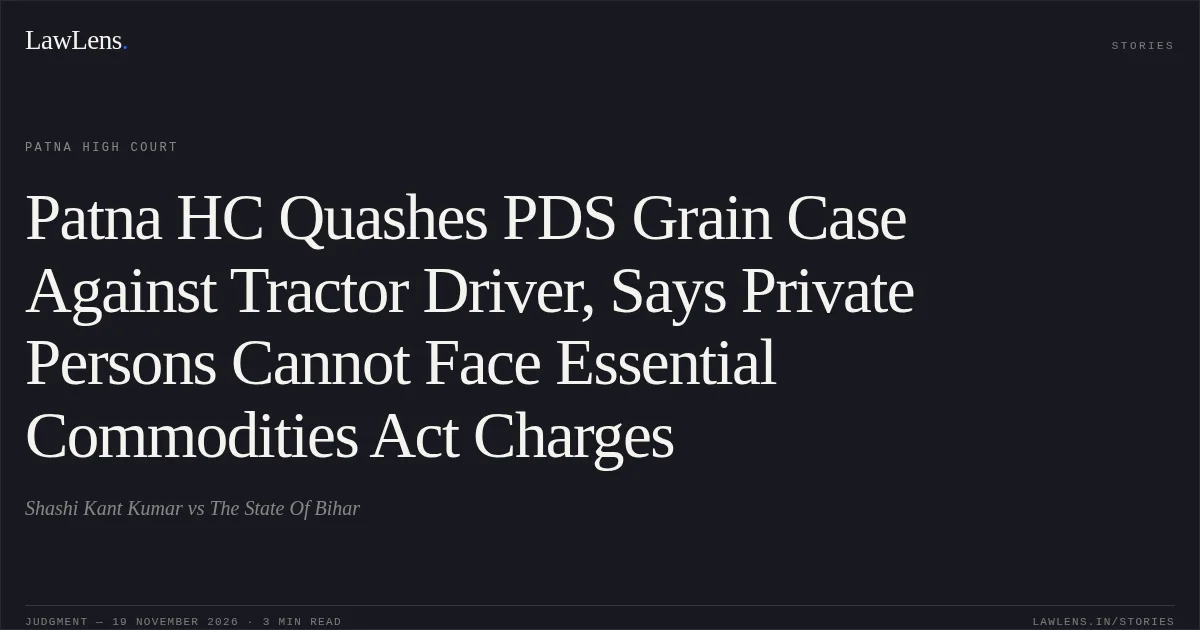
A Block Supply Officer, Sheikhpura, lodged a written report alleging the lifting of P.D.S. grains and their transportation to Jaishri Krishan Rice Mill. On this basis, a case was instituted under Sections 420, 409 and 120-B of the Indian Penal Code and Section 7 of the Essential Commodities Act.
¶ 3The petitioner was not named in the F.I.R. and is not the owner of the rice mill. He contended that he is merely a driver and that paragraph 50 of the case diary records him as the driver of tractor No. BR-52-8720.
¶ 4The State opposed quashing.
¶ 5The petitioner sought discharge under Section 239 CrPC, which the Sub-Divisional Judicial Magistrate, Sheikhpura rejected by order dated 29.07.2016. The petitioner then invoked Section 482 CrPC to quash that order.
¶ 202Issues
i.1. Whether a private person who is not a P.D.S. dealer or agent can be prosecuted under Section 7 of the Essential Commodities Act.
¶ 7–8ii.2. Whether the ingredients of Sections 409 and 420 IPC are made out against the petitioner.
¶ 9, 13iii.3. Whether the offence of criminal conspiracy under Section 120-B IPC can be sustained against the petitioner merely because he was the driver of the tractor.
¶ 10–11iv.4. Whether continuation of the proceedings against the petitioner amounts to an abuse of the process of court, warranting interference under Section 482 CrPC.
¶ 12–1403Law Applied
Under Section 7 of the Essential Commodities Act, read with the Control Orders, only P.D.S. dealers or their agents may be prosecuted; a private person who is not a P.D.S. dealer cannot be tried under that section, as held in Arvind Kumar v. State of Bihar (Cr. Misc. No. 21936 of 2011) and reaffirmed in Md. Qaiyum v. State of Bihar (Cr. Misc. No. 13560 of 2023).
¶ 7Under Section 409 IPC, entrustment of property and its dishonest misappropriation or use are sine qua non, and under Section 420 IPC, deception, dishonest inducement and mens rea are essential, as stated in N. Raghavender v. State of Andhra Pradesh, CBI, (2021) 18 SCC 70.
¶ 9Criminal conspiracy under Section 120-B IPC requires an agreement, evidenced by a meeting of minds; a few isolated circumstances are insufficient, as held in Esher Singh v. State of Andhra Pradesh, (2004) 11 SCC 585.
¶ 10Under Section 482 CrPC, the inherent power may be exercised where the allegations, even if taken at face value, or the uncontroverted material collected during investigation, do not disclose an offence, as laid down in State of Haryana v. Bhajan Lal, 1992 Supp (1) SCC 335.
¶ 12Provisions in the judgment · 5 · Linked ones open on LawLens
Code of Criminal Procedure, 1973 Section 239Section 482
Essential Commodities Act, 1955 Section 7
Indian Penal Code, 1860 Section 409Section 420
04Reasoning
The petitioner, as a non-dealer private individual, could not be prosecuted under Section 7 of the E.C. Act. The case diary shows him only as the driver of the tractor, with no material indicating that he was a P.D.S. dealer, agent, mill owner, or person entrusted with P.D.S. stock.
¶ 7–8Under Section 409 IPC, the prosecution had to establish entrustment of property and its dishonest misappropriation. No such entrustment is shown against the petitioner, and no allegation of deception or dishonest inducement under Section 420 IPC is attributed to him.
¶ 9On Section 120-B IPC, the Court held that the petitioner's status as driver cannot establish an agreement or meeting of minds with the other accused. The connection rests on suspicion rather than on material establishing conspiracy.
¶ 10–11Applying Bhajan Lal, the Court found that the material collected during investigation does not disclose the basic ingredients of Sections 409, 420 or 120-B IPC. Continuing the proceedings against him would therefore amount to an abuse of process.
¶ 12–1405Holding
The Court answered all four issues against the prosecution as regards the petitioner. A non-P.D.S. dealer cannot be prosecuted under Section 7 of the E.C. Act; the ingredients of Sections 409, 420 and 120-B IPC are not disclosed; and continuation of the case is an abuse of process.
¶ 8, 13–14The application is allowed. The order dated 29.07.2016 passed by the Sub-Divisional Judicial Magistrate, Sheikhpura, in G.R. Case No. 499 of 2013 (Sheikhpura (Hathiyawan O.P.) P.S. Case No. 161 of 2013), along with all consequential proceedings, is set aside and quashed only qua the petitioner. A copy of the judgment is directed to be sent to the trial court forthwith.
¶ 15–17Original Court PDF
Shashi Kant KumarvsThe State Of Bihar
Click to open original judgment
Original judgment, available to read, download and summarize on LawLens.in