Facts
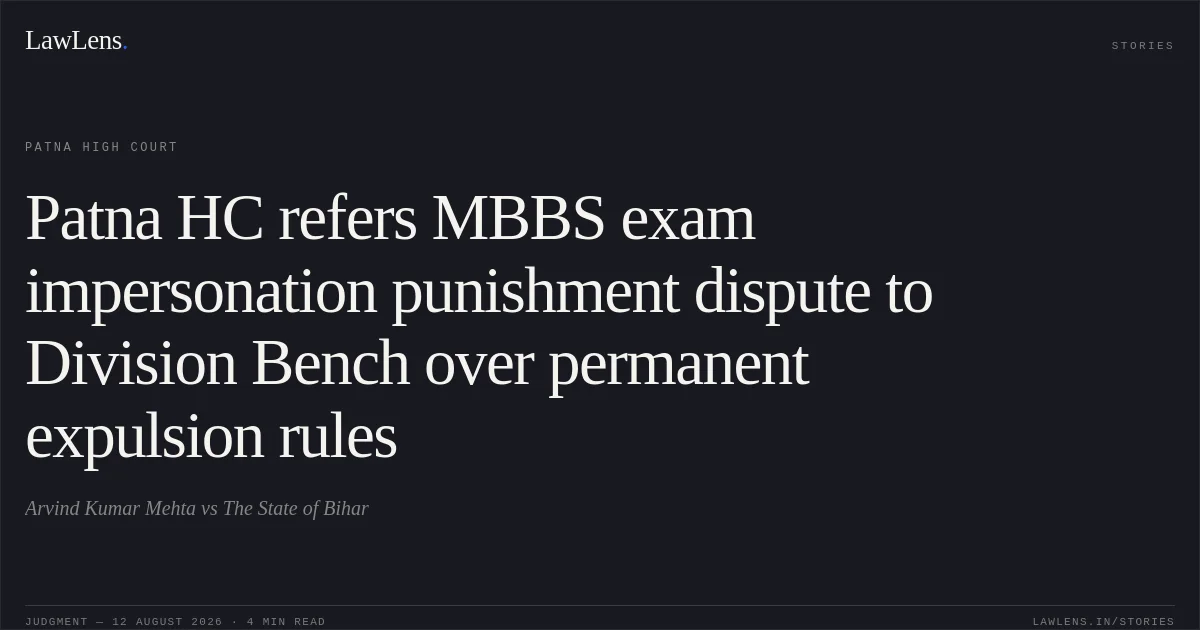
The petitioner, a 3rd Professional MBBS Part-I student at Government Medical College, Bettiah, was alleged to have permitted Abhishek Kumar, another MBBS student, to impersonate him in the ENT paper of the 3rd Professional MBBS Part-I Examination held on 27 September 2024.
Source reference: paras. 3–4The invigilator, Centre Superintendent and Observer reported the impersonation; Abhishek Kumar was handed over to the police and an FIR was registered as Jakkanpur P.S. Case No. 554 of 2024.
Source reference: paras. 3–4The University issued a show-cause notice and afforded the petitioner a personal hearing before the Unfairmeans Committee.
Source reference: paras. 5, 26–27In his response, the petitioner substantially acknowledged that Abhishek Kumar had offered to sit for the examination on his behalf and accepted responsibility for the incident.
Source reference: paras. 5, 26–27The 57th Unfairmeans Committee found the charge proved and recommended cancellation of the petitioner’s admission and his expulsion from the University under Category 5.1(c) of the Rules for Unfairmeans.
Source reference: paras. 6, 27–28The Vice-Chancellor approved the recommendation through order dated 12 November 2024, communicated to the College and the petitioner.
Source reference: paras. 6, 27–28The petitioner sought parity with other students, including Abhishek Kumar, whose identical punishment had been modified by a coordinate Bench in Bhawesh Kumar Bhaskar v. Aryabhatta Knowledge University & Ors., CWJC No. 19657 of 2024 and analogous cases, by reducing permanent expulsion to three years.
Source reference: paras. 7–10, 29Issues
Whether the petitioner was entitled to the benefit of parity with similarly situated students whose punishment of cancellation of admission and permanent expulsion had been modified by a coordinate Bench.
Source reference: para. 30Whether the decision in Bhawesh Kumar Bhaskar was inconsistent with, or required reconsideration in light of, the earlier decision in Prashant Bharti v. Aryabhatta Knowledge University & Ors., AIR 2020 Pat 154.
Source reference: paras. 23–24, 30, 36, 42Whether the Vice-Chancellor was required to independently consider a lesser or reformative punishment under Section 27(d) of the Statute, 2011, despite the Rules for Unfairmeans prescribing cancellation of admission and expulsion for impersonation.
Source reference: paras. 11–13, 36–37Law Applied
The Court considered the Aryabhatta Knowledge University Act, 2008 and the University Statute, 2011, particularly Section 27(d), which confers disciplinary authority on the Vice-Chancellor, and Section 27(f), under which rules concerning unfair means may be framed without prejudice to the Vice-Chancellor’s powers.
Source reference: paras. 11–12, 90–93 as reproducedCategory 5.1(c) of the University’s Rules for Unfairmeans prescribes cancellation of admission and expulsion where an impersonator appears for a student.
Source reference: paras. 16–17, 27The Court applied the limited scope of judicial review in academic and disciplinary matters under B.C. Chaturvedi v. Union of India, (1995) 6 SCC 749, under which judicial review examines the decision-making process rather than appellate correctness.
Source reference: para. 31Board of High School & Intermediate Examination, U.P. v. Bagleshwar Prasad, AIR 1966 SC 875, requires fairness, natural justice and evidentiary support while directing courts to exercise restraint in unfair-means cases.
Source reference: para. 32The Court also considered Prashant Bharti, which upheld disciplinary action where the inquiry was fair and supported by material.
Source reference: paras. 33–35State of U.P. v. Arvind Kumar Srivastava, (2015) 1 SCC 347, concerned equal treatment of identically situated persons.
Source reference: para. 14The Court further noted authorities emphasising examination integrity and the seriousness of unfair means, including Director (Studies), Dr. Ambedkar Institute of Hotel Management v. Vaibhav Singh Chauhan, (2009) 1 SCC 59.
Source reference: para. 41Reasoning
The Court found that the charge of impersonation was supported by the contemporaneous reports of the invigilator, Centre Superintendent and Observer, and was further corroborated by the petitioner’s own show-cause response.
Source reference: paras. 25–27The inquiry complied with natural justice because the petitioner received notice, submitted a reply and was given a personal hearing before the Unfairmeans Committee.
Source reference: paras. 5, 27Consequently, the Court held that the factual finding of guilt was not amenable to interference under the restricted standards of judicial review applicable to academic disciplinary proceedings.
Source reference: paras. 31–35However, the Court identified a legal divergence. While Bhawesh Kumar Bhaskar treated permanent expulsion as disproportionate and held that the Vice-Chancellor possessed discretion to impose a lesser, reformative penalty under Section 27(d), Prashant Bharti supported judicial restraint where the prescribed unfair-means procedure had been followed.
Source reference: paras. 36–37The Court observed that the Rules prescribe a single punishment for proved impersonation, but also recognised that Section 27(d) may confer broader discretionary power on the Vice-Chancellor.
Source reference: paras. 36–37Since the question had implications for the validity and operation of the University’s disciplinary framework, and because the petitioner claimed parity with students who had already obtained relief, the Court considered that the issue required authoritative resolution by a Division Bench.
Source reference: paras. 36, 42–43Holding
The Court did not finally decide whether the petitioner’s punishment should be reduced or whether he was entitled to parity.
It held that the divergent views concerning the scope of the Vice-Chancellor’s discretion under Section 27(d), the effect of the Rules for Unfairmeans, and the correctness of Bhawesh Kumar Bhaskar required consideration by a Division Bench.
Source reference: paras. 42–43The matter was accordingly referred to the learned Division Bench, with a direction that it be placed along with LPA No. 613 of 2026, filed by the University against the Bhawesh Kumar Bhaskar decision.
Source reference: paras. 43–44The petitioner was directed to file a second copy of the writ petition, counter-affidavit and other relevant pleadings, and the writ petition was ordered to abide by the final decision of the Division Bench.
Source reference: paras. 43–44Acts & Sections Cited
2 provisions across 2 statutes referred to in this judgment. Linked provisions open on LawLens.
Aryabhatta Knowledge University Act, 20081
Aryabhatta Knowledge University Statute, 20111
Original Court PDF
Arvind Kumar MehtavsThe State of Bihar
Click to open original judgment
Original judgment, available to read, download and summarize on LawLens.in