Facts
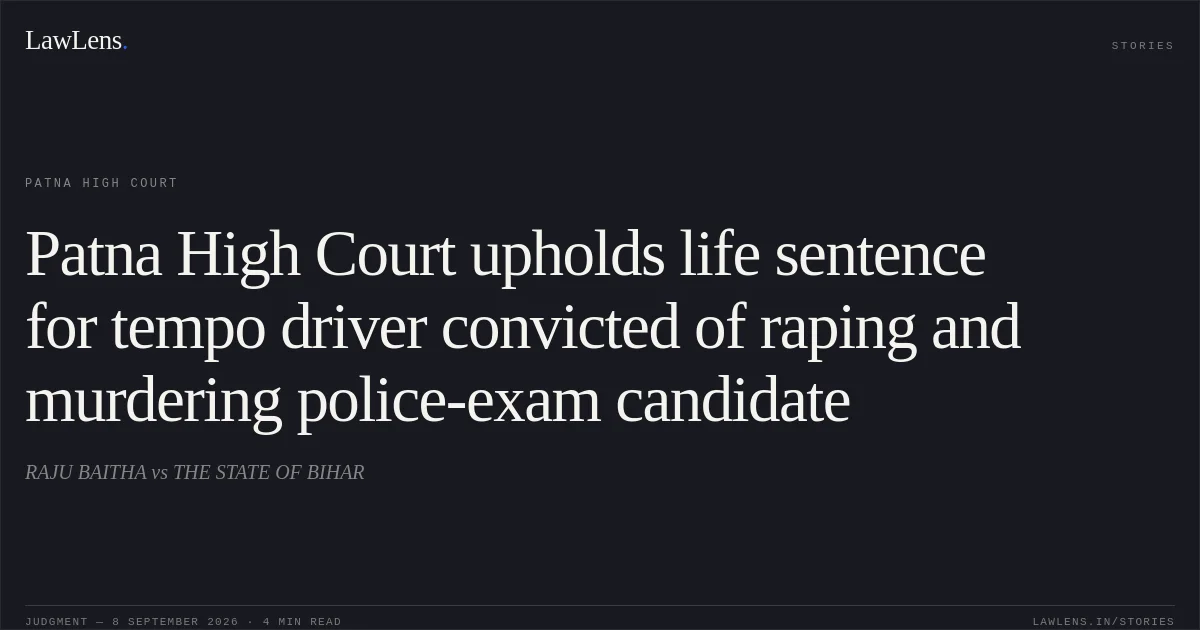
The victim travelled to Bettiah on 14 March 2021 to appear in a Bihar Police recruitment examination. While returning, she informed her family that she had reached Maryadpur and was travelling alone in a tempo. She thereafter went missing and her mobile phone was switched off.
Source reference: paras. 4, 35–46; pp. 3–25During the ensuing search, witnesses stated that she had travelled in a tempo driven by the appellant, Raju Baitha, who initially denied this but later gave inconsistent explanations regarding her having alighted and boarded another vehicle.
Source reference: paras. 4, 35–46; pp. 3–25The victim’s body was recovered floating in a canal on 18 March 2021. The post-mortem found signs of forcible sexual assault and death by throttling, with the estimated time since death being 36–72 hours.
Source reference: paras. 47–59; pp. 26–35The appellant was medically examined after arrest and injuries consistent with a human teeth bite were found on his forearm.
Source reference: paras. 51, 55–56; pp. 29–32The trial court convicted the appellant under Sections 302, 376 and 201 IPC and Section 3(i)(w)(i) of the SC/ST Act, imposing life imprisonment for murder and concurrent sentences for the other offences.
Source reference: paras. 2–3; pp. 1–3Issues
Whether the prosecution established a complete and reliable chain of circumstantial evidence proving that the appellant raped and murdered the victim and caused disappearance of evidence under Sections 302, 376 and 201 IPC?
Source reference: paras. 33–60; pp. 16–35Whether the disclosure/confessional statement allegedly made by the appellant, and the consequent recovery of the body, was admissible and sufficient under Section 27 of the Evidence Act?
Source reference: paras. 61–68; pp. 35–41Whether the call-detail records showing the appellant and victim at the same location were admissible in the absence of a certificate under Section 65B of the Evidence Act?
Source reference: paras. 69–70; pp. 41–43Whether the evidentiary lapses relating to the disclosure statement, electronic records and investigation created a reasonable doubt warranting interference with the conviction?
Source reference: paras. 67–73; pp. 38–44Law Applied
The Court applied Sections 302, 376 and 201 IPC concerning murder, rape and causing disappearance of evidence, along with Section 3(i)(w)(i) of the SC/ST Act.
Source reference: paras. 2–3; pp. 1–3In a case based on circumstantial evidence, the prosecution must establish a complete chain of circumstances consistent only with the guilt of the accused and inconsistent with his innocence.
Source reference: paras. 33, 60, 71–72; pp. 16–17, 35, 43–44Under Section 27 of the Evidence Act, only so much of information received from an accused in police custody as distinctly relates to the fact discovered is admissible; relying on Subramanya v. State of Karnataka, (2023) 11 SCC 255, the Court emphasised that the precise statement leading to discovery should be recorded in the presence of independent witnesses.
Source reference: para. 67; pp. 39–41Electronic records such as call-detail records require compliance with Section 65B of the Evidence Act; applying Arjun Panditrao Khotkar v. Kailash Kushanrao Gorantyal, (2020) 7 SCC 1, the Court held that a CDR unsupported by the requisite certificate is inadmissible.
Source reference: paras. 69–70; pp. 42–43The Court also considered the evidentiary significance of the accused’s statement under Section 313 CrPC as an additional link in the chain.
Source reference: paras. 34, 72; pp. 17, 44Reasoning
The Court found the testimonies of the victim’s brother and father, together with those of Ramayan Yadav, Deep Narayan Oraon and Gorakhnath Oraon, consistent in establishing that the victim had travelled alone in the appellant’s tempo and was last seen with him before disappearing.
Source reference: paras. 35–46; pp. 17–26The appellant’s shifting explanations regarding the victim having left in another tempo, his failure to satisfactorily explain her subsequent whereabouts, the medical evidence of rape and throttling, and the teeth-bite injury on his forearm were treated as mutually corroborative circumstances.
Source reference: paras. 51–60; pp. 29–35The Court expressly rejected reliance on the disclosure statement under Section 27 because it was not recorded in the legally appropriate manner, lacked independent witnesses and was not properly put to the appellant under Section 313 CrPC.
Source reference: paras. 61–68; pp. 35–41It similarly discarded the CDR because no Section 65B certificate from the service provider had been produced.
Source reference: paras. 69–70; pp. 41–43Nevertheless, the Court held that these evidentiary defects did not undermine the remaining prosecution case. The oral testimony, post-mortem findings, injuries on the appellant, surrounding conduct and the appellant’s own Section 313 statement sufficiently established the criminological chain connecting him with the victim’s last known movements and the subsequent offences.
Source reference: paras. 71–72; pp. 43–44Holding
The Court held that, even after excluding the disclosure statement and CDR, the prosecution had proved the appellant’s guilt beyond reasonable doubt through reliable circumstantial, medical and oral evidence.
The conviction under Sections 302, 376 and 201 IPC and Section 3(i)(w)(i) of the SC/ST Act, together with the sentences imposed by the trial court, was affirmed.
Source reference: paras. 73–75; p. 44The appeal was dismissed, and the trial court records were directed to be returned to the court below.
Source reference: paras. 73–75; p. 44Acts & Sections Cited
6 provisions across 2 statutes referred to in this judgment. Each provision opens on LawLens.
Indian Penal Code, 18605
Scheduled Castes and the Scheduled Tribes (Prevention of Atrocities) Act, 19891
Original Court PDF
RAJU BAITHAvsTHE STATE OF BIHAR
Click to open original judgment
Original judgment, available to read, download and summarize on LawLens.in