Facts
The petitioners claimed rights over three acres of land comprised in Mauza Mahuar/Mahua, Thana No. 11, Khesara/Plot No. 481, Khata No. 280, Danapur Circle, Patna.
Source reference: p. 2–3, paras. 3–5They asserted that jamabandi had been created in the names of their ancestors in 1938, that mutation had followed, and that irrigation parcha and land receipts had been issued in their favour.
Source reference: p. 2–3, paras. 3–5The Collector, Patna, issued Memo No. 904 dated 10 February 2023, recording that no jamabandi existed in anyone’s name and transferring the land to the Backward and Extremely Backward Classes Welfare Department for construction of a +2 residential girls’ school.
Source reference: p. 3, paras. 5–6During the pendency of the writ petition, the Circle Officer, Bihta recommended cancellation of the petitioners’ jamabandies.
Source reference: p. 3–4, paras. 7–8Jamabandi Cancellation Case No. 10 of 2023–24 was initiated, and the Additional Collector, Patna cancelled Jamabandi Nos. 155 to 158 on 29 March 2025.
Source reference: p. 3–4, paras. 7–8The State subsequently admitted that the jamabandi was in existence when the Collector passed the order dated 10 February 2023, although it was later cancelled.
Source reference: p. 4–6, paras. 11–13Issues
1. Whether the Collector’s order dated 10 February 2023 transferring the land for construction of a residential school was legally sustainable when it was based on the erroneous finding that no jamabandi existed in respect of the land?
Source reference: p. 6–7, paras. 12–172. Whether the High Court should determine the petitioners’ underlying title or instead leave the parties to pursue the remedies available against the subsequent cancellation of jamabandi?
Source reference: p. 7, para. 183. Whether an enquiry was required into the creation of the jamabandi and the responsibility of officials if the entries were found to have been improperly made?
Source reference: p. 7–8, paras. 19–20Law Applied
The Court applied the administrative-law principle that an executive order based on materially incorrect or suppressed facts is liable to be quashed in writ jurisdiction.
Source reference: p. 6–7, paras. 14–17It also applied the principle that cancellation of jamabandi and determination of the parties’ consequential rights must be pursued through the remedies available under law, without the writ court conclusively adjudicating disputed title.
Source reference: p. 7, para. 18No specific statutory provision or judicial precedent was cited in the judgment.
Source reference: no citationThe Court further directed that unexplained or unauthorised revenue entries should be examined administratively and, where wrongdoing is established, responsibility should be fixed and appropriate civil or criminal proceedings instituted.
Source reference: p. 7–8, para. 19Reasoning
The Collector’s order dated 10 February 2023 proceeded on the factual premise that no jamabandi existed over the disputed land.
Source reference: p. 4–6, paras. 11–13However, the State’s counter-affidavit and its submissions before the Court established that the petitioners’ jamabandi was in fact recorded and remained operative on that date; it was cancelled only on 29 March 2025 in separate cancellation proceedings.
Source reference: p. 4–6, paras. 11–13The Court therefore held that the Collector had been kept in the dark or had been supplied incorrect information by the subordinate authorities, including the Circle Officer who later recommended cancellation.
Source reference: p. 6–7, paras. 14–16Since the impugned transfer order was founded on this erroneous factual premise, it could not be sustained.
Source reference: p. 6–7, paras. 14–17At the same time, because the jamabandi had subsequently been cancelled, the Court declined to adjudicate the parties’ substantive title and left them to pursue the remedies available against that cancellation.
Source reference: p. 7, paras. 17–18Holding
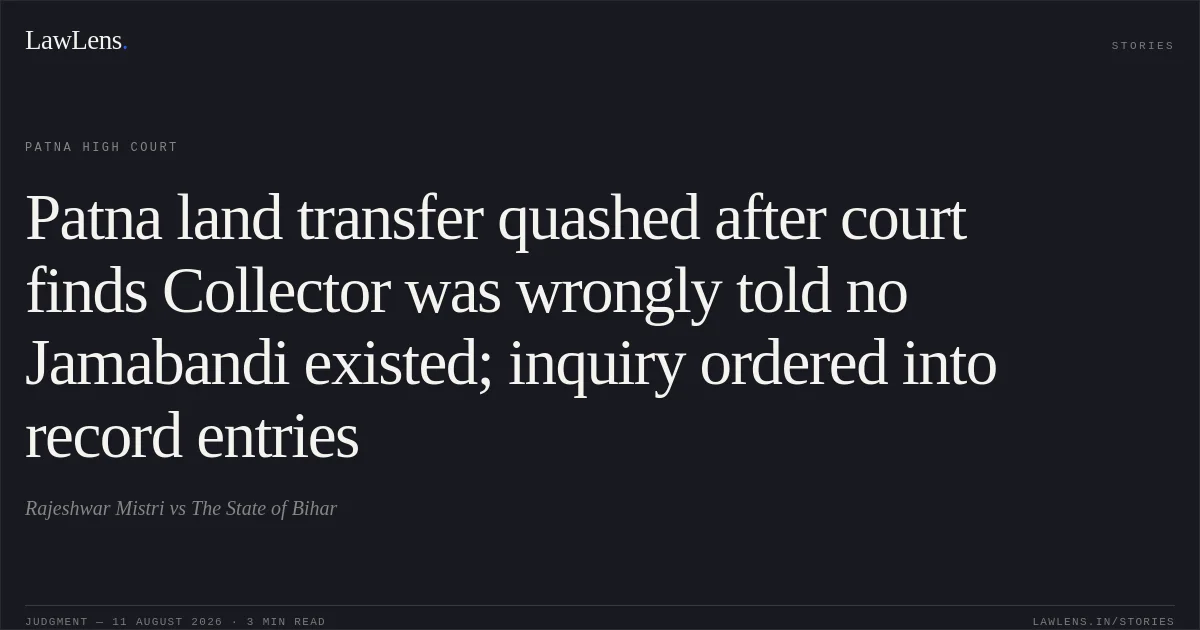
The High Court held that Memo No. 904 dated 10 February 2023 issued by the Collector, Patna, was erroneous because it incorrectly recorded that no jamabandi existed when the jamabandi was actually subsisting.
The memo was accordingly quashed.
Source reference: p. 7, para. 17The Court clarified that, in view of the subsequent cancellation of the jamabandi, the parties were at liberty to pursue the remedies available under law.
Source reference: p. 7, para. 18The Collector, Patna was further directed to enquire into the creation of the jamabandi entries and, if they were found to have been improperly made, to fix responsibility and institute appropriate civil or criminal proceedings.
Source reference: p. 7–8, para. 19The writ petition and pending interlocutory applications were disposed of.
Source reference: p. 8, para. 20Original Court PDF
Rajeshwar MistrivsThe State of Bihar
Click to open original judgment
Original judgment, available to read, download and summarize on LawLens.in