Facts
The applicants, retired employees, challenged an order dated 22.04.2016 which rejected their request to reconsider the withdrawal of higher pay scales (Rs. 5500-9000) originally granted in 2004.
Source reference: p. 2This withdrawal had seen prior litigation in the Bangalore Bench of the CAT and the High Court of Karnataka (WP (C) No. 3422/2021), both of which directed the respondents to provide fresh notices and reconsider the recovery of alleged excess payments.
Source reference: p. 2-3Following these directions, the respondents issued fresh individual notices but again rejected the applicants’ representations on 22.04.2016.
Source reference: p. 3The applicants filed the present Original Applications (OAs) in 2024 at the Principal Bench, New Delhi, accompanied by Miscellaneous Applications (MAs) for condonation of delay.
Source reference: p. 2The respondents objected, arguing the OAs were "hopelessly time-barred" as the cause of action arose in 2016.
Source reference: p. 3Issues
1. Whether the delay in filing the Original Applications challenging the pay re-fixation and recovery order of 2016 should be condoned on the grounds of a continuing cause of action.
Source reference: p. 4/para. 5-62. Whether the circumstances of the applicants as retired and geographically dispersed employees constitute sufficient cause for the delay.
Source reference: p. 4/para. 5.1-6Law Applied
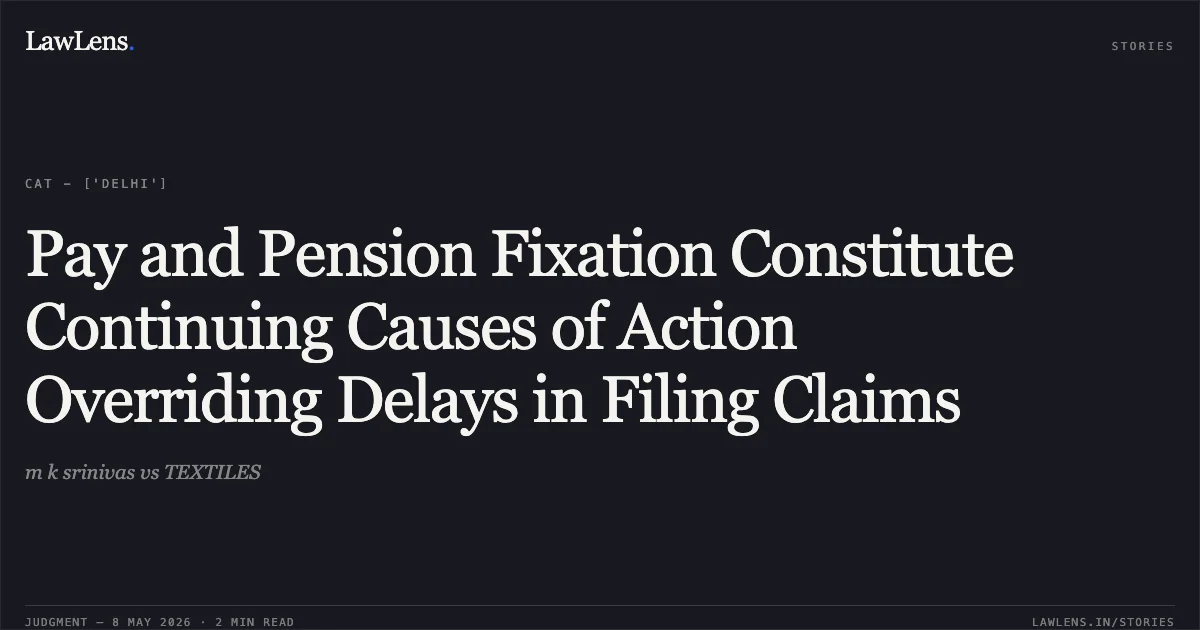
The Tribunal primarily applied the doctrine of "continuing cause of action" as established by the Supreme Court of India in M.R. Gupta v. Union of India & Ors. (1995), which holds that if an order involves a grievance regarding pay fixation, a fresh cause of action arises each month when the employee receives a reduced salary or pension.
Source reference: p. 4It further relied on Union of India v. Tarsem Singh (2008), which categorizes matters of pay and pension as exceptions to the general rule of limitation where delay may be condoned, provided no third-party rights are adversely affected.
Source reference: p. 4Reasoning
The Tribunal examined the timeline and noted that while the final rejection occurred on 22.04.2016, the applicants had made subsequent representations in 2018, 2019, 2021, and 2024.
Source reference: p. 5The Court acknowledged the respondent's argument that repeated representations do not normally extend the limitation period.
Source reference: p. 5However, the Tribunal balanced this against the nature of the claim, observing that pay fixation and pensionary benefits impact the applicants monthly, thereby constituting a recurring grievance.
Source reference: p. 4Taking into account the applicants' status as retired employees located at various sites across the country and the specific legal precedents cited, the Tribunal found that the case fell within the "rarest of the rare category" and the "exception of exceptions" where the interests of justice outweigh technical delays.
Source reference: p. 4-5Holding
The Tribunal allowed the Miscellaneous Applications and condoned the delay in filing OA No. 4374/2024 and OA No. 4194/2024.
The Court held that the grievances regarding pay re-fixation fall under the principles set by the Supreme Court in M.R. Gupta and Tarsem Singh.
Source reference: p. 5The respondents were directed to file counter-affidavits within four weeks, and the matter was scheduled before the Principal Registrar on 07.07.2026 for completion of pleadings.
Source reference: p. 5Acts & Sections Cited
1 provisions across 1 statute referred to in this judgment. Each provision opens on LawLens.
Administrative Tribunals Act, 19851
Original Court PDF
m k srinivasvsTEXTILES
Click to open original judgment
Original judgment, available to read, download and summarize on LawLens.in