Facts
The appellant Association represents employees of cooperative Sugar Mills in Tamil Nadu, whose service conditions are governed by the Tamil Nadu Co-operative Societies Act, 1983, the Rules and approved special bye-laws.
Source reference: p. 2–4The Association challenged the respondents’ reply dated 7 December 2023 and sought implementation of the Seventh Pay Commission’s recommendations for common-cadre employees, together with the remaining 3% increments for Special Grade and Selection Grade under G.O.Ms.No.237, dated 22 July 2013, with effect from 1 April 2013.
Source reference: p. 2After the writ court’s order dated 9 December 2025, the Association filed this writ appeal.
Source reference: p. 2The High Court noted that a committee was considering cadre and pay-revision issues, but its report had not yet been submitted.
Source reference: p. 6–7Issues
Whether Government Pay Commission benefits, including those under G.O.Ms.No.237, apply automatically to employees of cooperative Sugar Mills.
Source reference: p. 5, 8Whether the Association could obtain judicial directions to implement the Seventh Pay Commission while the committee’s review and the Government’s decision remained pending.
Source reference: p. 6–9Law Applied
Section 75 of the Tamil Nadu Co-operative Societies Act concerns the constitution of common cadres and provides that an employee’s salary, including allowances, shall not be varied to the employee’s disadvantage.
Source reference: p. 3–5Rule 149 of the Tamil Nadu Co-operative Societies Rules provides for service conditions—including pay scales and allowances—to be prescribed through a special bye-law adopted with the Registrar’s prior approval.
Source reference: p. 3–4These provisions protect existing salary against disadvantageous variation; they do not, by themselves, extend Government pay revisions to cooperative-society employees.
Source reference: p. 3–5G.O.Ms.No.237 applies to Government servants, and extension of Government Pay Commission benefits to cooperative Sugar Mill employees requires an independent administrative decision.
Source reference: p. 5The Court further held that, under Article 226, it could not direct implementation of a Pay Commission in the absence of that decision, particularly while the matter remained under consideration.
Source reference: p. 7–9Reasoning
The Court treated cooperative Sugar Mills as independent societies whose employees’ service conditions are governed by the Act, Rules and approved bye-laws, rather than by Government pay orders automatically.
Source reference: p. 3–5, 8Section 75’s protection against reducing an employee’s existing salary did not establish an entitlement to a Government pay revision or to G.O.Ms.No.237’s benefits.
Source reference: p. 4–5Because the committee had not submitted its report and the Government had yet to consider the matter and make an administrative decision, the claim for implementation of the Seventh Pay Commission was premature; the Court also held that it could not supply the required policy decision through judicial review.
Source reference: p. 6–9Holding
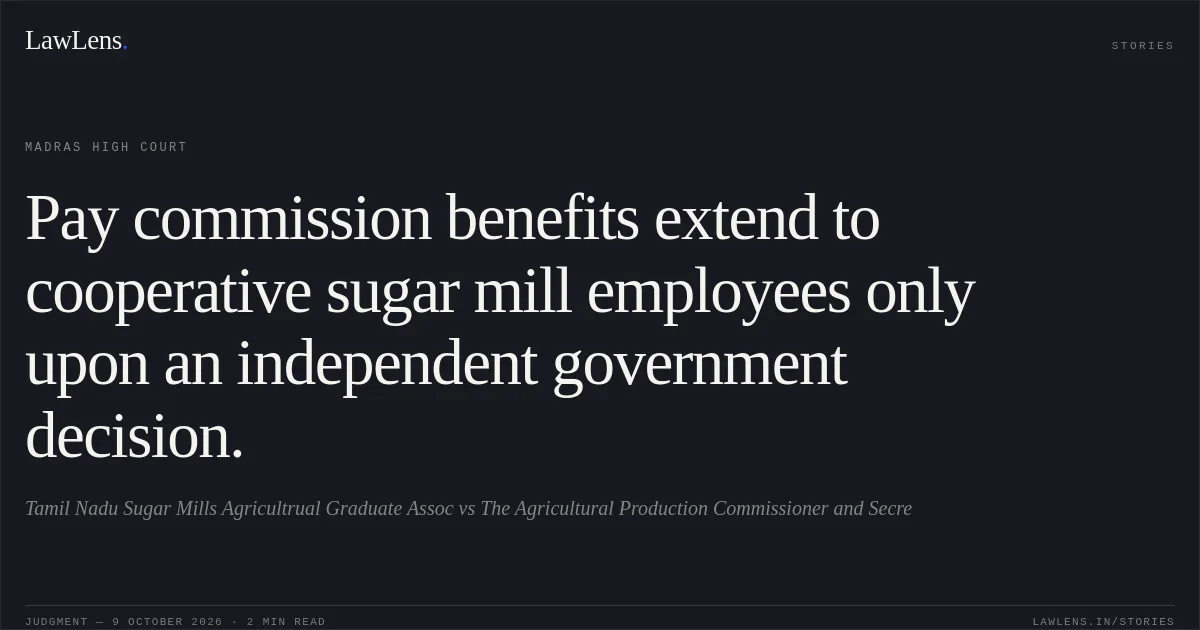
The Court held that Government Pay Commission benefits do not automatically extend to cooperative Sugar Mill employees and that no direction to implement those benefits could issue while the committee’s review and the Government’s decision remained pending.
It dismissed the writ appeal without costs.
Source reference: p. 9The Court also recorded that the 3% increment had been granted pursuant to the impugned writ order.
Source reference: p. 9Acts & Sections Cited
1 provisions across 1 statute referred to in this judgment. Linked provisions open on LawLens.
Tamil Nadu Co-Operative Societies Act, 19831
Original Court PDF
Tamil Nadu Sugar Mills Agricultrual Graduate AssocvsThe Agricultural Production Commissioner and Secre
Click to open original judgment
Original judgment, available to read, download and summarize on LawLens.in