Facts
The petitioner was recruited through the Tamil Nadu Public Service Commission as a Steno-Typist Grade III and joined service on 14 February 2007.
Source reference: p.2, para.2Pursuant to G.O.Ms. No. 1011 dated 7 December 2010 and G.O.Ms. No. 351 dated 30 June 2011, he was granted one additional increment, which continued to be reflected in subsequent pay revisions.
Source reference: p.2, para.2Following an audit objection, the respondents re-fixed his pay by withdrawing the additional increment on the ground that it was inadmissible.
Source reference: p.2, para.2After issuing a show-cause notice, the fourth respondent passed proceedings in ROC No. 1096/2021 dated 21 January 2022, directing recovery of ₹1,62,185 as excess payment.
Source reference: p.2, para.2The petitioner challenged the recovery order under Article 226 of the Constitution, seeking quashing of the order and refund of the recovered amount.
Source reference: no citationIssues
Whether the respondents were entitled to revise the petitioner’s pay by withdrawing the additional increment found to be inadmissible pursuant to an audit objection?
Source reference: p.3, para.3Whether recovery of ₹1,62,185 from the petitioner, after the excess payment had continued for several years without any misrepresentation by him, was legally permissible?
Source reference: pp.3–4, paras.4–5Whether the amount already recovered was required to be refunded to the petitioner?
Source reference: p.4, para.6Law Applied
Public authorities may rectify erroneous pay fixation and recover amounts that were not legally due, since unjust enrichment from public funds is impermissible.
Source reference: p.3, para.3Recovery may be prohibited where the excess payment resulted from the employer’s error, there was no misrepresentation by the employee, recovery after a prolonged period would cause hardship, or the recovery would be harsh, arbitrary or inequitable.
Source reference: pp.3–4, para.5The Court relied on State of Punjab v. Rafiq Masih, (2015) 4 SCC 334, particularly the principle that recovery is impermissible where excess payment has continued for more than five years before the recovery order and in cases where recovery would be iniquitous, harsh or arbitrary.
Source reference: pp.3–4, para.5The relevant Government Orders and applicable Pay Rules governed the correctness of the pay fixation, while the equitable limitations recognised in Rafiq Masih governed the permissibility of recovery.
Source reference: no citationReasoning
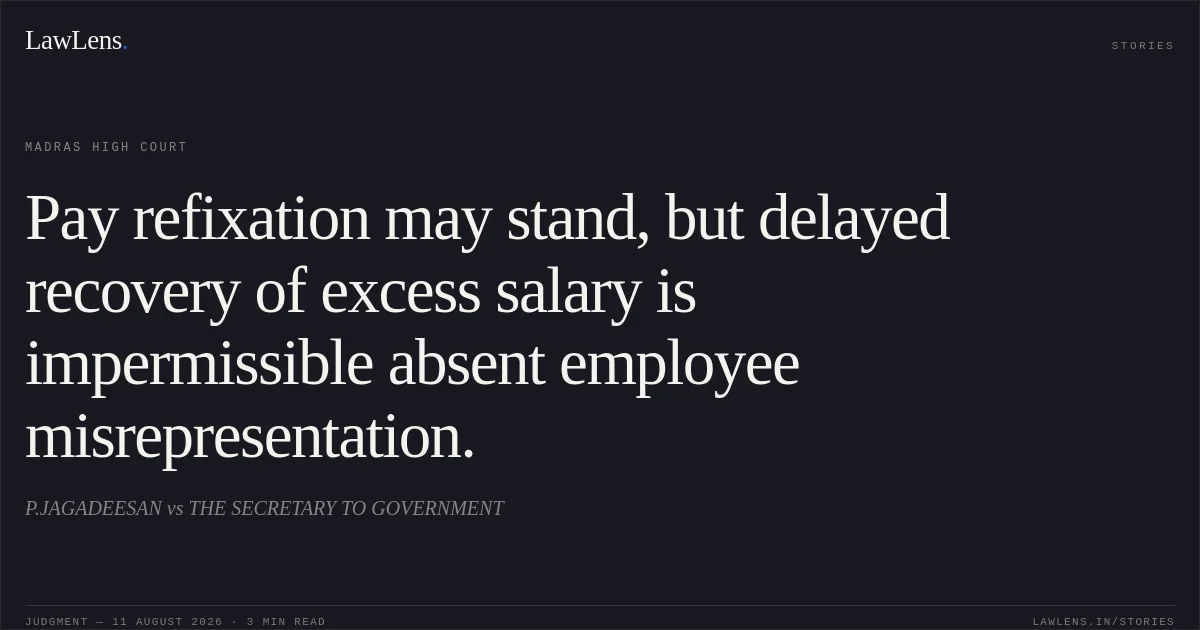
The Court held that the respondents were competent to correct the petitioner’s pay fixation after determining, pursuant to the audit objection, that the additional increment was inadmissible; accordingly, the revised pay fixation was allowed to stand.
Source reference: p.3, para.3; p.4, para.6Nevertheless, the respondents failed to establish that the petitioner had made any misrepresentation or played any role in the erroneous fixation of pay.
Source reference: p.3, para.4Since the additional increment had been reflected in the petitioner’s pay for several years, recovery at that stage would impose extreme hardship and would be inequitable under the principles in Rafiq Masih.
Source reference: pp.3–4, paras.4–5The Court therefore distinguished between correction of an erroneous pay fixation, which was valid, and recovery of the resulting excess payment, which was impermissible in the circumstances.
Source reference: no citationHolding
The writ petition was partly allowed.
The Court confirmed the revision of the petitioner’s pay consequent upon the audit objection but set aside the recovery of ₹1,62,185.
Source reference: p.4, para.6The respondents were directed to refund the amount already recovered to the petitioner within twelve weeks from the date of receipt of a copy of the order.
Source reference: p.4, para.6The connected miscellaneous petition was closed, with no order as to costs.
Source reference: p.4, para.7Original Court PDF
P.JAGADEESANvsTHE SECRETARY TO GOVERNMENT
Click to open original judgment
Original judgment, available to read, download and summarize on LawLens.in