Facts
The applicants (63 retired Assistant Superintendents and Superintendents of Posts) filed this Original Application (OA) seeking a retrospective pay scale revision to ₹6500-10500 for Inspectors and ₹7450-11500 for Assistant Superintendents effective from 01.01.1996.
Source reference: p. 9They also sought re-fixation of pension and 12% interest on arrears.
Source reference: p. 9The applicants relied on a 2006 decision by the Ernakulam Bench of the Tribunal (OA No. 671/2003) which granted similar relief to Auditors in the same department, a decision upheld by the Supreme Court in 2013.
Source reference: p. 11-12The respondents opposed the OA at the admission stage, citing a three-decade delay (limitation), the "fence-sitter" status of the applicants, and the argument that pay revision is a policy matter within the executive domain.
Source reference: p. 10-11Issues
1. Whether the OA is barred by limitation under Section 21 of the Administrative Tribunals Act, 1985, given the cause of action arose in 1996.
Source reference: p. 10 / para. 2.1(i)2. Whether the applicants are "fence-sitters" who are disentitled to relief due to laches despite subsequent favorable judgments for other employees.
Source reference: p. 11 / para. 2.1(iii)3. Whether the Tribunal should interfere in matters of retrospective pay revision, which fall under the executive's policy domain.
Source reference: p. 10 / para. 2.1(ii)Law Applied
Section 21 of the Administrative Tribunals Act, 1985, which mandates strict timelines for filing applications.
Source reference: p. 11S.S. Rathore v. State of MP, establishing that repeated representations do not extend the limitation period.
Source reference: p. 16Union of India v. P.V. Hariharan, which held that pay fixation is a complex government function and Tribunals should exercise restraint to avoid cascading financial effects.
Source reference: p. 13-14State of UP v. Arvind Kumar Srivastava, which dictates that employees who wait for others to litigate and succeed before filing their own belated claims are barred by laches and acquiescence.
Source reference: p. 17-18The Court distinguished M.R. Gupta v. Union of India and Union of India v. Tarsem Singh, noting that those cases applied to "continuing wrongs" in individual pay fixations, not general retrospective pay revisions.
Source reference: p. 16Reasoning
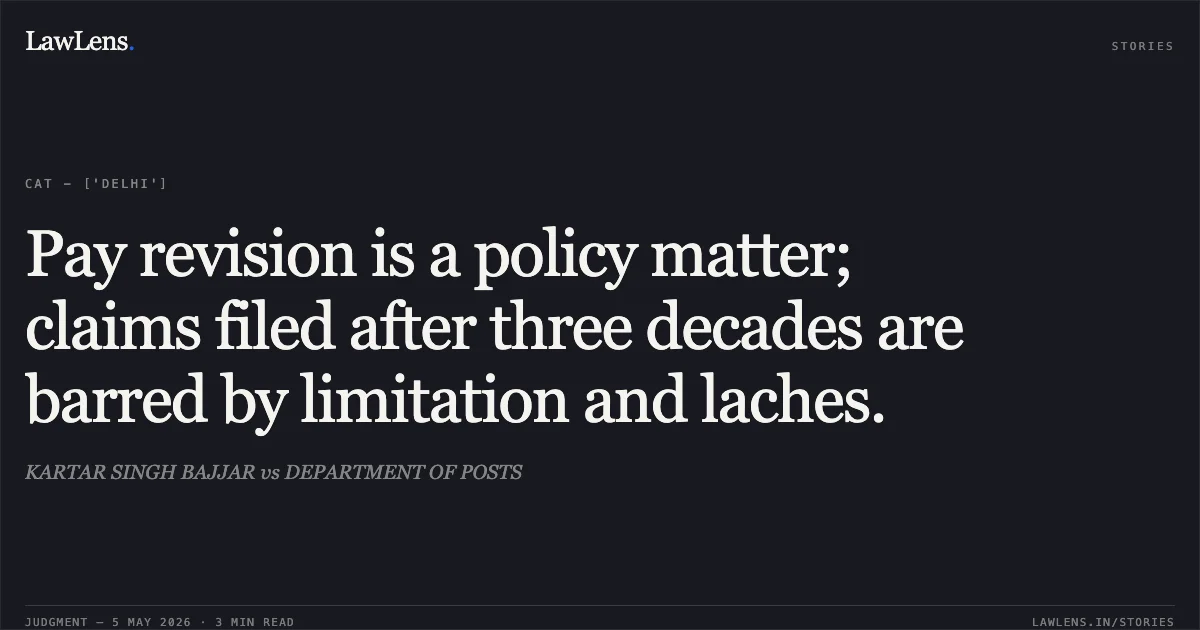
The Tribunal reasoned that the applicants were seeking a "pay revision" effective from 1996, which is a policy decision belonging to the Executive and Pay Commissions, rather than a mere correction of a mechanical "pay fixation" error.
Source reference: p. 13The Tribunal found that nearly 30 years had elapsed since the implementation of the 5th CPC, and the applicants failed to file a Miscellaneous Application for condonation of delay.
Source reference: p. 15Even after the 2006 Ernakulam Bench order they relied upon, the applicants waited 20 years to approach the Tribunal.
Source reference: p. 17The Court determined that the applicants were "fence-sitters" who had acquiesced to the existing scales.
Source reference: p. 18Furthermore, the Tribunal emphasized that granting such retrospective relief after three successive Pay Commissions (5th, 6th, and 7th) would cause an impermissible "cascading effect" on the public exchequer.
Source reference: p. 14-15Holding
The Tribunal held that the application was barred by limitation and the doctrine of laches/delay.
The Court concluded that the applicants, as fence-sitters, could not claim the benefit of older judgments rendered in personam.
Source reference: p. 18-19The claim for retrospective pay revision was deemed a policy matter beyond the Tribunal’s primary functions, especially after such a prolonged period.
Source reference: p. 15The Tribunal dismissed the OA in limine (at the admission stage). No order as to costs was made.
Source reference: p. 19Acts & Sections Cited
2 provisions across 1 statute referred to in this judgment. Each provision opens on LawLens.
Administrative Tribunals Act, 19852
Original Court PDF
KARTAR SINGH BAJJARvsDEPARTMENT OF POSTS
Click to open original judgment
Original judgment, available to read, download and summarize on LawLens.in