Facts
The petitioners, Health Educators in the State Health Department, challenged the State’s decision to grant them a re-revised pay structure of ₹10,300–34,800 with Grade Pay of ₹4,200 only from 1 February 2016.
Source reference: p. 7–9; paras 2(iii), 8(iv)–8(v)The same Grade Pay had been granted to their feeder category, Male/Female Health Supervisors (later Multipurpose Health Supervisors), from 1 October 2012.
Source reference: p. 7–9; paras 2(iii), 8(iv)–8(v)The Health Educators’ Recruitment and Promotion Rules treated their posts as promotional posts and prescribed different qualifications and recruitment methods from those applicable to the feeder category.
Source reference: p. 25–30; paras 8(i)–8(ii)Their Original Application before the State Administrative Tribunal was transferred to the High Court after the Tribunal’s abolition.
Source reference: p. 1; para 1Issues
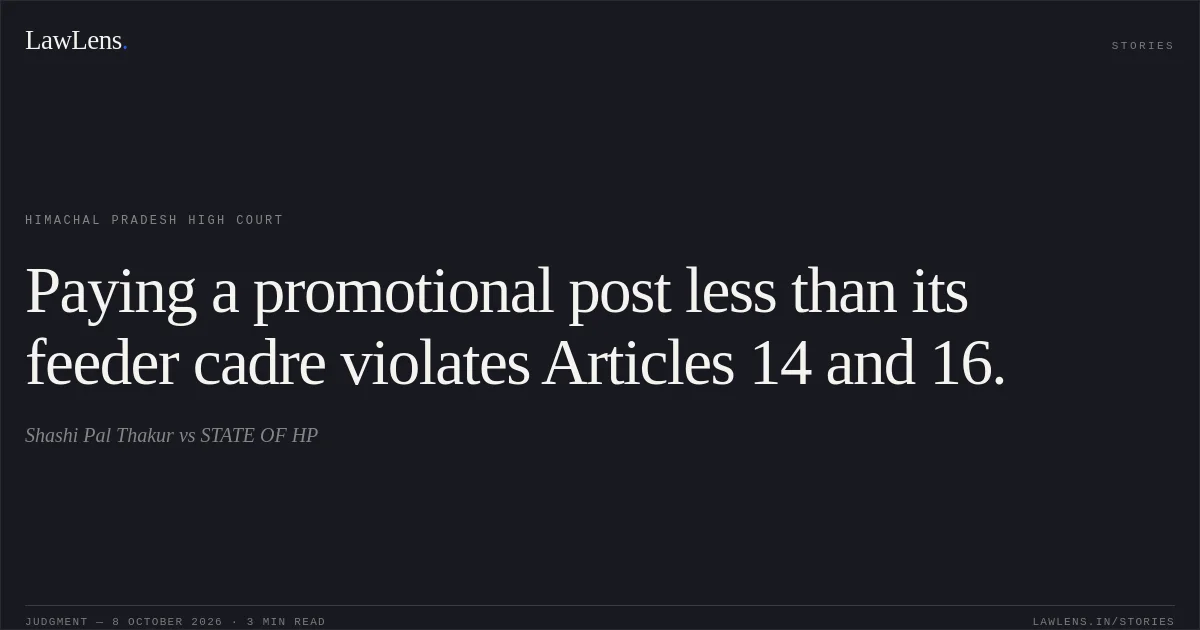
Whether granting the Health Educators the same Grade Pay as their feeder category, and from a later date, created an arbitrary pay anomaly contrary to Articles 14 and 16 of the Constitution
Source reference: p. 45–50; paras 10(ii)–10(iv); p. 80–89; paras 13–15Whether the State could treat the Health Educators’ promotional posts as equivalent to the feeder posts, or change their status from “promotion” to “placement,” without amending the applicable Recruitment and Promotion Rules
Source reference: p. 71–80; paras 12(i)–12(iv)Whether Rules 1(ii), 8 and 9 of the Himachal Pradesh Civil Services (Category/Post-wise Revised Pay) Rules, 2012 permitted the State to apply the re-revised pay structure from different dates in a manner that discriminated against the petitioners
Source reference: p. 30–33; para 8(iii); p. 85–93; paras 14–16Law Applied
The Court recognised that pay-scale fixation and post-equivalence ordinarily fall within the executive’s domain and that courts should intervene only where there is cogent evidence of grave error, arbitrariness or hostile discrimination.
Source reference: p. 61–65; para 11(ix); p. 100–105; paras 21(ii)–21(vi)In assessing pay parity, it relied on the principles that the nature of duties, qualifications, recruitment method, responsibility and accountability are relevant, and that equal pay for equal work is not established by designation or functional similarity alone (Government of West Bengal v. Tarun K. Roy, (2004) 1 SCC 347; SBI v. M.R. Ganesh Babu, (2002) 4 SCC 556; State of Haryana v. Charanjit Singh, (2006) 9 SCC 321; Steel Authority of India Ltd. v. Dibyendu Bhattacharya, (2011) 11 SCC 122).
Source reference: p. 52–60; paras 11(ii)–11(viii)It also relied on Secretary, Finance Department v. West Bengal Registration Service Association, 1993 Supp (1) SCC 153, concerning judicial review where a grave pay-fixation error causes injustice, and State of U.P. v. Virender Bahadur Katheria, (2024) 15 SCC 1, for the principle that a promotional or higher post should not carry a lower pay structure than its feeder cadre.
Source reference: p. 47–49; para 10(iii); p. 61–65; para 11(ix); p. 105–106; para 21(vii)The applicable statutory framework included the Health Educators’ Recruitment and Promotion Rules, 1999; the 2012 Revised Pay Rules, particularly Rules 1(ii), 8 and 9; and Articles 14, 16 and 309 of the Constitution.
Source reference: p. 25–33; paras 8(i)–8(iii)Reasoning
The Court found that the Health Educator posts were recognised by the 1999 Rules as promotional posts and differed from the feeder posts in qualifications, recruitment, duties, responsibilities and hierarchical position.
Source reference: p. 65–71; para 11(ix)It held that leaving the petitioners on a lower pay structure while feeder-category employees received Grade Pay of ₹4,200 from 1 October 2012, and granting the petitioners the same Grade Pay only from 1 February 2016, produced an unexplained and discriminatory anomaly.
Source reference: p. 45–50; paras 10(ii)–10(iv); p. 80–89; paras 13–15The State could not alter the promotional character of the posts through a pay notification without amending the statutory Recruitment and Promotion Rules; nor, in the Court’s view, did Rule 8 override those Rules in this respect.
Source reference: p. 76–80; paras 12(iv)–12(iii); p. 90–98; paras 16, 19Given the absence of a cogent explanation for the differential effective dates and the resulting prejudice, the Court held that the State’s exercise of discretion warranted judicial intervention.
Source reference: p. 106–110; para 21(viii)Holding
The High Court allowed the petition.
It quashed the 30 January 2016 notification insofar as it granted the petitioners Grade Pay of ₹4,200 from 1 February 2016, and directed the State to reconsider the matter and grant an appropriate proportionately higher Grade Pay from 1 October 2012.
Source reference: p. 111–115; paras 22–25It also quashed the prospective effective date, read down Rules 1(ii) and 9, held Rule 8 inapplicable to the case, and declared the unamended change from “promotion” to “placement” inoperative.
Source reference: p. 113–115; para 25(i)–(vii)The revised benefits were to be notionally fixed from 1 October 2012, with actual monetary benefits limited to the three years preceding the filing of the writ petition—15 September 2013—and thereafter; the State was directed to comply within four weeks.
Source reference: p. 115; para 25(viii)–(ix)Original Court PDF
Shashi Pal ThakurvsSTATE OF HP
Click to open original judgment
Original judgment, available to read, download and summarize on LawLens.in