Facts
The petitioner, a partnership firm, was subjected to search and seizure operations by the Directorate General of GST Intelligence (DGGI) on 11.07.2025 at its business and residential premises
Source reference: para. 2During the search, the petitioner deposited ₹2,35,23,506/- (via ITC reversal and cash) through Form GST DRC-03
Source reference: para. 2.2The petitioner subsequently retracted statements made during the search, alleging the payments were made under coercion and departmental pressure
Source reference: para. 2.3The respondents claimed the payment was a voluntary "self-ascertainment" of tax liability under Section 74(5) of the CGST Act following intelligence that the petitioner availed fraudulent ITC without physical supply of goods
Source reference: para. 4.2The petitioner moved the High Court seeking a refund of the deposited amount
Source reference: para. 1Issues
1. Whether the amount of ₹2,35,23,506/- deposited through Form GST DRC-03 during search and seizure proceedings was a voluntary payment under Section 74(5) of the CGST Act or obtained through coercion
Source reference: para. 72. Whether the non-issuance of Form GST DRC-04 and non-adherence to CBIC Instruction No. 01/2022-23 vitiates the characterization of the payment as "voluntary"
Source reference: para. 13, 15Law Applied
Section 74(5) of the CGST Act, 2017, which permits a person to pay tax, interest, and a 15% penalty based on self-ascertainment before the service of a show-cause notice
Source reference: para. 6.1Rule 142(2) of the CGST Rules, 2017, which mandates the proper officer to issue an acknowledgment in Form GST DRC-04 upon receipt of voluntary payment
Source reference: para. 6.3The court relied on the "voluntariness" standards established in Vallabh Textiles v. Senior Intelligence Officer and Bhumi Associate v. Union of India, as incorporated in CBIC Instruction No. 01/2022-23, which advises that voluntary payments should be made after the conclusion of search proceedings to prevent coercion
Source reference: para. 8.1, 15The court referenced the Supreme Court’s dictum in Radhika Agarwal v. UOI, emphasizing that Section 74(5) does not postulate payment under force or threat of arrest
Source reference: para. 10Reasoning
The court reasoned that the "voluntariness" of a payment is a question of fact determined by the attending circumstances
Source reference: para. 10.1It observed that the deposit was made while search proceedings were ongoing and records were under the control of authorities, leaving no room for independent "self-ascertainment" by the petitioner
Source reference: para. 12The court found that the respondents produced no contemporaneous material to show the petitioner determined the liability independently prior to the search
Source reference: para. 11Furthermore, the respondents failed to issue the mandatory acknowledgment in Form GST DRC-04
Source reference: para. 13The court rejected the Revenue's argument that the payment was voluntary based on the remarks in Form DRC-03, noting that the deposit occurred only after the investigative machinery was set in motion and failed to adhere to the safeguard of making payments after search teams left the premises
Source reference: para. 12.1, 15The petitioner's prompt retraction further negated the plea of voluntary compliance
Source reference: para. 14Holding
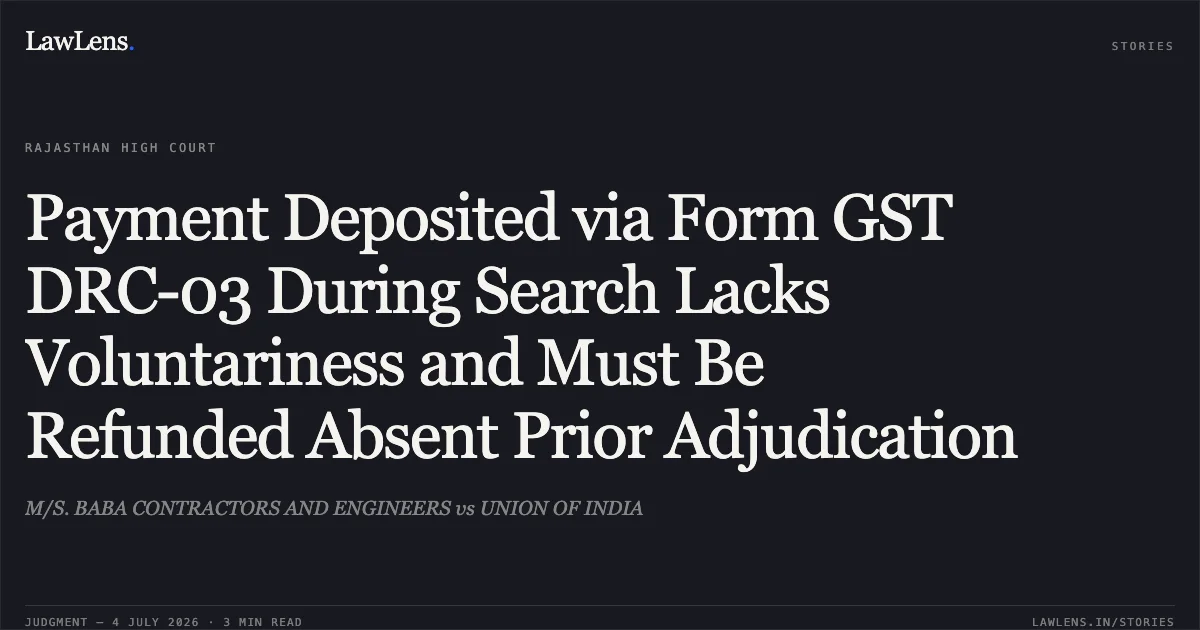
The court held that the deposit was not voluntary and was obtained in violation of statutory safeguards and CBIC instructions
It partially allowed the writ petition and directed the respondents to refund ₹2,35,23,506/- within eight weeks
Source reference: para. 18, 19The court declined to grant interest at this stage, as the final tax liability is yet to be adjudicated in the ongoing investigation
Source reference: para. 18.1The respondents were permitted to continue their investigation and initiate formal adjudication proceedings in accordance with the Law
Source reference: para. 20Acts & Sections Cited
15 provisions across 1 statute referred to in this judgment. Each provision opens on LawLens.
Central Goods and Services Tax Act, 2017
Original Court PDF
M/S. BABA CONTRACTORS AND ENGINEERSvsUNION OF INDIA
Click to open original judgment
Original judgment, available to read, download and summarize on LawLens.in