Facts
The Petitioner, Tata Sons, entered into a Shareholders Agreement (SHA) with NTT Docomo in 2009
Source reference: para. 4Following disputes regarding share buyback obligations, an LCIA Arbitral Tribunal awarded Docomo damages of approximately USD 1.17 billion plus interest and costs
Source reference: para. 5Docomo initiated enforcement proceedings in the UK and USA, and a petition in the Delhi High Court under Sections 47 and 48 of the Arbitration and Conciliation Act (ACA)
Source reference: para. 6The parties entered into Consent Terms before the Delhi High Court, wherein Tata agreed to pay the award amount (approx. Rs. 8,450 crores) and Docomo agreed to suspend and eventually withdraw the foreign enforcement proceedings
Source reference: para. 37, 41The Respondents (DGGI) issued an intimation (DRC-01A) and a subsequent Show Cause Notice (SCN) demanding Rs. 1,524 crores as IGST
Source reference: para. 2, 16The Revenue alleged that by withdrawing foreign execution proceedings and "tolerating" the breach of the SHA, Docomo provided a taxable "supply of service" under the "reverse charge" mechanism
Source reference: para. 46, 54Issues
1. Whether the settlement of an arbitral award for damages, including the agreement to withdraw enforcement proceedings, constitutes a "supply" of service under Section 7 of the CGST Act read with Entry 5(e) of Schedule II
Source reference: para. 40, 562. Whether the impugned Show Cause Notice was issued in violation of binding CBIC Circulars and settled legal principles regarding the nature of damages
Source reference: para. 30(v), 69Law Applied
Section 7 of the CGST Act, which defines the scope of "supply" as requiring "consideration" and being in the "course or furtherance of business"
Source reference: para. 57Schedule II, Entry 5(e), which classifies "agreeing to the obligation to refrain from an act, or to tolerate an act" as a supply of service
Source reference: para. 58CBIC Circular No. 178/10/2022-GST, which clarifies that liquidated damages paid for breach of contract are a "mere flow of money" and not consideration for a supply
Source reference: para. 69The principle from Union of India v. Raman Iron Foundry, affirming that damages are compensation granted by the "fiat of the court" rather than a pre-existing pecuniary liability
Source reference: para. 82-83Reasoning
The Court reasoned that for Entry 5(e) of Schedule II to apply, there must be an independent agreement to tolerate an act for a specific consideration
Source reference: para. 61, 74The payment made by Tata was purely to satisfy an arbitral award for damages arising from a breach of contract
Source reference: para. 66The Court found that the withdrawal of foreign enforcement proceedings (UK/US) was an "incidental" and "logical consequence" of the satisfaction of the debt, not an independent service
Source reference: para. 63, 67, 80The Revenue's attempt to bifurcate the settlement into a "new contract" for toleration was held to be a "fundamental flaw"
Source reference: para. 68Since the award amount was characterized as damages (compensation for injury) and not consideration for any activity, no "supply" occurred
Source reference: para. 71, 76The Court emphasized that the Revenue’s logic would absurdly subject every court-mandated settlement of a money decree to GST
Source reference: para. 69, 79Holding
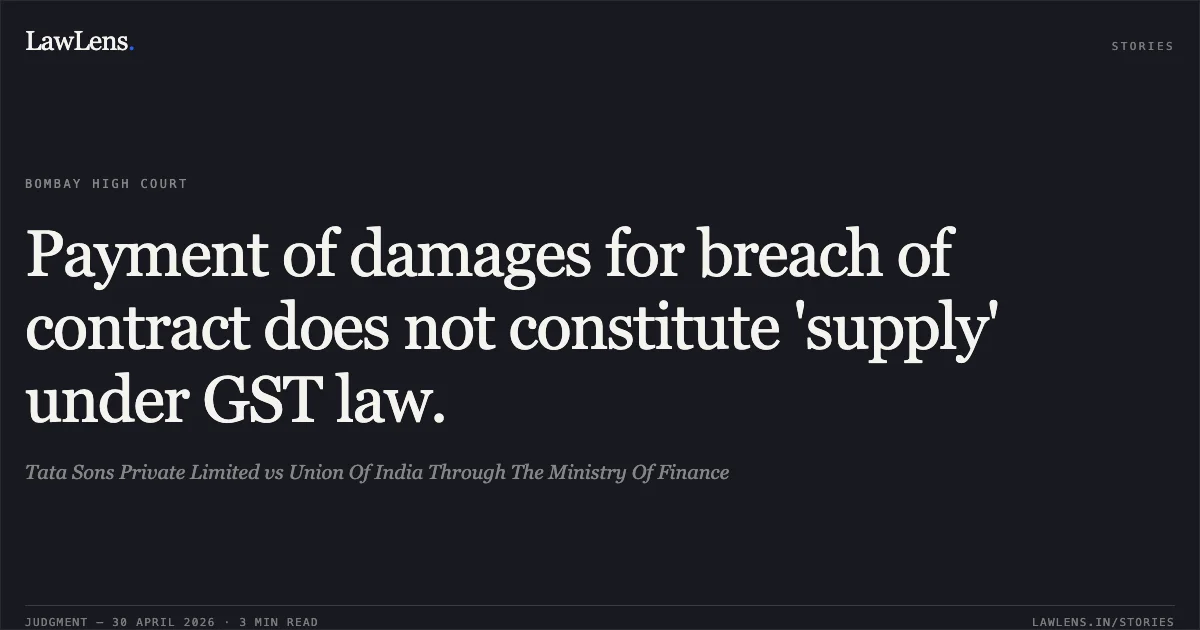
The Court held that the settlement of an arbitral award does not constitute a "supply" under Section 7 of the CGST Act
The agreement to not pursue execution proceedings is integral to the satisfaction of the decree and lacks independent consideration
Source reference: para. 78, 84The DGGI lacked jurisdiction to levy IGST on the decretal amount
Source reference: para. 87The Court quashed and set aside the intimation under Form DRC-01A and the Show Cause Notice dated 26 July 2023
Source reference: para. 90Acts & Sections Cited
30 provisions across 8 statutes referred to in this judgment. Each provision opens on LawLens.
Central Goods and Services Tax Act, 2017
Integrated Goods and Services Tax Act, 20175
Arbitration and Conciliation Act, 19965
Indian Contract Act, 18722
Code of Civil Procedure, 19083
Transfer of Property Act, 18821
Customs Act,19621
Customs Tariff Act, 19751
Original Court PDF
Tata Sons Private LimitedvsUnion Of India Through The Ministry Of Finance
Click to open original judgment
Original judgment, available to read, download and summarize on LawLens.in