01Facts
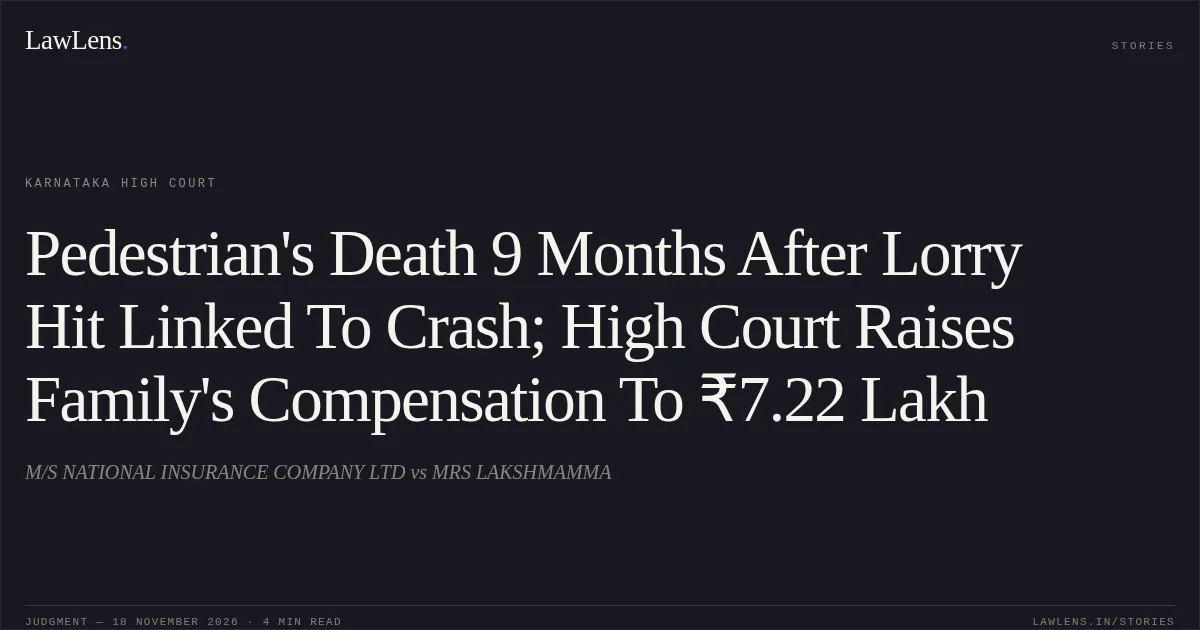
On 09.01.2008, the deceased, Muniyappa (aged about 60), was walking on foot when a lorry (KA-30/2485) struck him due to rash and negligent driving.
¶ 4He was treated at Harsha Hospital and then admitted as an in-patient at Abhaya Hospital for about 40 days, including ventilator support, tracheostomy, and ICU care, and was discharged on 20.02.2008 in a "stable" condition needing conservative management.
¶ 4 · ¶ 12 · ¶ 14He died on 12.10.2008, roughly nine months after the accident, and the post-mortem recorded septicemic shock.
¶ 4 · ¶ 12.1The Insurance Company contended that the death was unconnected to the injuries, that the deceased had diabetes and hypertension, and that no post-discharge treatment was documented.
¶ 4.2 · ¶ 10 · ¶ 10.1The Tribunal's first dismissal of the claim (02.12.2010) was set aside and remanded on 07.06.2017 in MFA No. 5380/2011, for fresh evidence.
¶ 3On remand, the Tribunal found negligence and causation proved, assessed notional income at Rs.5,000/- per month, applied a multiplier of 9 with a 50% personal-expense deduction, and awarded Rs.5,07,977/- with 9% interest from the petition date.
¶ 7 · ¶ 8 · ¶ 8.1 · ¶ 8.2The Insurance Company appealed (MFA 2534/2018) against liability and quantum. The claimants (wife and two sons) appealed (MFA 4942/2018) seeking enhancement to Rs.13,00,000/-.
¶ 2 · ¶ 9 · ¶ 11.102Issues
i.1. Whether the death of the deceased, approximately nine months after the accident, can be causally attributed to the injuries sustained in the motor vehicle accident, despite the claimed pre-existing diabetes and hypertension.
¶ 10 · ¶ 13 · ¶ 14 · ¶ 15.1ii.2. Whether the Tribunal erred in deducting 50% towards personal expenses where the deceased had three dependants, and whether the compensation under the conventional heads requires modification in light of Pranay Sethi.
¶ 11.1 · ¶ 16 · ¶ 17iii.3. Whether interest at 9% per annum on the compensation is justified in a death case.
¶ 18 · ¶ 1903Law Applied
The Court's reasoning rests on the claim framework under Section 166 of the Motor Vehicles Act, 1988 and the appellate power under Section 173(1), as invoked in the appeals.
p. 1 (preamble) · ¶ 2On causation, the Court relied on the principle that the evidentiary record, including the discharge summary and post-mortem report, must establish a nexus between accident injuries and death; the absence of contrary evidence on the insurer's side (for hypertension or diabetes) is decisive.
¶ 14 · ¶ 15On quantum, the Court applied National Insurance Co. Ltd. v. Pranay Sethi (2017) 16 SCC 680, which governs multiplier and dependency computation, consortium (Rs.40,000/- per claimant), and a 30% escalation on conventional heads.
¶ 8 · ¶ 16.1 · ¶ 17On interest, the Court followed United India Insurance Co. Ltd. v. Malyadri M. and the Division Bench rulings in Smt. Divya V.M. v. Veerabhadrashetti K.C. (NC: 2026:KHC:39850-DB) and Bimal Gogai v. BMTC (NC: 2026:KHC:27563-DB), which hold that 9% per annum is appropriate in death and serious-injury cases involving long delay, with no rigid formula.
¶ 18 · ¶ 18.1 · ¶ 19Provisions in the judgment · 5 · Linked ones open on LawLens
Motor Vehicles Act, 1988 Section 173Section 166Section 187
Indian Penal Code, 1860 Section 279Section 337
04Reasoning
On causation, the Court rejected the insurer's delay-based argument. It reasoned that a 60-year-old pedestrian who survived a lorry impact with severe head injuries, required two ventilator episodes, and was discharged only for conservative management with a nurse recommended, could not have been self-sufficient.
¶ 14The post-mortem's septicemia finding, a recognised life-threatening complication, was treated as a continuing consequence of the injuries.
¶ 15The Court found the insurer had produced no evidence that hypertension or diabetes caused death, and that the claimants' admitted lack of post-discharge treatment records did not break the causal chain.
¶ 14 · ¶ 15.1On quantum, the Court corrected the Tribunal's 50% deduction. Because three dependants were admitted, the deduction was reduced to one-third, and the dependency loss rose from Rs.2,70,000/- to Rs.3,60,000/-.
¶ 16Consortium was fixed at Rs.40,000/- per claimant, totalling Rs.1,20,000/-, then escalated by 30%. The Court left the medical expenses (Rs.1,67,977/-) undisturbed.
¶ 16.1 · ¶ 17 · ¶ 8.1 · ¶ 17, TableTwo points warrant note for practitioners: the 30% escalation is stated to apply to "conventional heads" yet is not applied to the loss of dependency figure; and the Tribunal's separate Rs.15,000/- loss-of-love-and-affection award does not appear in the revised table.
¶ 8.1 · ¶ 17On interest, the Court relied on the consistent 9% rate for death cases, given the claimants' long wait since the 2008 death.
¶ 18 · ¶ 1905Holding
The Insurance Company's appeal (MFA 2534/2018) is dismissed; the Court holds that the death was causally linked to the accident and that the insurer's liability stands.
¶ 15.1 · ¶ 20(i)The claimants' appeal (MFA 4942/2018) is allowed in part. The Court holds that the deduction for personal expenses must be one-third where there are three dependants, and that consortium and escalation under Pranay Sethi apply. Compensation is enhanced to Rs.7,22,977/- (loss of dependency Rs.3,60,000/-; consortium Rs.1,56,000/-; funeral Rs.19,500/-; transportation Rs.19,500/-; medical Rs.1,67,977/-).
¶ 16 · ¶ 16.1 · ¶ 17 · ¶ 17.1 · ¶ 20(iii)Interest at 9% per annum is retained on the entire compensation from the date of petition until realisation.
¶ 19 · ¶ 20(iii)The Insurance Company is directed to deposit the entire compensation with interest within eight weeks, with release to the claimants on application; the remainder of the Award stands undisturbed; no order as to costs.
¶ 20(iv)–(ix)Original Court PDF
M/S NATIONAL INSURANCE COMPANY LTDvsMRS LAKSHMAMMA
Click to open original judgment
Original judgment, available to read, download and summarize on LawLens.in