Facts
On September 3, 2019, Suryakant Upadhyay (the deceased), an NTPC trainee, died in a motor vehicular accident when a trailer (OD-16-D-3941) hit his scooty.
Source reference: p. 2, 3The claimants (legal representatives) filed for compensation under Section 166 of the M.V. Act.
Source reference: no citationThe Tribunal awarded Rs. 1,14,51,118/- with 6% interest and a 12% penal interest clause for default.
Source reference: p. 2The Insurer appealed on grounds of non-deduction of income tax, erroneous inclusion of rehabilitation schemes, and the illegality of penal interest.
Source reference: p. 4, 5The claimants appealed seeking an enhancement of the quantum.
Source reference: p. 4, 5Issues
1. Whether the compensation should be reduced due to potential employment benefits under the NTPC "NEFERS" scheme.
Source reference: p. 5, 62. Whether the Tribunal had the authority to impose a default penal interest rate of 12%.
Source reference: p. 63. Whether the Tribunal erred in its methodology for deducting income tax and calculating the net income of the deceased.
Source reference: p. 7Law Applied
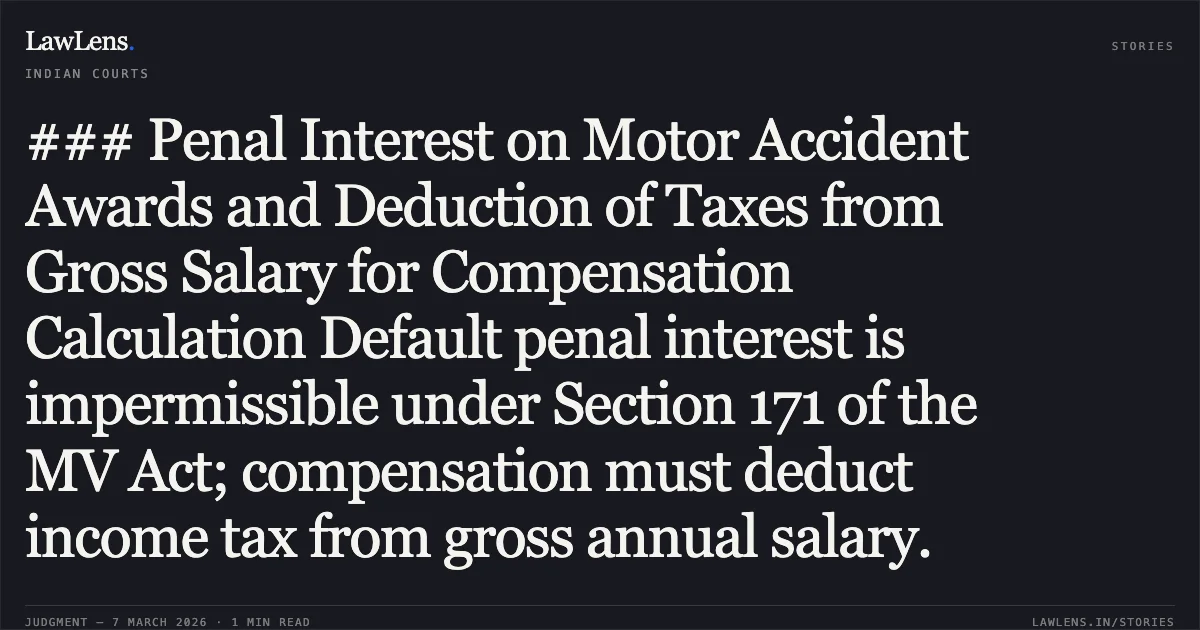
The Court applied Section 171 of the Motor Vehicles Act, 1988, which empowers Tribunals to award interest but does not provide for "default" or "penal" interest rates.
Source reference: p. 6It followed the principles for calculating "Loss of Dependency" established in Sarla Verma v. DTC and National Insurance Co. Ltd. v. Pranay Sethi, specifically regarding the 50% deduction for personal expenses of a bachelor.
Source reference: p. 8The principles from Sarla Verma v. DTC and National Insurance Co. Ltd. v. Pranay Sethi regarding a 50% addition for future prospects of a person below 40 years with a permanent job were applied.
Source reference: p. 7The principles from Sarla Verma v. DTC and National Insurance Co. Ltd. v. Pranay Sethi regarding the mandatory deduction of actual/estimated income tax from gross income were applied.
Source reference: p. 7, 8Reasoning
The Court found the insurer’s claim regarding the "NEFERS" benefit meritless, as NTPC confirmed the deceased was an ineligible trainee.
Source reference: p. 6Regarding interest, the Court held that the law only contemplates standard interest; thus, the 12% penal clause was legally unsustainable.
Source reference: p. 6Critically, the Court found the Tribunal's tax deduction flawed as it deducted tax on a monthly basis rather than calculating it on an annual slab.
Source reference: p. 7The Court recalculated the gross annual income as Rs. 9,35,280/- and added 50% for future prospects.
Source reference: p. 7, 8From this total, it subtracted 50% for personal expenses (bachelor status), applied a 10% notional income tax deduction (due to lack of specific tax records), and deducted professional tax and 'Sneha Kiran' contributions before applying a multiplier of 18.
Source reference: p. 8, 9Holding
The Court partially allowed the Insurer’s appeal and dismissed the claimants' appeal.
It modified the award, reducing the total compensation from Rs. 1,14,51,118/- to Rs. 1,13,10,452/-.
Source reference: p. 9The Court specifically struck down the 12% penal interest clause, maintaining only the 6% simple interest from the date of the claim.
Source reference: p. 9The Insurer was directed to deposit the modified amount within eight weeks.
Source reference: p. 10Acts & Sections Cited
3 provisions across 1 statute referred to in this judgment. Each provision opens on LawLens.
Motor Vehicles Act, 19883
Original Court PDF
Ramakrishna Upadhyay & Another v. Rajesh Kumar Pandey & Another
Click to open original judgment
Original judgment, available to read, download and summarize on LawLens.in