Facts
The Petitioner, an Assistant Engineer and Public Information Officer (PIO) at the Chhattisgarh State Power Distribution Company Limited (CSPDCL), received two RTI applications from Respondent No. 2 seeking information regarding electricity grievance cases
Source reference: para. 4, 10-11As the information pertained to a different office, the Petitioner forwarded the applications to the Junior Engineer (JE), Sakri, on 07.11.2017
Source reference: para. 4The JE failed to provide the information within the stipulated 30 days due to being away for training
Source reference: para. 12Following a first appeal, the information was eventually provided by both the JE and the First Appellate Authority
Source reference: para. 4-5Despite this, the Respondent No. 1 (Information Commission) initiated show-cause proceedings and subsequently issued orders dated 06.03.2020 imposing the maximum penalty of ₹25,000 in each case upon the Petitioner for the delay
Source reference: para. 2-4Issues
1. Whether the Petitioner could be held liable for penalty under Section 20(1) of the RTI Act when she had forwarded the application to the concerned subordinate officer under Section 5(4) of the Act
Source reference: para. 5, 172. Whether the imposition of the maximum penalty by the State Information Commission was legally sustainable in the absence of a finding of mala fide intent or unreasonable delay
Source reference: para. 14, 17Law Applied
The Court primarily applied Section 20(1) of the Right to Information Act, 2005, which empowers the Commission to impose penalties only if a PIO has, without reasonable cause, refused an application, delayed information, or acted mala fide
Source reference: para. 5, 16The Court also relied on Sections 5(4) and 5(5) of the RTI Act, regarding the assistance of other officers and the liability of such "deemed PIOs"
Source reference: para. 5Furthermore, the Court applied the precedent set in Nitin Singhvi v. Chhattisgarh State Information Commission (WA No. 215/2020), which established that the power to impose penalty is not mechanical or automatic but requires a reasoned finding of mala fide intent or lack of reasonable cause
Source reference: para. 14Reasoning
The Court observed that the Petitioner acted bona fide by immediately transferring the RTI application to the relevant custodian of information (the JE, Sakri) within a week of receipt
Source reference: para. 13Under Section 5(5) of the RTI Act, once the application was forwarded, the JE became the "deemed PIO" responsible for the delay, which in this case was attributed to the JE's official training schedule rather than the Petitioner's negligence
Source reference: para. 5, 12The Court found that the Respondent No. 1 failed to satisfy the statutory requirements of Section 20(1), as there was no evidence of the Petitioner deliberately withholding or destroying information
Source reference: para. 15-16The Commission’s decision to impose the maximum penalty—despite acknowledging that the Petitioner had forwarded the request—was deemed an arbitrary and mechanical exercise of power that ignored the absence of mala fides
Source reference: para. 17Holding
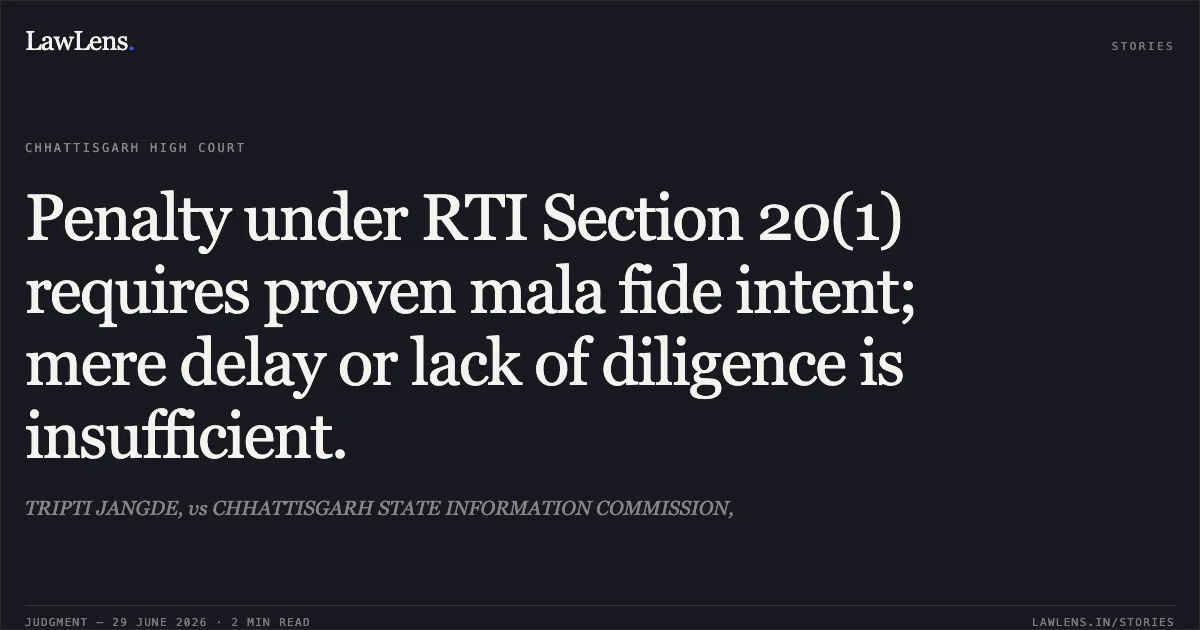
The Court answered the issues in the negative, holding that the Petitioner had fulfilled her statutory duties and could not be penalized for delays occurring at the level of the deemed PIO.
Both writ petitions were allowed, and the orders dated 06.03.2020 passed by the Chhattisgarh State Information Commission imposing a total penalty of ₹50,000 were quashed
Source reference: para. 19Acts & Sections Cited
3 provisions across 2 statutes referred to in this judgment. Each provision opens on LawLens.
Right to Information Act, 20052
Electricity Act, 20031
Original Court PDF
TRIPTI JANGDE,vsCHHATTISGARH STATE INFORMATION COMMISSION,
Click to open original judgment
Original judgment, available to read, download and summarize on LawLens.in


