Facts
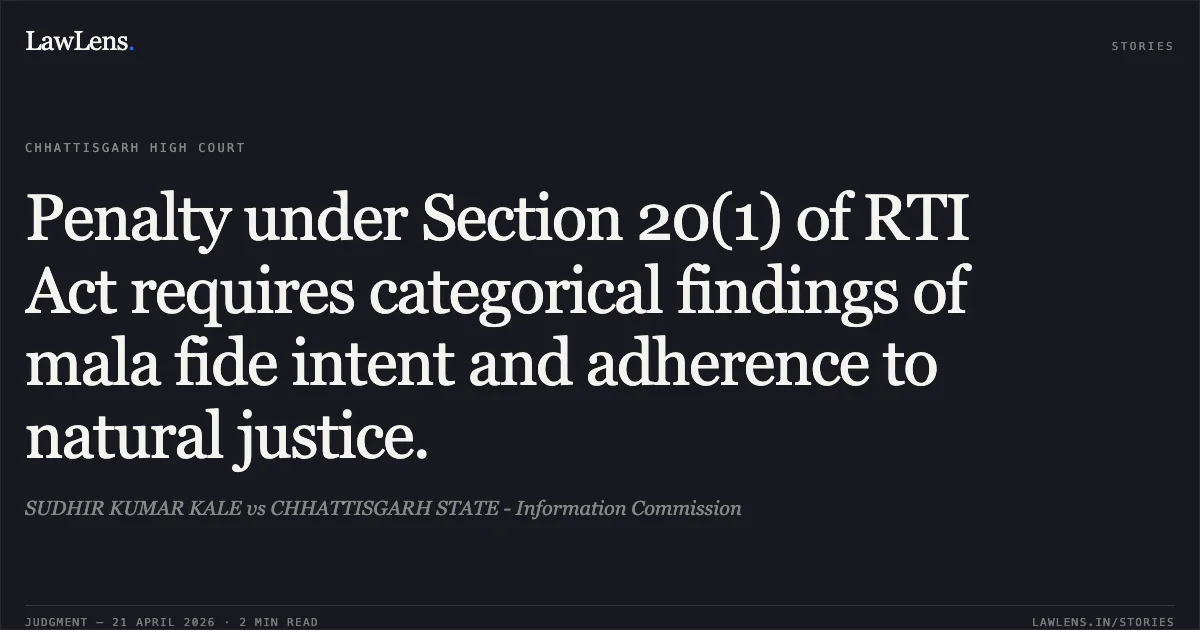
The petitioner, an Under Secretary serving as a Public Information Officer (PIO), challenged two orders dated 25.06.2021 passed by the Chhattisgarh State Information Commission
Source reference: para 2Respondent No. 5 had filed RTI applications seeking information regarding the appointment of the State Information Commissioner
Source reference: para 2The petitioner denied the request, citing exemptions under Sections 8(1)(d) and 8(1)(j) of the RTI Act, 2005, a decision subsequently upheld by the First Appellate Authority (FAA)
Source reference: para 2, 6Instead of preferring a Second Appeal under Section 19, Respondent No. 5 filed complaints under Section 18 read with Section 20 of the Act
Source reference: para 6The Commission, without serving a show-cause notice or affording a hearing, imposed a penalty of ₹25,000 in each case
Source reference: para 2, 3Issues
1. Whether the State Information Commission could validly entertain a complaint under Section 18 and impose penalties when the complainant failed to exhaust the statutory remedy of a Second Appeal under Section 19
Source reference: para 7, 102. Whether the imposition of a penalty under Section 20(1) without recording findings of mala fide intent and without affording the PIO a reasonable opportunity of hearing is legally sustainable
Source reference: para 10, 11Law Applied
The court primarily applied the procedural scheme of the Right to Information Act, 2005, specifically Section 19 regarding the statutory remedy of Second Appeals and Section 18 regarding complaints
Source reference: para 6, 7It further relied on the mandatory requirements of Section 20(1) of the Act, which stipulates that a penalty can only be imposed if the Commission finds that the PIO denied information "without any reasonable cause" or with "mala fide intent"
Source reference: para 10The court also applied the principles of natural justice, which require a reasonable opportunity of being heard before the imposition of a penalty
Source reference: para 10Reasoning
The court observed that Respondent No. 5 bypassed the statutory appellate route under Section 19, erroneously filing a complaint after the FAA had already affirmed the PIO’s decision
Source reference: para 10The court reasoned that the Commission failed to adhere to the mandatory safeguards of Section 20(1)
Source reference: para 10It noted that the Commission did not record the necessary categorical findings—specifically, that the PIO acted without reasonable cause or with mala fide intent—before imposing the penalty
Source reference: para 10Furthermore, the court found the proceedings vitiated because the petitioner was not granted a hearing or served with a show-cause notice, rendering the Commission’s action a mechanical exercise of power in violation of the principles of natural justice and the express provisions of the RTI Act
Source reference: para 10, 11Holding
The High Court held that the impugned orders suffered from material illegality and procedural infirmity as they were passed in contravention of the statutory scheme and the principles of natural justice
The court answered the issues in the negative, quashing and setting aside the Commission’s orders dated 25.06.2021
Source reference: para 11Both writ petitions were allowed, effectively nullifying the ₹25,000 penalties imposed on the petitioner
Source reference: para 12No costs were awarded
Source reference: para 13Acts & Sections Cited
4 provisions across 1 statute referred to in this judgment. Each provision opens on LawLens.
Right to Information Act, 20054
Original Court PDF
SUDHIR KUMAR KALEvsCHHATTISGARH STATE - Information Commission
Click to open original judgment
Original judgment, available to read, download and summarize on LawLens.in