Facts
The respondent-assessee filed its return declaring a loss of ₹11,07,23,687.
Source reference: no citationDuring scrutiny under Section 143(3) of the Income Tax Act, 1961, the Assessing Officer (“AO”) found that the assessee had claimed a revenue loss on the sale of land.
Source reference: no citationThe assessee subsequently filed a revised return, treating the loss as capital in nature, but the revision was not accepted and the assessment was completed at nil income, with no loss permitted to be carried forward, on 23 December 2010.
Source reference: p.2, paras. 8–9The AO recorded that the assessee had “furnished inaccurate particulars thereby concealing the particulars of income” and initiated penalty proceedings under Section 271(1)(c) read with Section 274.
Source reference: p.3, para. 9On the same day, the AO issued a notice under Section 271(1)(c) stating that the assessee had “concealed the particulars of your income or furnished inaccurate particulars of such income,” without striking off or specifying either limb of the provision.
Source reference: p.3, para. 10The AO thereafter imposed penalty on the ground that the assessee had furnished inaccurate particulars of income.
Source reference: p.3, para. 12The Commissioner of Income Tax (Appeals) upheld the penalty, but the Income Tax Appellate Tribunal allowed the assessee’s appeal and set aside the penalty.
Source reference: p.4, para. 14The Revenue challenged the Tribunal’s order before the High Court.
Source reference: no citationThe delay of 85 days in filing the appeal was condoned.
Source reference: p.1, paras. 3–5Issues
Whether a penalty under Section 271(1)(c) of the Income Tax Act, 1961, is legally sustainable where the AO’s notice under Section 274 fails to specify whether the penalty is proposed for concealment of income or for furnishing inaccurate particulars of income.
Source reference: p.2, para. 7; p.9, paras. 29–31Whether the AO’s general satisfaction recorded in the assessment order regarding initiation of penalty proceedings can cure the failure to identify the specific limb of Section 271(1)(c) in the penalty notice.
Source reference: p.7, para. 27; p.9, paras. 30–31Law Applied
The Court applied Sections 271(1)(c) and 274 of the Income Tax Act, 1961.
Source reference: pp. 7–9, paras. 26–32Section 271(1)(c) contains two distinct and disjunctive grounds for penalty—concealment of particulars of income and furnishing inaccurate particulars of income—and Section 274 requires the assessee to be given an effective opportunity to show cause.
Source reference: pp. 7–9, paras. 26–32The Court relied on *CIT v. Manjunatha Cotton & Ginning Factory*, [2013] 359 ITR 565 (Karnataka), and *CIT v. SSA’s Emerald Meadows*, [2016] 73 taxmann.com 241, for the rule that the penalty notice must clearly identify the applicable limb.
Source reference: pp. 7–9, paras. 26–32It also followed *PCIT v. Unitech Reliable Projects (P) Ltd.*, [2023] 153 taxmann.com 495 (Delhi), whose view was noted as having been affirmed by the Supreme Court, and *PCIT v. Gragarious Projects Pvt. Ltd.*, [2024] SCC OnLine Del 8142.
Source reference: pp. 7–9, paras. 26–32The Court distinguished *CIT v. S.V. Angidi Chettiar*, (1962) 44 ITR 739 (SC), as concerning the necessity of recording satisfaction before initiating penalty proceedings, and *K.P. Madhusudan v. CIT*, (2001) 251 ITR 99 (SC), as concerning omission to mention statutory explanations rather than failure to identify the substantive penalty limb.
Source reference: pp. 7–9, paras. 26–32Reasoning
The Court held that the AO had, in fact, recorded satisfaction that penalty proceedings should be initiated; however, the satisfaction did not clarify whether the alleged default was concealment of income or furnishing inaccurate particulars.
Source reference: p.8, para. 27The notice similarly reproduced both alternatives using the word “or” and did not select either one.
Source reference: p.3, para. 10; p.7, para. 21Since the two grounds are independent and may require different factual explanations and defences, the assessee could not be expected to respond meaningfully without knowing the precise charge.
Source reference: p.9, paras. 29–31The Court therefore rejected the Revenue’s argument that the notice was merely procedural or that the AO’s intention could be inferred from the assessment or penalty order.
Source reference: no citationThe authorities cited by the Revenue did not alter this conclusion: *S.V. Angidi Chettiar* dealt with recording satisfaction, while *K.P. Madhusudan* dealt with the non-mentioning of explanations to Section 271 and not the failure to specify the applicable limb.
Source reference: p.8, paras. 26–28Holding
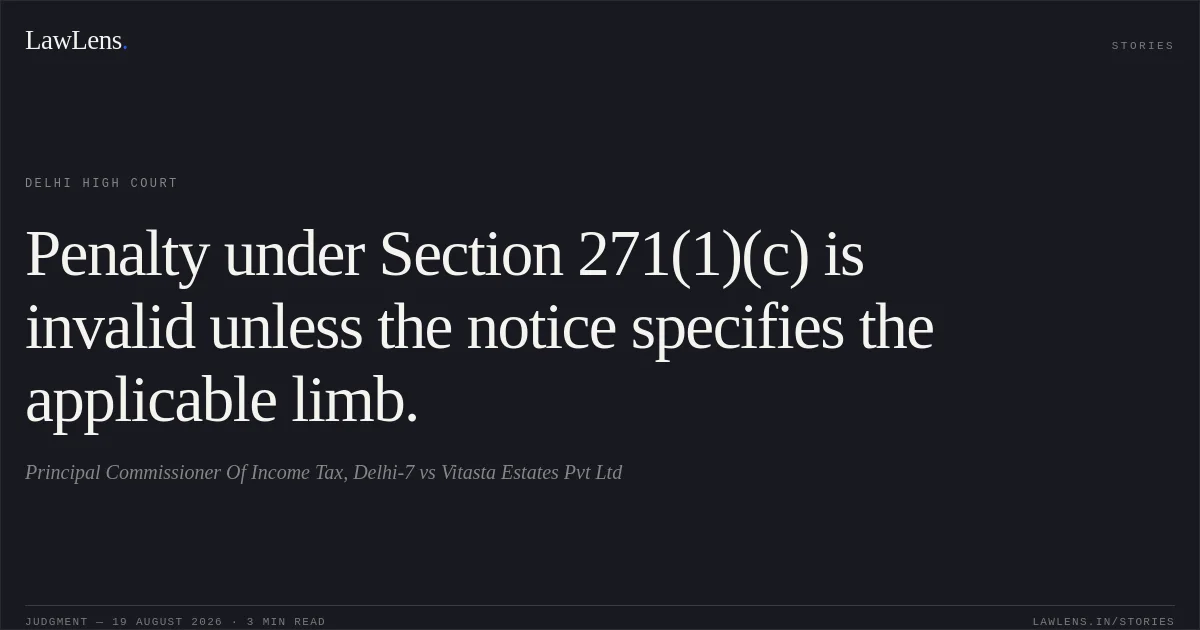
The High Court answered the issue against the Revenue and held that a penalty notice under Section 274 read with Section 271(1)(c) is invalid when it fails to specify whether the proceedings are for concealment of income or furnishing inaccurate particulars.
The AO’s general satisfaction regarding initiation of penalty proceedings could not cure this foundational defect.
Source reference: p.9, para. 32Following *Unitech Reliable Projects* and *Gragarious Projects*, the Court dismissed the Revenue’s appeal and thereby upheld the Tribunal’s setting aside of the penalty.
Source reference: p.10, para. 34The interlocutory applications were also disposed of.
Source reference: p.10, para. 35Acts & Sections Cited
4 provisions across 2 statutes referred to in this judgment. Linked provisions open on LawLens.
Income Tax Act, 19613
Income-tax Act, 19221
Original Court PDF
Principal Commissioner Of Income Tax, Delhi-7vsVitasta Estates Pvt Ltd
Click to open original judgment
Original judgment, available to read, download and summarize on LawLens.in