Facts
The petitioners challenged the orders of the Sub-Divisional Officer (SDO), Lahar (dated 08.10.2025) and the Additional Collector, Bhind (dated 26.03.2026) which rejected their interlocutory applications.
Source reference: p. 1-2The petitioners had sought to summon pre-settlement records under Order XIII Rule 10 of the CPC and Section 32 of the MPLRC to prove that Survey No. 737 was not a government pathway.
Source reference: p. 2They also sought to stay the revenue proceedings due to a pending civil suit regarding the same property.
Source reference: p. 2The SDO rejected the applications on the grounds that the petitioners failed to produce any stay order from the civil court and could have obtained certified copies of the records themselves.
Source reference: p. 2-3The Additional Collector affirmed these findings in revision.
Source reference: p. 3Issues
1. Whether the mere pendency of a civil suit necessitates the stay of statutory revenue proceedings under the Madhya Pradesh Land Revenue Code.
Source reference: p. 22. Whether the refusal to summon original pre-settlement records under Order XIII Rule 10 CPC constitutes a jurisdictional error when certified copies are available.
Source reference: p. 2-33. Whether the High Court should exercise its extraordinary writ jurisdiction under Article 226 of the Constitution to interfere with interlocutory orders of revenue authorities.
Source reference: p. 3-4Law Applied
The court applied the statutory provisions of Section 32 and Section 75 of the Madhya Pradesh Land Revenue Code (MPLRC), 1959, regarding the conduct of inquiries and correction of revenue maps.
Source reference: p. 2It further considered Order XIII Rule 10 read with Section 151 of the Code of Civil Procedure (CPC) concerning the summoning of records.
Source reference: p. 2The court also relied on the established constitutional principle that judicial review under Article 226 is limited to cases of patent illegality, perversity, or jurisdictional error, and does not function as a court of appeal over statutory authorities.
Source reference: p. 3-4Reasoning
The Court reasoned that the SDO provided cogent reasons for the rejection, noting that the petitioners failed to present an injunction or stay order from the Civil Court that would legally bar the revenue proceedings.
Source reference: p. 2-3Regarding the summoning of pre-settlement records, the Court held it was neither arbitrary nor perverse for the authority to require the petitioners to produce certified copies themselves rather than seeking the court's assistance to summon the entire record.
Source reference: p. 3The Court found that the Additional Collector had independently reviewed the record and confirmed that Survey No. 737 was recorded as a pathway following a proper inquiry by the Revenue Inspector.
Source reference: p. 3Consequently, since no procedural impropriety or violation of natural justice was demonstrated, the High Court found no grounds to interfere with the discretionary interlocutory orders.
Source reference: p. 4Holding
The Court answered the issues in the negative and dismissed the writ petition.
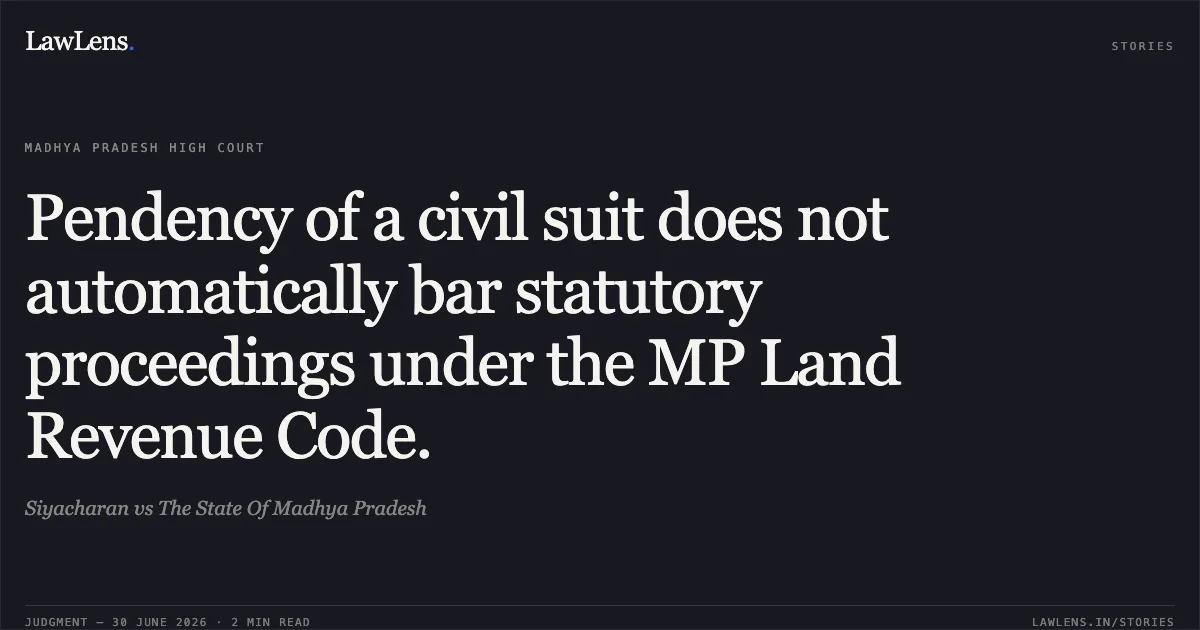
It held that the pendency of a civil suit does not automatically operate as a bar against revenue proceedings.
Source reference: p. 2Further, the authorities did not err in rejecting the applications as the petitioners failed to meet their burden of proof or demonstrate high-level legal infirmity.
Source reference: p. 3No order as to costs was made.
Source reference: p. 4Acts & Sections Cited
3 provisions across 2 statutes referred to in this judgment. Each provision opens on LawLens.
Code of Civil Procedure, 19081
MP Land Revenue Code 19592
Original Court PDF
SiyacharanvsThe State Of Madhya Pradesh
Click to open original judgment
Original judgment, available to read, download and summarize on LawLens.in


