Facts
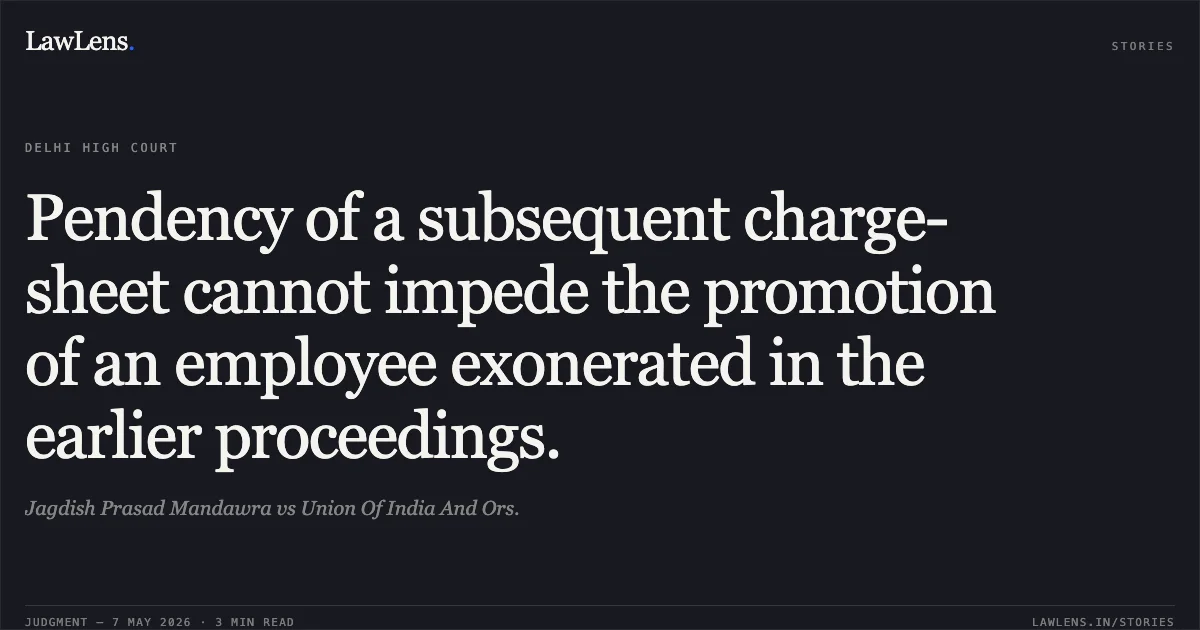
The Petitioner, an Assistant Executive Engineer in the Border Roads Organisation (BRO), was issued a charge-sheet on 07.11.2017
Source reference: para. 3While this disciplinary proceeding was pending, a Departmental Promotion Committee (DPC) met on 18.04.2018 to consider promotions to the post of Executive Engineer (Civil). Following the "sealed cover" procedure due to the pending inquiry, the Petitioner's results were withheld while his juniors were promoted on 24.04.2018
Source reference: para. 3On 25.03.2021, a second charge-sheet was issued to the Petitioner for a separate incident
Source reference: para. 6Subsequently, on 01.10.2021, the Petitioner was fully exonerated of the first charge-sheet
Source reference: para. 4However, the Respondents refused to open the sealed cover, citing the pendency of the second charge-sheet, which eventually resulted in a penalty order on 09.11.2023
Source reference: para. 6Issues
1. Whether the pendency of a subsequent charge-sheet, issued after the DPC met but before the conclusion of the initial disciplinary proceeding, justifies the refusal to open a sealed cover following exoneration in the first proceeding
Source reference: para. 82. Whether a penalty imposed in a subsequent proceeding should prevent retrospective promotion based on a prior DPC recommendation
Source reference: para. 11Law Applied
The court primarily applied the precedent of Delhi Jal Board v. Mahinder Singh (2000) 7 SCC 210, which established that the findings of a disciplinary inquiry exonerating an officer must be given effect as they relate back to the date of the charges; a subsequent inquiry cannot act as an impediment to benefits derived from an anterior selection
Source reference: para. 9, 10It also referenced Union of India v. K.V. Janakiraman (1991) 4 SCC 109 regarding the sealed cover procedure
Source reference: para. 4Additionally, the court applied Paragraph 6.2 of the DoPT Office Memorandum dated 24.02.2003 (updated 30.08.2022), which stipulates that if a penalty is imposed in subsequent proceedings after a junior's promotion, the penalty should be modified and applied to the promoted post rather than blocking the promotion itself
Source reference: para. 11Reasoning
The Court reasoned that the right to be considered for promotion is a fundamental right under Article 16
Source reference: para. 10Relying on Delhi Jal Board, the Court noted that at the time the DPC met in 2018, the Petitioner was only under the "cloud" of the first charge-sheet. Since he was eventually exonerated of those specific charges, the law treats the situation as if he were never subjected to that inquiry
Source reference: para. 9, 10The second charge-sheet, issued years later in 2021, cannot retroactively disqualify the Petitioner from the 2018 DPC recommendation because he was not under its cloud when the DPC originally sat. The court dismissed the Respondents' reliance on a 1989 OM, noting that Supreme Court precedents and the 2003/2022 DoPT instructions specifically provide for the promotion to be granted retrospectively, with any subsequent penalties simply being adjusted to the new pay scale of the promoted post
Source reference: para. 11, 12Holding
The Court allowed the petition and directed the Respondents to open the sealed cover. If found fit by the 2018 DPC, the Petitioner must be promoted to Executive Engineer (Civil) effective from 24.04.2018 (the date his juniors were promoted)
The Court ordered the restoration of seniority and payment of salary arrears with 6% interest per annum. Crucially, the penalty from the second charge-sheet dated 09.11.2023 is to be implemented against the Petitioner's pay in the promoted post of Executive Engineer. Directions must be implemented within eight weeks
Source reference: para. 13Acts & Sections Cited
1 provisions across 1 statute referred to in this judgment. Linked provisions open on LawLens.
Office Memorandum dated 24.02.2003 (DoPT)1
Original Court PDF
Jagdish Prasad MandawravsUnion Of India And Ors.
Click to open original judgment
Original judgment, available to read, download and summarize on LawLens.in