Facts
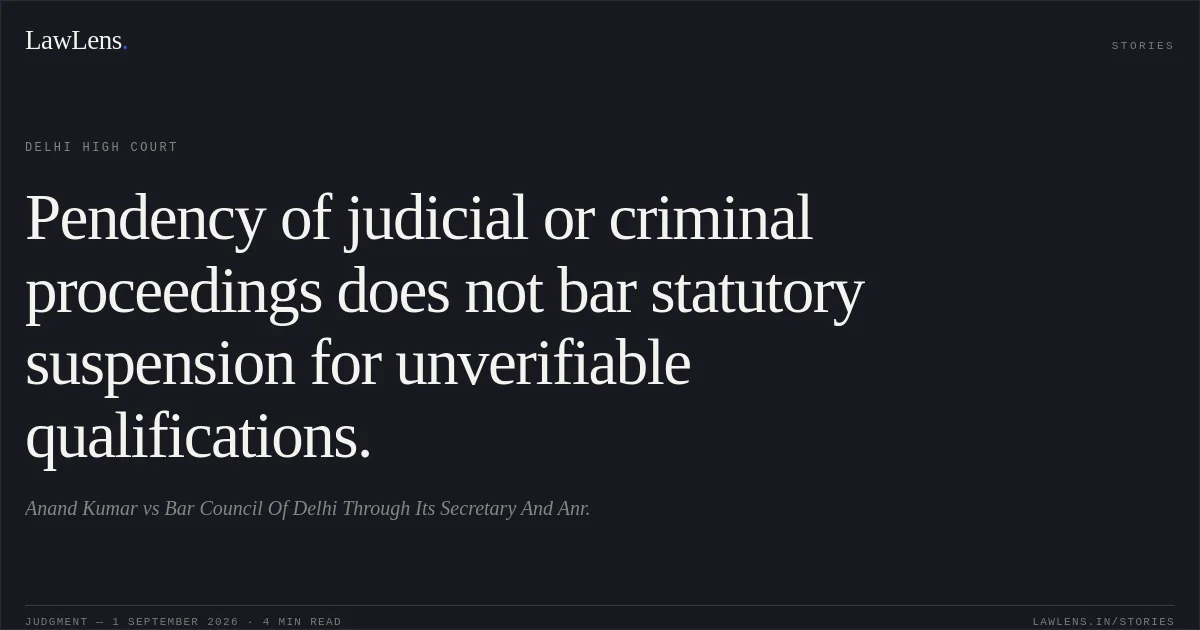
The appellant completed a three-year LL.B. course from Bundelkhand University, Jhansi, and had been enrolled as a practising Advocate with the Bar Council of Delhi (“BCD”) since 2001.
Source reference: para. 6Pursuant to the Supreme Court’s directions in Ajayinder Sangwan v. Bar Council of Delhi, BCD undertook verification of practising advocates’ LL.B. degrees. The University initially informed BCD that the appellant’s roll number could not be verified and that his records were unavailable, leading to show-cause notices in 2019.
Source reference: para. 7–8In 2021, the Bar Council of India (“BCI”) informed the appellant that proceedings had been initiated under the proviso to Section 26(1) of the Advocates Act, 1961, on the allegation that his name had been entered on the roll through misrepresentation and fraud.
Source reference: para. 8Subsequently, the University issued a verification report dated 20 March 2024 stating that the appellant’s mark sheets and LL.B. degree were not genuine. On that basis, BCD passed orders dated 2 April 2024 and 10 June 2024 removing/suspending the appellant from the roll of Advocates.
Source reference: para. 9His challenge before the Allahabad High Court was dismissed for want of territorial jurisdiction, after which he approached the Delhi High Court.
Source reference: para. 10During the pendency of the writ proceedings, a criminal charge sheet was filed against him for offences under Sections 420, 468 and 471 of the IPC.
Source reference: para. 11The Single Judge dismissed the writ petition, holding that the pendency of other proceedings did not prevent BCD from exercising its statutory powers. The appellant preferred the present intra-court appeal.
Source reference: para. 12Issues
1. Whether BCD’s orders removing/suspending the appellant from the roll of Advocates were illegal or violated the principles of natural justice merely because proceedings concerning the genuineness of his LL.B. degree were pending before the Allahabad High Court.
Source reference: paras. 21–242. Whether continuation of the suspension violated the appellant’s rights under Articles 19(1)(g) and 21 of the Constitution.
Source reference: para. 253. Whether the pendency of the criminal trial rendered the disciplinary/regulatory action premature or amounted to pre-trial punishment.
Source reference: para. 26Law Applied
The Court applied the proviso to Section 26(1) of the Advocates Act, 1961, concerning removal proceedings where an advocate’s name is alleged to have been entered on the roll through misrepresentation or fraud.
Source reference: para. 8It also relied on Section 49 of the Act, under which the Bar Council of India is empowered to frame rules concerning legal education, qualifications for enrolment and the conditions governing an advocate’s right to practise.
Source reference: para. 24The Court recognised that the right to practise a profession under Article 19(1)(g), read with Article 21, is subject to reasonable statutory regulation designed to preserve the integrity of the legal profession and protect litigants.
Source reference: para. 25It further applied the principle that mere pendency of proceedings does not bar an independent statutory authority from exercising its jurisdiction in the absence of a specific stay or restraining order.
Source reference: paras. 23–24Criminal prosecution and professional/regulatory proceedings are distinct, operate independently, and apply different standards of determination; therefore, pendency of a criminal trial does not ordinarily prevent protective regulatory action.
Source reference: para. 26Reasoning
The Court held that no interim order or stay in the Allahabad proceedings restrained BCD from acting under the Advocates Act. Accordingly, BCD retained jurisdiction to examine the appellant’s eligibility and continued entitlement to remain on the rolls, notwithstanding the pendency of the Allahabad petition.
Source reference: paras. 23–24The action was based first on the University’s communication that the appellant’s records were unavailable and later on its verification report expressly stating that the mark sheets and LL.B. degree were not genuine.
Source reference: paras. 8–9, 18The Court therefore rejected the allegation of violation of natural justice and found no jurisdictional infirmity in BCD’s orders.
Source reference: para. 24It further held that statutory regulation of enrolment and practice, undertaken to safeguard the legal profession and litigating public, constituted a permissible restriction on the appellant’s asserted professional and livelihood rights.
Source reference: para. 25Finally, the criminal trial concerned proof of offences beyond reasonable doubt, whereas the BCD proceedings concerned professional eligibility and regulatory protection. The pending criminal case consequently neither exonerated the appellant nor made the suspension premature or punitive in the nature of pre-trial punishment.
Source reference: para. 26Holding
The Division Bench dismissed the appeal and upheld the Single Judge’s order dated 14 January 2026.
It held that BCD was entitled to proceed against and suspend/remove the appellant despite the pendency of the Allahabad proceedings and the criminal trial, as no stay operated against BCD and the regulatory action was based on the University’s verification report.
Source reference: paras. 24, 26–27All pending applications were disposed of, with no order as to costs.
Source reference: para. 27Acts & Sections Cited
5 provisions across 2 statutes referred to in this judgment. Each provision opens on LawLens.
Advocates Act, 19612
Indian Penal Code, 18603
Original Court PDF
Anand KumarvsBar Council Of Delhi Through Its Secretary And Anr.
Click to open original judgment
Original judgment, available to read, download and summarize on LawLens.in