Facts
The petitioner, Parvaiz Ahmad Ganie, was detained under the Prevention of Illicit Traffic in Narcotic Drugs and Psychotropic Substances Act, 1988 (PITNDPS Act) via Detention Order No. DIVCOM “K”/04/2026 dated 09.01.2026.
Source reference: p. 1-2The detention was based on the petitioner’s involvement in FIR No. 89/2024 at P/S Zainapora, where 1.916 Kg and 250 grams of 'charas' powder (identified as Ganja) were recovered from his premises.
Source reference: p. 4-5Although the petitioner was granted bail on 30.12.2024 with conditions not to indulge in further illegal activities, intelligence reports suggested he continued clandestine involvement in drug trafficking.
Source reference: p. 5-6The petitioner challenged the detention on grounds of staleness, vagueness, and lack of "live nexus" between past acts and the detention order.
Source reference: p. 2Issues
1. Whether the grounds of detention were stale or lacked proximity to the object of the detention order given the time elapsed since the initial FIR.
Source reference: p. 3 / para. 62. Whether the detaining authority is precluded from invoking preventive detention when ordinary criminal law (prosecution and bail) has already been set in motion.
Source reference: p. 2 / para. 23. Whether the grounds of detention were sufficiently specific to allow the petitioner to make an effective representation.
Source reference: p. 9 / para. 11Law Applied
Section 3 of the PITNDPS Act, 1988, regarding preventive detention for illicit trafficking.
Source reference: p. 2Sama Aruna v. State of Telangana, which establishes that while stale incidents cannot justify detention, the assessment of staleness depends on the continuity of conduct.
Source reference: p. 4Haradhan Saha v. State of West Bengal, which posits that preventive detention is a precautionary measure distinct from punitive prosecution; thus, the pendency of a trial or grant of bail is not a bar to detention.
Source reference: p. 6-8Naresh Kumar Goyal v. Union of India and Union of India v. Dimple Happy Dhakad to emphasize that the object of detention is "interceptive" rather than "punitive".
Source reference: p. 9-10Reasoning
The Court reasoned that the petitioner’s activities were not isolated incidents but part of a recurring pattern of conduct that continued even after he was released on bail.
Source reference: p. 5-6The Court found that the intelligence reports regarding his clandestine activities post-bail provided the necessary "subjective satisfaction" and "live nexus" required for preventive detention.
Source reference: p. 6, 8The Court rejected the "staleness" argument, noting that the detention record showed a chain of activities demonstrating a continuing propensity for drug trafficking.
Source reference: p. 8Regarding procedural fairness, the Court observed that the grounds of detention explicitly cited the FIR particulars, recovery details, and FSL reports, thereby providing the petitioner sufficient clarity to exercise his right of representation under Article 22(5) of the Constitution.
Source reference: p. 9Holding
The Court held that the detention order was legally valid as it was based on a reasonable prognosis of the petitioner's future behavior derived from his past and continuing conduct.
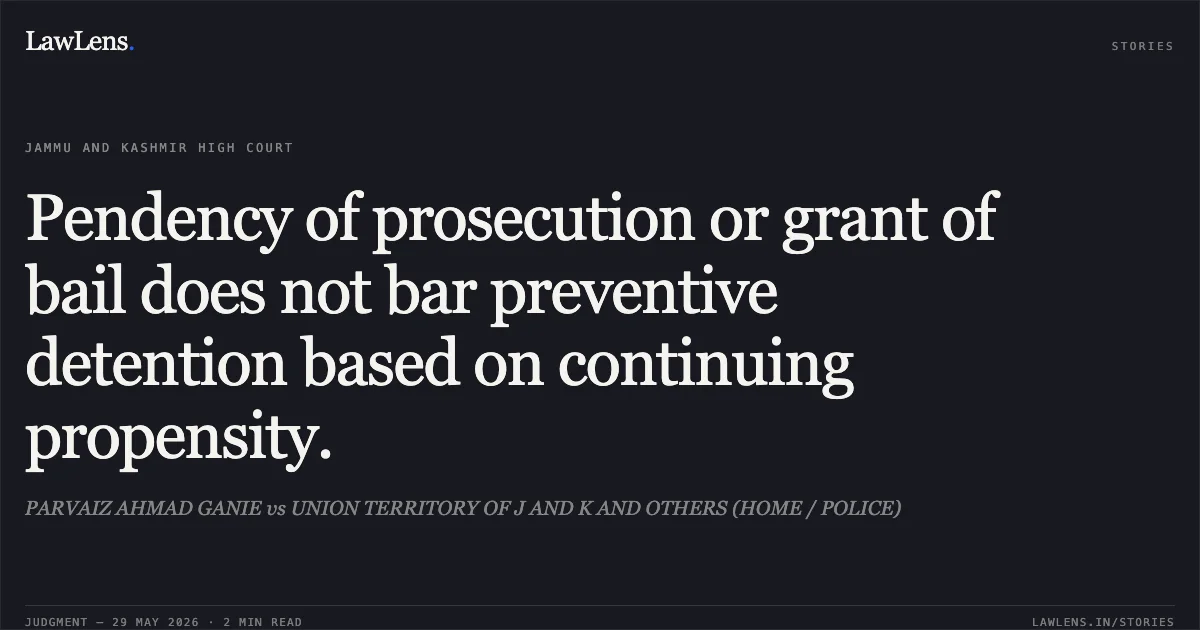
The grant of bail in a criminal case does not denude the authority’s jurisdiction to order preventive detention if a continuing threat to society exists.
Source reference: p. 6Consequently, the High Court dismissed the petition, upheld Detention Order No. DIVCOM “K”/04/2026, and found no violation of constitutional or statutory safeguards.
Source reference: p. 11Acts & Sections Cited
2 provisions across 1 statute referred to in this judgment. Each provision opens on LawLens.
Narcotic Drugs and Psychotropic Substances Act, 19852
Original Court PDF
PARVAIZ AHMAD GANIEvsUNION TERRITORY OF J AND K AND OTHERS (HOME / POLICE)
Click to open original judgment
Original judgment, available to read, download and summarize on LawLens.in