Facts
The petitioners, proposed accused in proceedings arising from a complaint by the second respondent, challenged the order dated 1 November 2025 of the XVIII Metropolitan Magistrate, Saidapet, passed under Section 156(3) Cr.P.C., directing the jurisdictional police to register an FIR and investigate allegations of trespass, vandalism, theft, criminal intimidation and forcible interference with possession.
Source reference: para. 1; p.2The dispute arose in the context of landlord–tenant litigation concerning commercial premises.
Source reference: no citationThe second respondent asserted that he had been operating a business from the premises since 2016 with the landlady’s knowledge, had obtained a civil injunction protecting his possession, and that during November and December 2024 the petitioners and others forcibly entered the premises, broke open locks, damaged the establishment, removed business articles valued at approximately ₹15,00,000, and intimidated him.
Source reference: paras. 17–24; pp.8–12He claimed to have repeatedly approached the police and superior police authorities, but no FIR was registered, compelling him to invoke Section 156(3) Cr.P.C.
Source reference: paras. 25–26; pp.12–13Issues
Whether the Magistrate’s order under Section 156(3) Cr.P.C. directing registration of an FIR and investigation suffered from illegality, perversity, non-application of mind or jurisdictional error warranting interference in revision under Sections 397 and 401 Cr.P.C.?
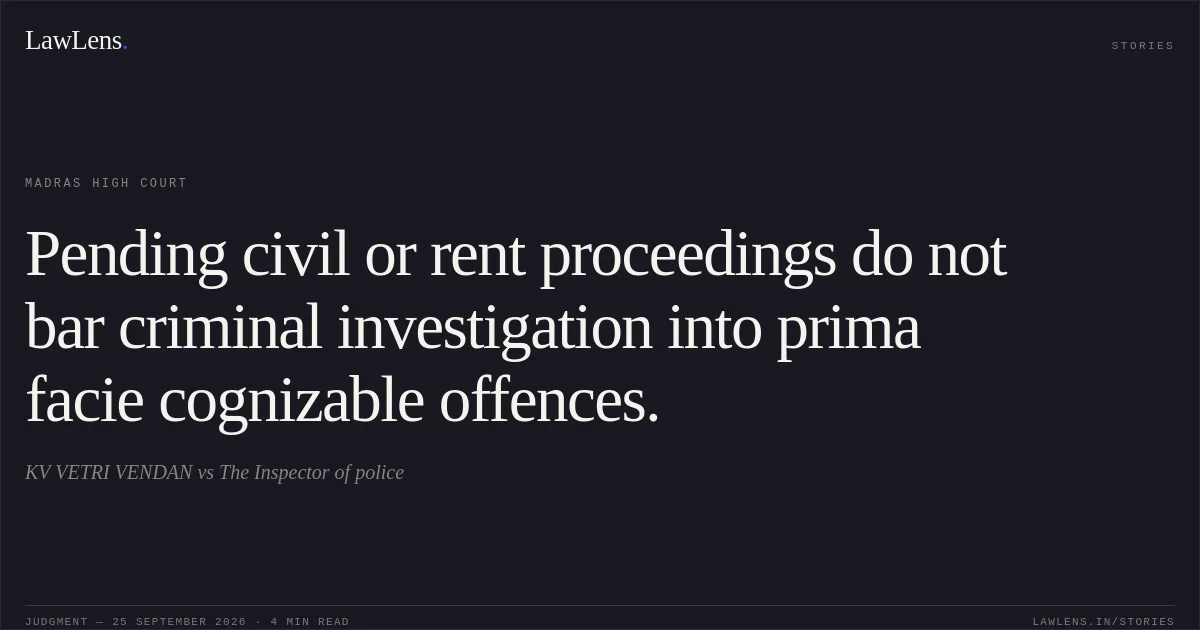
Source reference: paras. 30–37, 71–72; pp.14–18, 32–33Whether the pendency of landlord–tenant, civil and rent-control proceedings barred or rendered impermissible a criminal investigation into allegations of trespass, theft, mischief and criminal intimidation?
Source reference: paras. 38–47; pp.18–23Whether the complaint disclosed cognizable offences warranting investigation, notwithstanding the petitioners’ factual disputes regarding possession, the alleged loss, CCTV footage and the authenticity of the allegations?
Source reference: paras. 47–58; pp.23–27Whether the second respondent had complied with the requirement of approaching the police authorities under Section 154 Cr.P.C. before invoking Section 156(3) Cr.P.C.?
Source reference: paras. 59–62; pp.28–29Law Applied
The Court applied Section 156(3) Cr.P.C., under which a Magistrate empowered under Section 190 may order police investigation into a cognizable offence, read with Section 156(1), and held that the Magistrate’s role at this stage is limited to determining whether the complaint, taken as a whole, prima facie discloses cognizable offences requiring investigation; the Magistrate is not to adjudicate disputed facts, assess evidentiary reliability or conduct a trial-like enquiry.
Source reference: paras. 30–37, 47–54; pp.14–18, 23–26The Court distinguished Section 156(3) proceedings from a complaint enquiry under Section 200 Cr.P.C. and recognised the revisional jurisdiction under Sections 397 and 401 Cr.P.C. as limited, particularly against an order merely commencing investigation.
Source reference: paras. 32, 34; pp.15–16It further applied the principle that civil and criminal proceedings may coexist where the facts independently disclose criminal offences, relying on Rocky v. State of Telangana [2025 INSC 1384], C.S. Prasad v. C. Satyakumar [2026 INSC 39], Nazibul Rahim Khan v. State of Uttar Pradesh [2026 INSC 619] and Accama Sam Jacob v. State of Karnataka [2026 SCC OnLine SC 585].
Source reference: paras. 42–45; pp.20–23The Court also referred to State of Bihar v. A.C. Saldanna, (1980) 1 SCC 554, for the breadth of the Magistrate’s power to direct proper or further investigation under Section 156(3) Cr.P.C.
Source reference: paras. 50–54; pp.24–26Reasoning
The Court held that the petitioners’ objections—whether the second respondent was a lawful tenant, whether the alleged damage occurred, whether the CCTV footage was genuine, and whether the complaint was a counterblast—were disputed questions requiring investigation and could not be conclusively determined in revision at the pre-investigation stage.
Source reference: paras. 35–37, 57–58; pp.17–18, 27The complaint contained specific allegations of forcible entry, breaking open locks, vandalism, removal of movable property and intimidation, together with dates, the alleged value of the property, the identity of the principal participants, references to CCTV footage and details of prior police complaints. These allegations, if taken at face value, disclosed cognizable offences.
Source reference: paras. 55–58; pp.26–27The pendency of rent-control and civil proceedings did not create immunity from criminal investigation because the alleged acts involved more than a contractual or tenancy dispute and independently constituted possible criminal offences.
Source reference: paras. 38–46; pp.18–23The existence of the civil injunction further provided context to the allegation that the petitioners had allegedly resorted to self-help rather than lawful procedure, though the Court did not determine the ultimate truth of that allegation.
Source reference: para. 41; p.20The Court also found that the second respondent had approached the jurisdictional police and superior authorities repeatedly before invoking Section 156(3), thereby satisfying the statutory requirement under Section 154 Cr.P.C.
Source reference: paras. 59–62; pp.28–29The dispute regarding production and authenticity of the pen drive was held immaterial at this stage, since its evidentiary value could be tested during investigation and trial.
Source reference: paras. 63–69; pp.29–32Holding
The High Court dismissed the Criminal Revision Case, holding that the Magistrate had acted within jurisdiction, applied the requisite prima facie satisfaction and rightly directed registration of an FIR and investigation under Section 156(3) Cr.P.C.
The order dated 1 November 2025 in Crl.M.P. No. 4230 of 2025 was affirmed, and the Inspector of Police, E-2 Royapettah Police Station, was directed to register an FIR on the second respondent’s complaint dated 22 November 2024 and proceed with the investigation in accordance with law. No order was made as to costs.
Source reference: para. 73; p.33Acts & Sections Cited
8 provisions across 1 statute referred to in this judgment. Each provision opens on LawLens.
Code of Criminal Procedure, 19738
Original Court PDF
KV VETRI VENDANvsThe Inspector of police
Click to open original judgment
Original judgment, available to read, download and summarize on LawLens.in