Facts
The four petitioners, claiming to be landless "Parchadharis," assert they were granted possession of 25 decimals of land in Village-Kauriram (Khata No. 48, Khesra No. 243) via Parchas issued in 1988.
Source reference: para. 3They allege they have regularly paid rent and maintained possession until they were forcibly dispossessed by the District Administration for the construction of a government building.
Source reference: para. 3The petitioners filed Title Suit No. 899 of 2023, which is currently pending before the Civil Judge, Senior Division, Mohania.
Source reference: para. 4Additionally, they submitted a representation to the District Magistrate-Cum-Collector, Kaimur, on January 13, 2026, which remained undecided, prompting this writ petition.
Source reference: para. 6Issues
1. Whether the pendency of a Title Suit in a civil court bars the petitioners from seeking an administrative remedy through a writ for the disposal of their representation.
Source reference: para. 5 & 82. Whether the District Magistrate is obligated to redress grievances regarding alleged administrative atrocities even while judicial proceedings regarding title are sub-judice.
Source reference: para. 8 & 9Law Applied
The court applied the principle of "different and distinct" remedies under Article 226 of the Constitution of India.
Source reference: para. 8It distinguished between judicial remedies—where a Civil Court determines legal title and the validity of Parcha cancellations—and administrative remedies, where a District Collector is responsible for addressing grievances regarding executive actions or local authorities' "atrocities".
Source reference: para. 8Reasoning
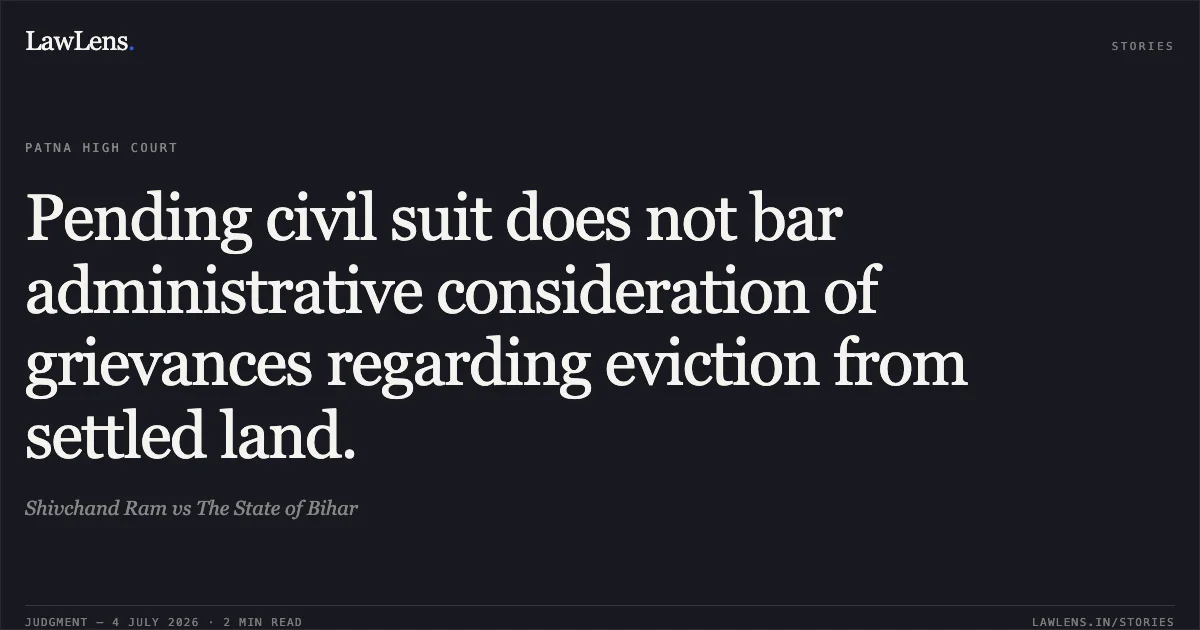
The court rejected the State's contention that the pending Title Suit precluded writ jurisdiction.
Source reference: para. 5The Court reasoned that the two remedies seek different ends: the civil suit is a judicial inquiry into the legal right to land and the validity of eviction, whereas the representation to the Collector is an administrative plea to address the immediate grievances of homeless individuals against local authorities.
Source reference: para. 7-8The Court noted that the Collector’s failure to act on the representation dated January 13, 2026, forced the petitioners into the writ jurisdiction.
Source reference: para. 6Consequently, the Court found it necessary to compel the executive to perform its administrative duty regardless of the ongoing title litigation.
Source reference: para. 9Holding
The Court held that the administrative and judicial remedies are distinct and can coexist.
It directed the District Magistrate-Cum-Collector, Kaimur (Respondent No. 2), to dispose of the petitioners' representation dated January 13, 2026, in accordance with the law within four weeks of receiving the order.
Source reference: para. 9The writ petition was disposed of with these directions.
Source reference: para. 10Original Court PDF
Shivchand RamvsThe State of Bihar
Click to open original judgment
Original judgment, available to read, download and summarize on LawLens.in