Facts
Petitioner No. 1 purchased agricultural land bearing Survey No. 25, subsequently renumbered as Survey No. 271, admeasuring 0-60-70 hectares at Village Limadiya, Taluka Tilakwada, District Narmada, from respondent No. 3 through a registered sale deed dated 9 August 2011. The transaction was recorded and certified through Mutation Entry No. 491. Petitioner No. 1 subsequently sold the land to petitioner Nos. 2 and 3 by a registered sale deed dated 16 January 2014, pursuant to which Mutation Entry No. 569 was recorded and certified
Source reference: p. 2, para. 3.1After approximately four years, the Additional Collector initiated suo motu proceedings under Rule 108(6) of the Gujarat Land Revenue Rules and cancelled the mutation entry, principally on the ground that the transaction violated the Gujarat Prevention of Fragmentation and Consolidation of Holdings Act, 1947 (“Fragmentation Act”). The Collector dismissed the petitioners’ appeal, and the Special Secretary, Revenue Department (Appeals), dismissed the revision application
Source reference: pp. 2–3, para. 3.2The petitioners contended that the purchaser was an agriculturist, that the earlier mortgage entry had already been cancelled, and that the revenue authorities could not conclusively adjudicate an alleged violation of the Fragmentation Act in summary RTS proceedings without initiating independent proceedings under that Act
Source reference: pp. 3–5, paras. 4–8The State acknowledged that no independent proceedings under the Fragmentation Act had been initiated. During the hearing, the State also produced the Gujarat Ordinance No. 2 of 2026/Notification dated 14 July 2026, introducing Section 9(4), under which certain transfers or partitions made between 29 January 1948 and 31 March 2026 were deemed regularised and pending proceedings were to abate
Source reference: pp. 6–7, paras. 10–11; p. 10, para. 15Issues
1. Whether the revenue authorities could cancel a certified mutation entry in RTS proceedings solely on the basis of an alleged violation of the Fragmentation Act, without independent adjudicatory proceedings under that Act?
Source reference: pp. 4–5, paras. 5–82. Whether the amendment introducing Section 9(4) of the Fragmentation Act applied to the petitioners’ 16 January 2014 transaction and required the pending proceedings to abate?
Source reference: pp. 7–10, paras. 11–163. Whether the matter ought to be remanded to the revenue authority for reconsideration in light of the statutory amendment?
Source reference: pp. 7, 10–11, paras. 11–12, 17–18Law Applied
The Court considered Rule 108(6) of the Gujarat Land Revenue Rules, which governs suo motu revision of revenue/mutation entries, and the Gujarat Prevention of Fragmentation and Consolidation of Holdings Act, 1947, particularly the newly inserted Section 9(4).
Source reference: no citationSection 9(4) provides that transfers or partitions contrary to the Fragmentation Act made on or after 29 January 1948 and on or before 31 March 2026 shall be deemed regularised without penalty or premium, and that all pending proceedings before any officer or authority concerning such transfer or partition shall abate
Source reference: p. 9, para. 15The Court also applied the principle that RTS proceedings are summary in nature and are not the appropriate forum for conclusively determining disputed violations of substantive land legislation
Source reference: pp. 4–5, paras. 7–8Relying on Peter Augustine v. K.V. Xavier, 2025 INSC 771, the Court held that remand is not routine and should not be ordered where it would serve no useful purpose or merely prolong litigation
Source reference: p. 11, para. 18Reasoning
The cancellation of the mutation entry rested solely on the alleged violation of the Fragmentation Act, while the other objections—relating to the purchaser’s agriculturist status and the alleged mortgage—had been found against the authorities or had otherwise ceased to survive
Source reference: p. 4, para. 5Since no independent proceedings under the Fragmentation Act had been initiated, the revenue authorities’ determination of the alleged breach in summary RTS proceedings was legally unsustainable
Source reference: pp. 5–6, paras. 7–10In any event, the 2014 transaction fell within the temporal scope of Section 9(4), which deemed such transfers regularised and expressly directed that pending proceedings abate
Source reference: pp. 9–10, paras. 15–16The Court rejected the State’s request for remand because the statutory amendment had already resolved the controversy and remand would create unnecessary multiplicity and prolongation of proceedings, contrary to the principle stated in Peter Augustine
Source reference: pp. 10–11, para. 18Holding
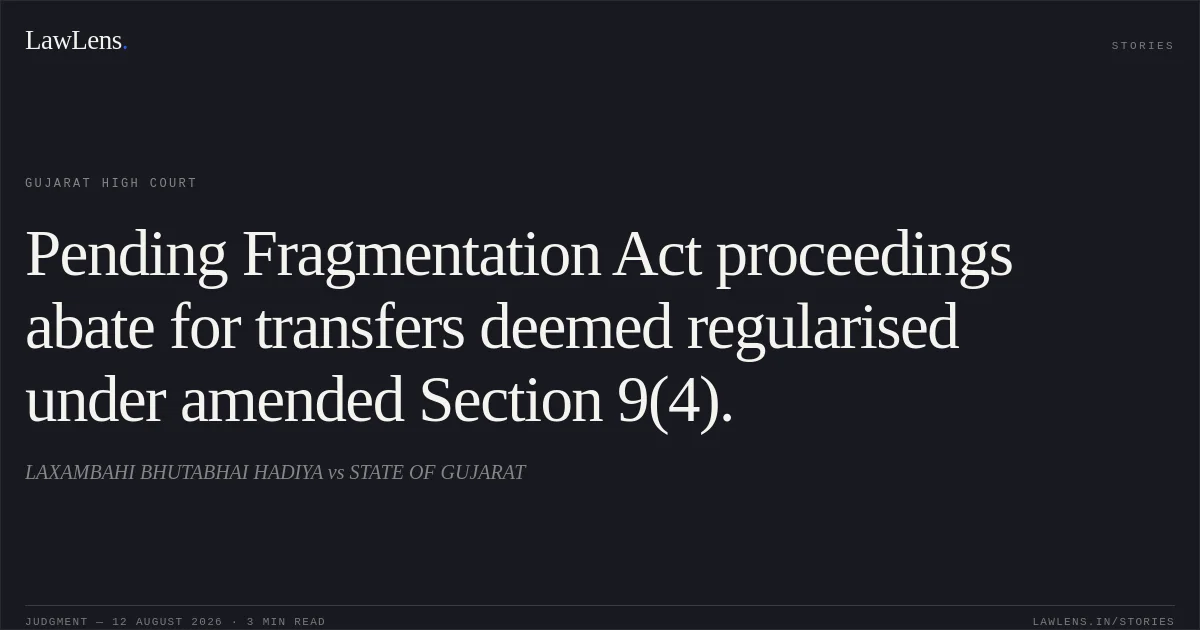
The Court held that the petitioners’ transaction dated 16 January 2014 was covered by Section 9(4) of the Fragmentation Act. Consequently, the proceedings initiated against the petitioners were required to abate.
The petition was allowed; the orders passed by the Additional Collector, the Collector, and the Special Secretary, Revenue Department, were quashed and set aside
Source reference: p. 12, para. 19Acts & Sections Cited
3 provisions across 1 statute referred to in this judgment. Each provision opens on LawLens.
Original Court PDF
LAXAMBAHI BHUTABHAI HADIYAvsSTATE OF GUJARAT
Click to open original judgment
Original judgment, available to read, download and summarize on LawLens.in